

Every safe hiring signal your team trusts – the brand-name resume, the warm referral, the personality test, the fourth interview round – was built to shield the person making the call from blame.
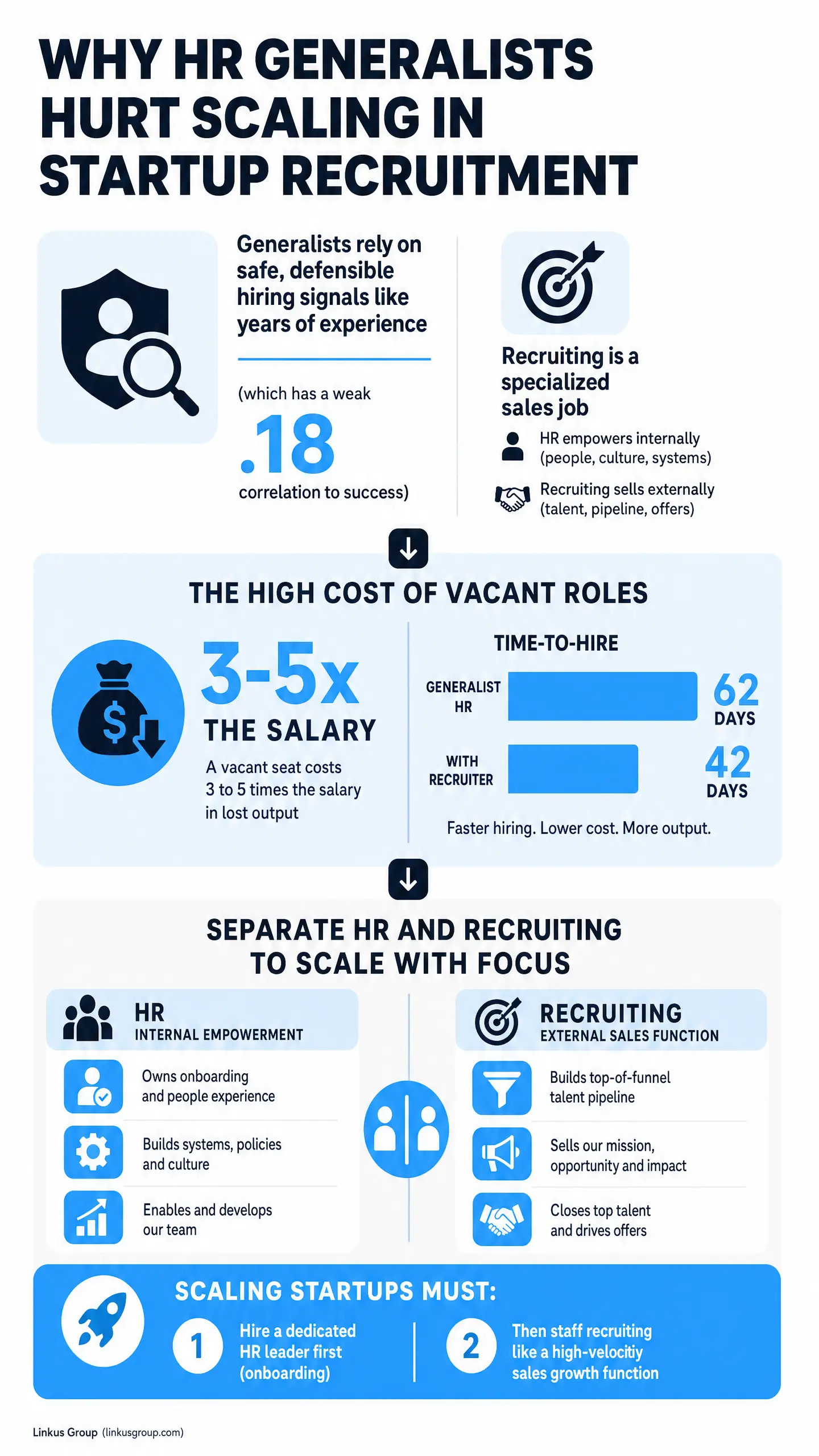
A generalist under pressure defaults to whatever is easiest to justify later, which is how you hire the top rep from Salesforce and watch them crash in month four. Schmidt and Hunter reviewed 85 years of selection research and found that years of experience predict future performance at a correlation of only .18, the weakest number in the file and the easiest one to defend.
The candidate who could change your company is the one no junior generalist has the standing to fight for.
Key Takeaways
- Schmidt and Hunter's review of 85 years of research found that years of job experience predict future performance at a weak correlation of only .18, making it an unreliable startup hiring signal.
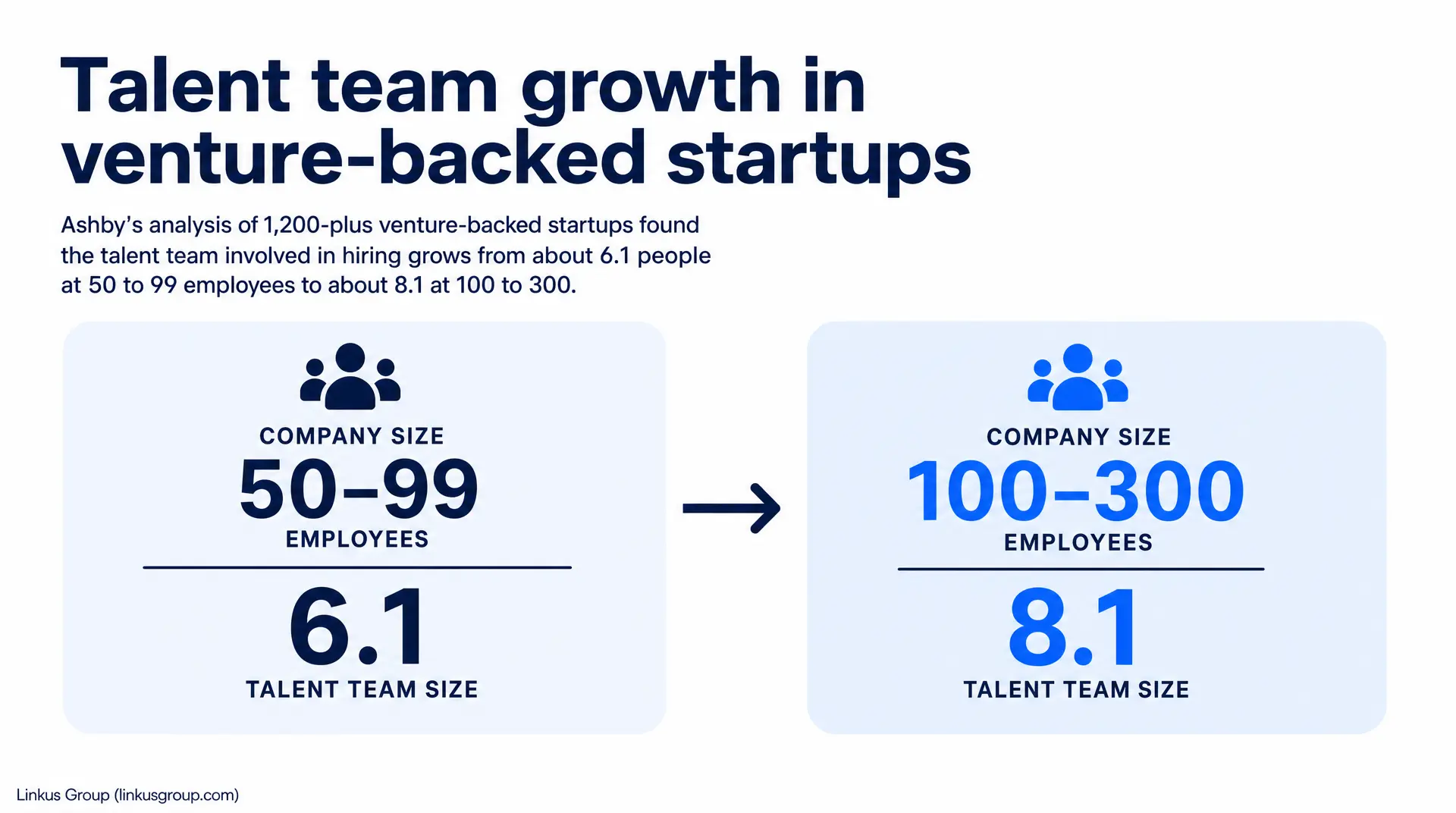
- Ashby's analysis of over 1,200 venture-backed startups reveals that scaling companies typically employ 6.1 talent team members at the 50-to-99 employee stage, contrasting with the common mistake of utilizing a single generalist.
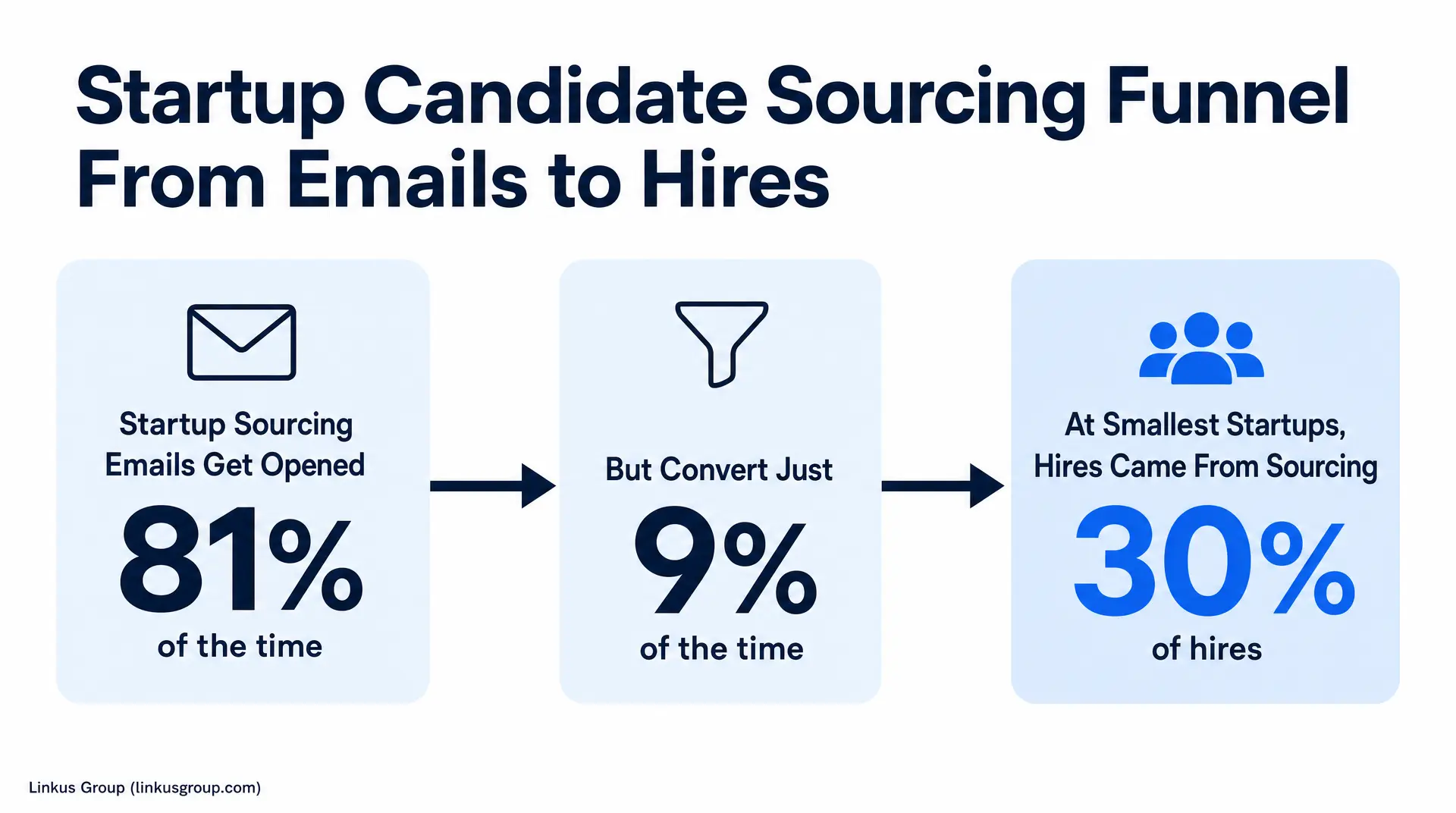
- Startup recruitment sourcing emails achieve an 81% open rate but only a 9% conversion rate, demonstrating that capturing passive talent requires specialized sales skills rather than traditional administrative posting.
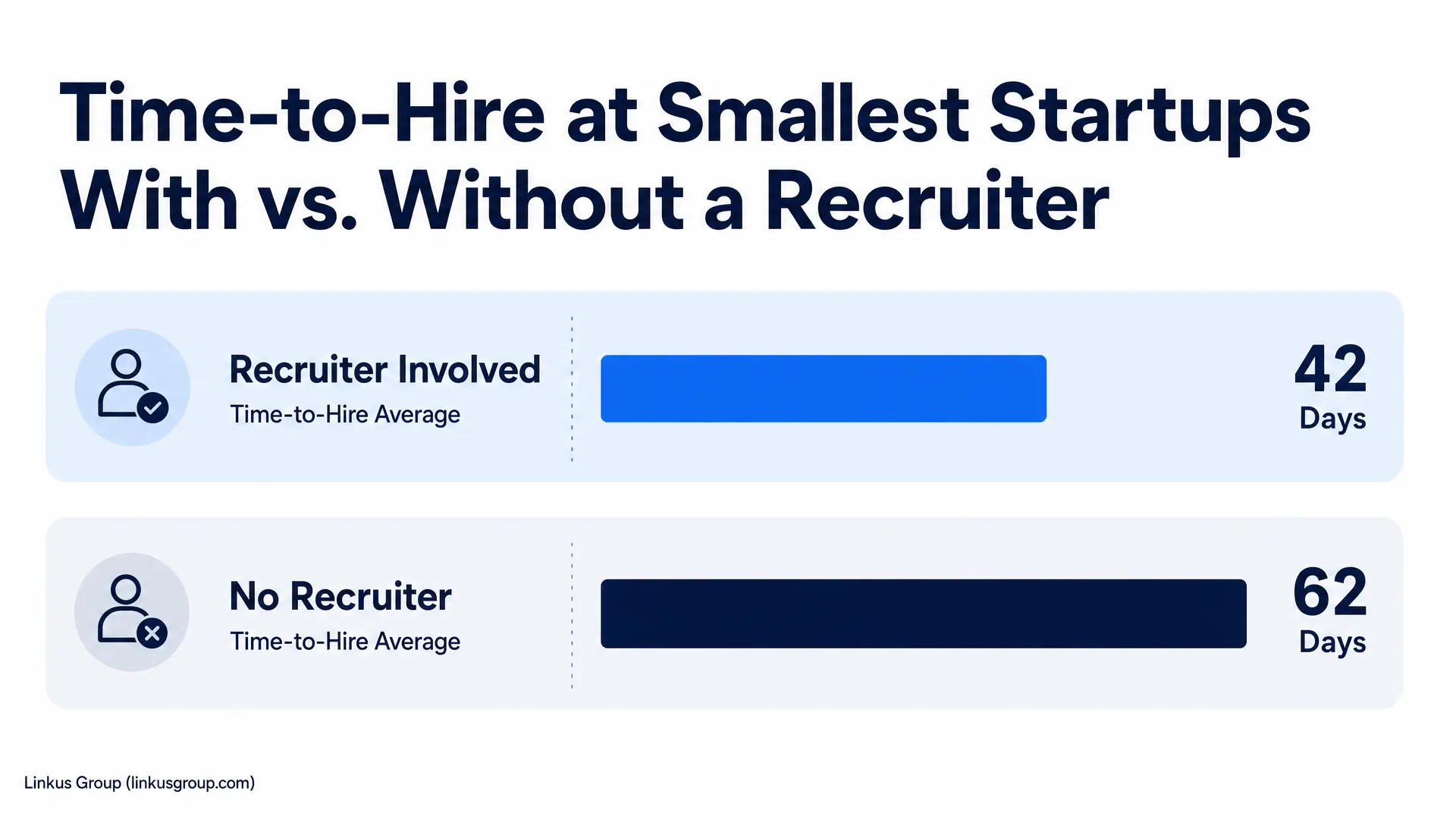
- Operating without a dedicated recruiter extends the average startup time-to-hire from 42 to 62 days, which costs between $48,000 and $60,000 in lost productivity for an empty $150,000-per-year role.
- Interviewer misalignment frequently derails final-stage startup hiring decisions, with Ashby data demonstrating that 38% of interviewer scorecard pairs disagree by at least one full point on the same candidate.
- Startups should prioritize building internal onboarding processes before external recruiting functions, as Gallup research indicates exceptional onboarding makes employees 2.6 times more likely to report extreme job satisfaction.
Why Do Venture-Backed Startups Under-Resource Their In-House Recruiting Departments?
Recruiting is the only department in a company where leadership throws fewer resources at the problem to get it right. Nobody runs sales that way. You'd never hand your whole pipeline to one generalist making 10 calls a day and call it a strategy. Still that's exactly how most Series A companies structure hiring.
The companies that scale don't run it that lean. Ashby's analysis of 1,200-plus venture-backed startups found the talent team involved in hiring grows from about 6.1 people at 50 to 99 employees to about 8.1 at 100 to 300, not counting hiring managers. The founder I'm describing has one person. And that person is also running benefits, payroll questions, and the performance review cycle.
Why Should Startups Separate Human Resources and In-House Recruitment Roles?
The HR person's responsibility is to empower the people within the organization. The recruiter's responsibility is to empower people outside of the organization. It's a different mindset, and in my experience very few people flip between the two on the same afternoon.
Recruiting, done properly, is a sales job. Roughly nine in 10 professionals are open to a better opportunity if it's presented the right way at the right time. LinkedIn's own candidate research put it at 87% of active and passive candidates. The hard part is getting a top performer who isn't looking to give you 30 seconds, then keep talking, then trust you with the biggest decision of their year. That's a close, and nobody trained your HR person to do it.
Your generalist will post the job instead. Job descriptions suck. If they worked, I'd be out of a job. The candidates you actually want are working, not scrolling. Ashby found that at the smallest startups, 30% of hires came from sourcing, meaning somebody went out and found them. The same Ashby data shows startup sourcing emails get opened 81% of the time but convert just 9%. Everything between the open and the hire is sales.
Why Does Startup Recruitment Strategy Require Extensive Hiring Experience?

90% of recruiting is experience. Have I been in this particular situation before? It's like sports. You need to have been in certain situations to know what might come up. You can't read your way there.
Look at what your recruiting function decides every week. How long do you keep the post open? What's the pay band, and what happens to your pipeline if you're 10% under market? Do you make the offer tonight, or run one more panel while a competing offer lands tomorrow?
Sure, you can ask an LLM those questions and get an answer. But every answer is contextual to what you're doing, who you're up against, and what the market is saying about you right now. Someone without the reps can't speak from experience, so it's hard for them to justify a call. They go with their best guess. That's possible to do. It's just expensive.
I've seen both sides of this. We've worked with a lot of junior HR reps who are excellent and highly capable. The ones who won were self-aware enough to pull us in for the context they didn't have still. The companies that went it alone hired the wrong people, then struggled to put the right structure and work environment in place afterward.
I won't speak poorly of HR people. Some incredible ones do both jobs, and a few do it at an elite level. When it backfires, it isn't because of them. Somebody handed a job that runs entirely on context to a person who had none.
What Is the Financial Cost of a Vacant Role in a Scaling Startup?
Let's do the math.
Take the annual salary of the seat you're filling and divide it by 2,000. That's the hourly rate. Now multiply it by four or five, because a great hire should generate three to five times their salary anyway. That number is what every hour of the empty seat costs you in lost output.
Ashby found that at the smallest startups, time-to-hire averaged 42 days with a recruiter involved. Without one, it was 62. Run those extra 20 days through the formula on a $150,000 seat and you get $48,000 to $60,000 in lost output, before you count the fee you were trying to save. And 42 days is still slow. We get founders a candidate they want to interview or hire inside 48 hours, and usually they hire the first person we send.
We worked with an Amazon e-commerce brand where an empty manager seat risked inventory mistakes and hundreds of thousands of dollars in lost revenue every week it sat open. I've also seen a company win a major bank contract and lose it to a competitor. Their interview process wasn't aligned to the project timeline, and they couldn't hire the three people they needed fast enough. Their hiring structure cost them a bank.
Slowness has a second price that never hits the spreadsheet. I've seen a highly prepared Head of Sales candidate stall because the company said they were too busy to move. That told the candidate exactly where they ranked. Time kills all deals.
How Do Safe Hiring Defaults Screen Out Top Performers in Startup Recruitment?

Under pressure, a generalist reaches for whatever feels defensible. The resume with the right logo. The referral from someone the founder trusts. The personality test that puts a number on a gut feeling. Every one of those is a way to avoid blame if it goes wrong. Oh well, the resume looked great. Personality tests are a stalling tactic, and a fourth round tells a top candidate exactly how little confidence you have.
That's also how you end up hiring the top rep from Salesforce or AWS and watching them crash in month four. On paper they're perfect. In reality they've never sold an unknown logo without pre-warmed leads and an SDR team behind them. The resume shows you the brand, never whether the person survives without it. Schmidt and Hunter's review of 85 years of selection research found that years of job experience predicted future performance at a correlation of only .18. Your generalist is filtering on one of the weakest signals in the file because it's the easiest one to defend.
My core conviction after two decades is that the person who does best in the job is usually the person you'd least expect. We once pushed a technology client to interview a CTO whose resume didn't line up with their industry at all. That CTO helped them raise their Series A and Series B, and later co-founded new ventures with the team. No checklist surfaces that name, and no junior generalist has the standing to fight for it.
I've also watched a hiring team dismiss someone over short tenures and a lack of specific schooling, then meet the person and realize those surface-level weaknesses were their greatest strengths. A degree filter alone knocks out more than half the workforce. Census data shows only 44.5% of employed U.S. workers hold a bachelor's or higher. You only catch these people when someone in the room has seen it before. It always comes down to TAG: trust, attitude, and grit. Skills can be taught. Attitude and drive can't, and reading them across a table takes hundreds of at-bats.
Why Do Unaligned Stakeholders Derail Startup Hiring Decisions at the Final Stage?

Hiring processes fail at the very end more often than at the start, because nobody aligned upfront on who actually owns the outcome of the role. So a stakeholder who will never manage the hire kills the perfect candidate in the final hour, usually with a feeling instead of a reason.
That misalignment is measurable. Ashby found that 38% of interviewer scorecard pairs disagreed by at least a point on the same candidate. When the room can't agree, someone has to hold the line on what the role was built to solve. A senior recruiter who has earned the founder's trust can push back on a hiring manager whose criteria are wrong. A junior generalist won't, because they report to the person they'd be pushing back on.
How Should Startups Structure In-House Recruiting Teams for 50 to 250 Employees?

Most companies hire a recruiter first. I'd flip it. Your first people hire should be an HR leader, because 90% of recruiting is the onboarding process. Success is mostly decided after the start date. Gallup found employees with exceptional onboarding were 2.6 times as likely to be extremely satisfied in their jobs. If nobody owns setting high performers up to win, every great hire is a coin flip.
That HR leader has to have built a recruiting function from nothing. Plenty of people have only ever run one they were handed, and on a resume those two look identical. So work backwards from training. Ask how they'd train someone to do what they built, then reverse the order and make them walk you through every stage: what, why, how, and who was in the room. Ask who on their old team can verify it. Then hand them your scenario. If you had to build our talent engine here, how would you go about it? Ask me what you'd need.
Once the inside is owned, the outside job needs its own owner, staffed like sales. Depending on volume, that's a dedicated recruiter with real sales DNA, or an embedded partner who does this all day, every day. The strongest outcomes I've seen combine the two. We sit inside our clients' Slack or Teams as a second set of eyes for their HR lead, headhunt from competitors it would be awkward for them to call directly, and bring back what the market is actually saying about their employer brand. We refuse to work with our clients' direct competitors, so there's no rock we can't lift.
And when your investors say twenty hires this quarter, my answer is: whoa, whoa, whoa. Let's plan. Do you know your revenue per employee? Maybe you need eight better people. Hiring less, better people unlocks more for the org and the investors than hiring at all costs. A junior generalist can't walk into a board meeting with that argument. A senior talent leader with the numbers can.
How Should Scaling Startups Transition Seed-Stage HR Generalists During Growth?
Whoever ran hiring through your chaos phase got you here. Maybe it was you. But it's the same bottleneck you're seeing in engineering and sales, just wearing a people-team badge.
You'll know it's time when you feel the pain of the business not moving forward and you're making the same hire twice. You have three moves: transition them into another role, layer a specialist over them, or have a candid conversation and keep it short. If you layer, make sure the team understands the new leader brings mentorship and fits the stage you're at now. If the person holds equity, get an employment lawyer in the room first.
Hiring should actually be easy. Companies make it hard by putting the wrong person in the seat and then wondering why every search takes 60 days. Staff recruiting like the growth function it is. Speed doesn't kill quality. Not having clarity does. And clarity comes from people who've been there before. Capisce?
Frequently Asked Questions
Why is our in-house team struggling to fill senior technical and engineering roles?
Technical hiring is structurally slower. You aren't failing. You're fighting gravity. Ashby data shows technical roles take a median 76 days to fill versus 56 for business roles, demanding 18 interviews per hire. You need dedicated technical sourcers with pure sales DNA, not generalists praying over job boards.
How do we prevent early managers from relying on gut feelings during interviews?
Mandate structured interviewing. Unstructured chats let managers hire whoever they like best – a fast track to biased failures. Research proves structured interviews deliver a .51 predictive validity, compared to .38 for unstructured formats. Standardize your scorecards, enforce strict rubrics, and never let internal managers just wing it.
Should our recruitment structure prioritize employee referrals to scale faster?
Yes, but with strict guardrails. Referrals aren't a safety default for lazy recruiting. Ashby found 52% of referred candidates pass initial screens, boasting an 89% offer acceptance rate for business roles. However, over-relying breeds monoculture. Use referrals to accelerate the pipeline, but force teams to actively source outsiders.
How do we structure our vetting to filter out enterprise reps who cannot build playbooks?
Force them to backward-engineer a system from scratch. Enterprise reps succeed because the playbook already exists. To find a true builder, ask them to map out their exact 90-day strategy with zero brand recognition. If they ask about inbound lead volume, end the interview. You need raw outbound survivalists.
How should our Talent Head handle VCs demanding arbitrary headcount milestones?
Fight back with revenue-per-employee data. VCs push hiring at all costs, but bloated headcounts destroy margins. A strong talent leader must look the board in the eye and prove that hiring eight elite, specialized operators yields higher ROI than 20 average bodies. You hire less, better people. Never scale chaos.