

Every resume in your inbox is a quiet confession that no one where this person works is fighting to keep them. A company built from that pile runs on people their own employer was willing to lose.
The hire who could change your trajectory is heads-down at a competitor, hasn't opened her resume in four years, and will never see your posting. For every active seeker there are three passive candidates open to a move, and the best of them sit deepest in that silence.
The people worth having are the ones with no reason to answer you. Reaching them is the whole job.
Key Takeaways
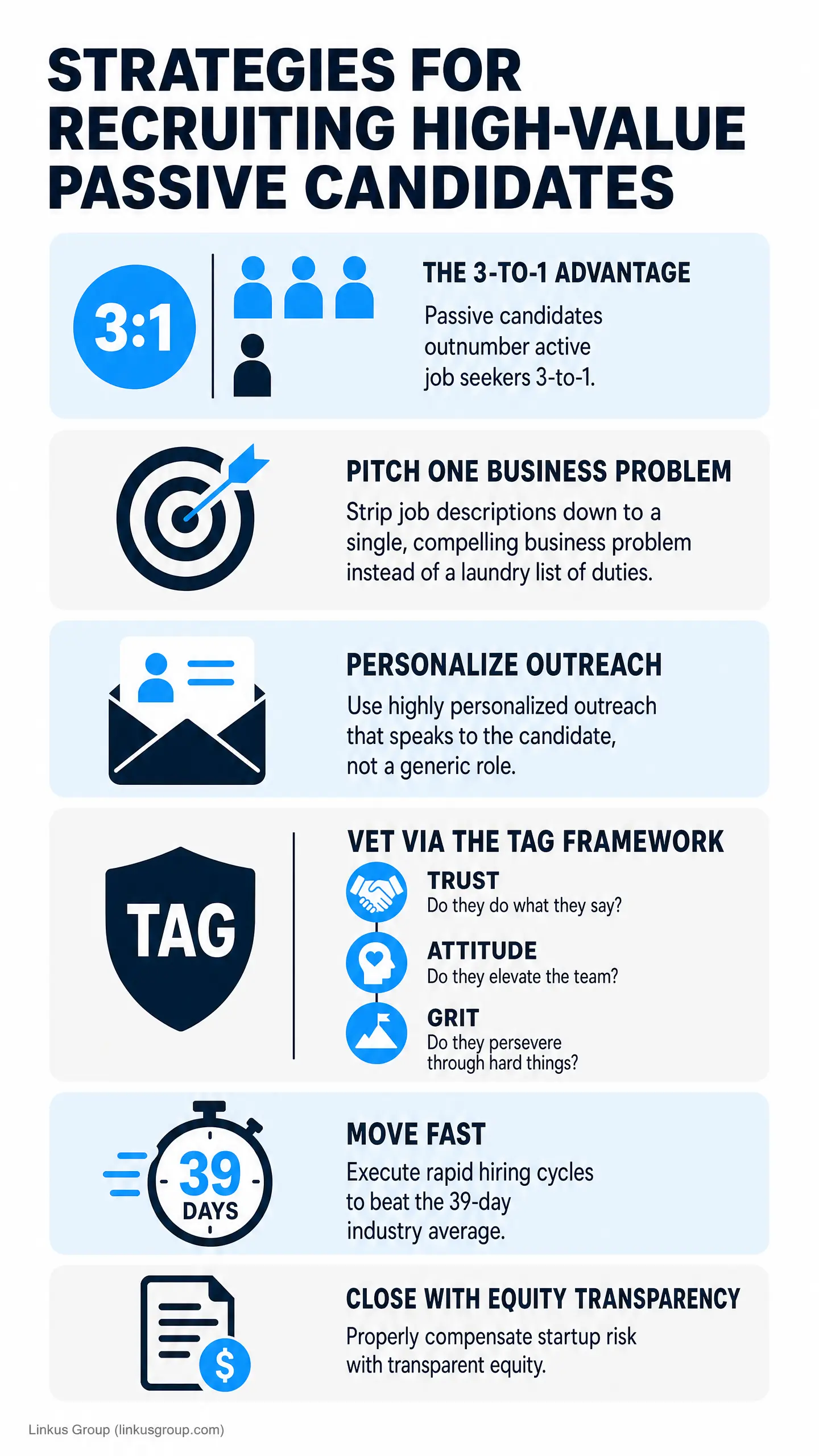
- LinkedIn hiring research indicates there are three passive candidates open to opportunities for every one active job seeker, making applicant-only pools restrictively small for startups.
- Founders must replace multi-role job descriptions with a single business outcome required in year one to capture the brief attention span of passive candidates.
- Personalizing candidate outreach increases LinkedIn InMail acceptance rates by 40%, preventing recruiter accounts from facing platform restrictions triggered by sub-13% response rates.
- Using structured evaluation models like the Trust, Attitude, and Grit framework predicts employee performance with .51 validity, compared to .38 for unstructured interview methods.
- With the median time-to-fill for nonexecutive roles sitting at 39 calendar days, startups that prolong interview rounds frequently lose passive candidates back to their current employers.
- To compete with high corporate salaries, startups should explicitly map equity offers to double the candidate cash sacrifice to properly compensate for vesting schedules and risk.
Why Do Traditional Job Postings Miss Passive Candidates in Recruiting?
Posting a role and waiting is like putting one flyer up in a couple of places and hoping the right person happens to walk past your restaurant. Meanwhile your competitor is out bringing in leads and showing people what it's actually like to work there.
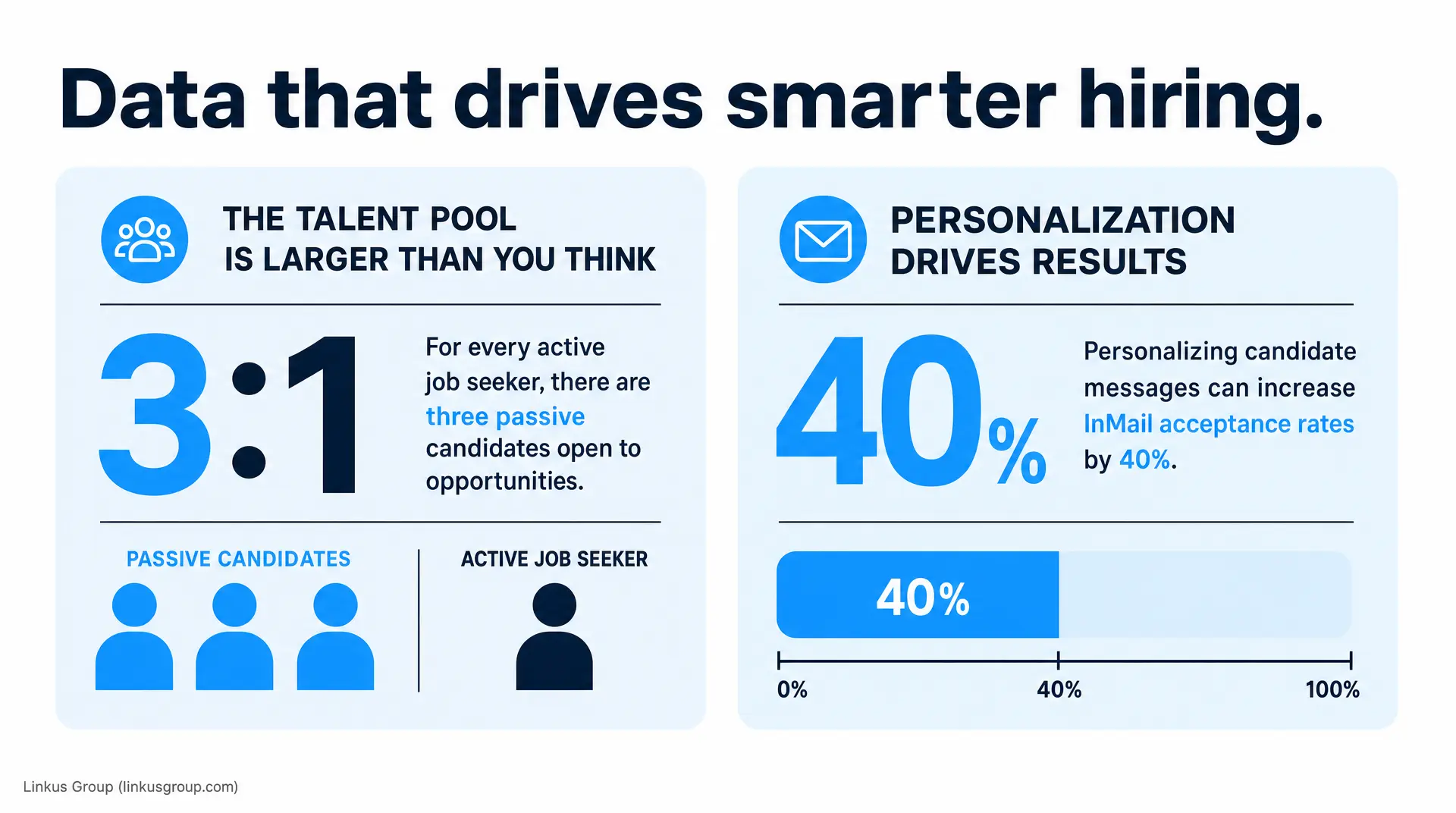
The math on this is brutal. LinkedIn's small-business hiring research found that for every active job seeker, there are three passive candidates open to opportunities who aren't applying anywhere. Post and pray, and you're fishing in a quarter of the pond – the same crowded quarter every other founder is fishing in.
There's a bias problem too. An applicant-only pool skews toward people who need to leave, and need is a very different motivator than fit. Posting a job and trying to do hiring internally is just the bare minimum. It's a salesperson making 10 phone calls a day and calling it a pipeline.
Why Should Founders Strip Job Descriptions Down to a Single Business Problem for Passive Candidates?

Before you send a single message, get clear on what you're solving, because jobs are really just business problems that companies need to solve. Founders come to me with three-page descriptions for someone who can code, sell, manage, and write copy. Three roles stapled together at one below-market salary. With active applicants, a Franken-role just gets ignored. With passive candidates, it's fatal. You get 30 seconds of a busy person's attention, and a pitch that sounds like three jobs reads as a company that doesn't know what it wants.
I had a client with terrible Glassdoor reviews. They wanted very specific experience, they wanted to underpay for it, and they'd burned bridges across their own industry with poor candidate experiences. I told them what I tell everyone: there are three levers you can pull – location, compensation, and requirements. If you won't move at least one, we're not the right fit to help you, and you can come back when something changes. Passive recruiting exposes a weak offer faster than anything else, because these people don't need you.
So write down the single outcome this hire must produce in year one. Revenue from a specific segment. A shipped product. A compliance gate cleared. Everything else is fluff, and honestly, job descriptions suck. If they worked, I'd be out of a job.
How Do Personalized Recruiting Hooks Disrupt Passive Candidate Inertia?
My opener is some version of: "I've got something great that I think you're going to want to hear about, and here's why. Are you open to giving me 30 seconds?" The hook itself changes every time – "this job is for you," "you were born for this role" – but it only lands if it's built on their trajectory, their motives, and where their career is heading. Never on my client's job description.
The data backs up how much precision matters here. LinkedIn reports that personalizing candidate messages can increase InMail acceptance rates by 40%. LinkedIn even polices the sloppy side of this: Recruiter accounts that fall below a 13% InMail response rate get restricted. Outbound recruiting is a response-rate game, and volume players lose it.
Which brings me to the AI question, because by now every founder has seen the pitch: a scraping tool that messages 10,000 candidates in 30 seconds. Sure. So can everyone else, which is exactly why it stopped working. Access isn't a moat, it's distribution. A top performer deciding whether to leave a stable job wants a human who knows her situation and picks up the phone on a Saturday, because that's when big career decisions actually get made. It's why I built Hipo around mutual interest instead of blasts – no resumes, no cover letters, off-market people matched more like a dating app than a job board.
I saw the reverse-flow effect at scale during COVID with the TalentHelp List, which Communitech later acquired. When companies reached out to candidates instead of waiting for applications, people got hired faster, partly because candidates stopped applying to the wrong roles.
Why Is Extreme Transparency Critical When Pitching Startup Roles to Passive Candidates?

LinkedIn's talent research found the number one obstacle for people changing jobs was not knowing what it's really like to work at a company, and number two was not understanding what the role expected of them.
That maps exactly to what I see every week. On the surface, startups look identical now. You're remote? So is everyone. You have a mission? So does everyone. A passive candidate is comparing your pitch against a job she already has and understands completely, so vague selling loses to the status quo every time.
Be transparent about the good, the bad, and the ugly. Tell her the budget is thin, the ambiguity is real, and the upside is ownership. Everyone hates surprises, and a passive hire who gets surprised in month two is a resignation you paid for twice.
What Is the TAG Framework for Vetting Passive Candidates?

Resumes are a poor predictor of success, and referrals prove it. Your referred hires are usually your best performers, and they rarely arrive with a perfect resume – they arrive because someone vouches for their trust, attitude, and grit. Economists studying call centers and trucking found referred workers produced substantially higher profits per worker, mostly through lower turnover. Passive recruiting is manufacturing that referral effect at scale. It's also why I treat LinkedIn as the live resume. People can't lie there the way they can on a private PDF, because their own network will call them out.
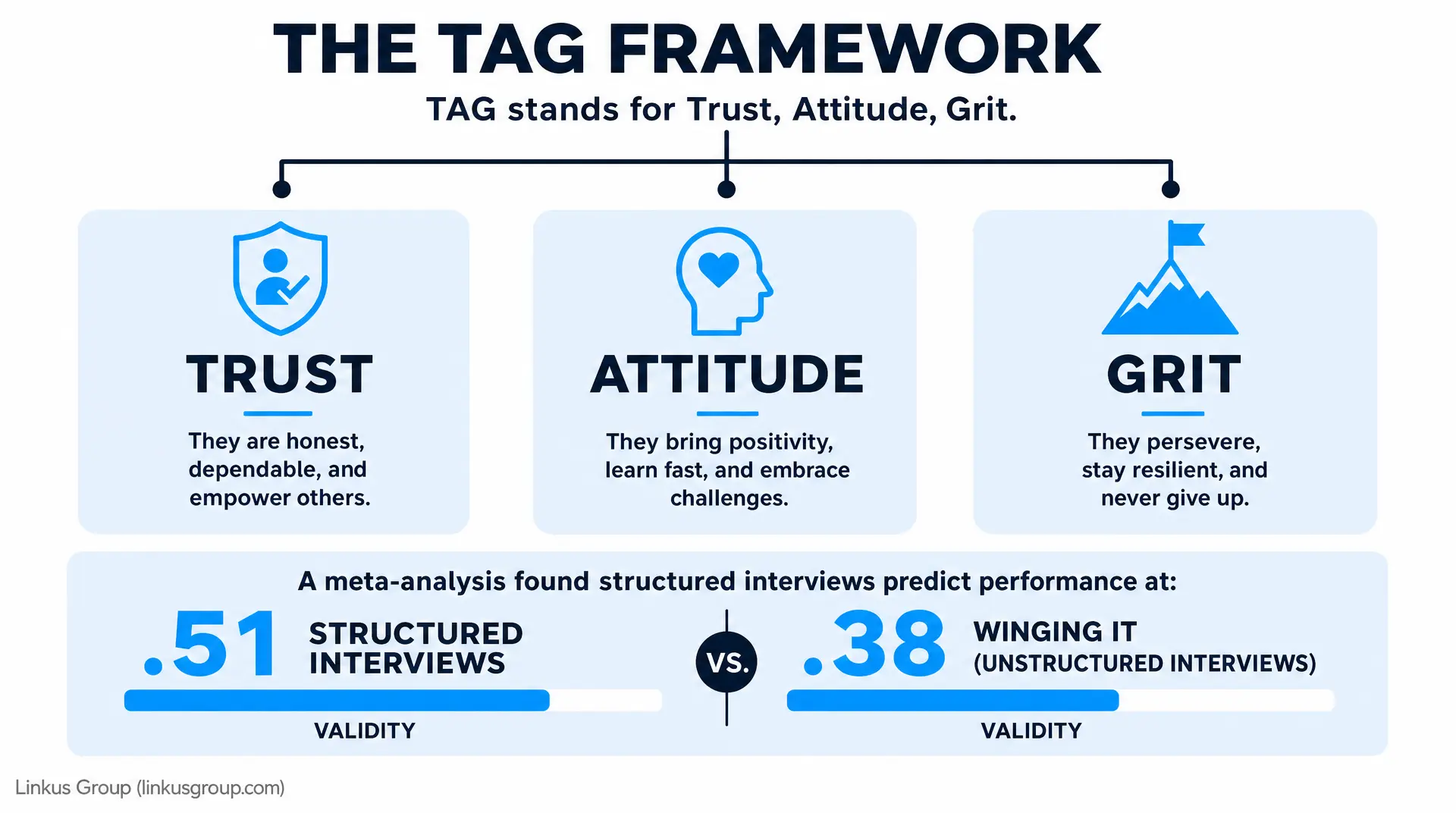
TAG stands for Trust, Attitude, Grit, and it's how we screen at Linkus. We run interviews like a podcast: unscripted, conversational, circling the same territory from different angles.
How Do Recruiters Test Trust and Grit Within the TAG Framework?
For trust, I'm just honest with them: "We work with customers that have sensitive information. We deal with salaries. How do we know we can trust you in these situations?" Then I ask for examples. If the answer sounds rehearsed, I come back to it 20 minutes later from another direction and check whether the two versions line up.
For grit, I ask around the outcome. "Tell me about a time you had to work harder than anyone on your team." Then, much later: "Was there ever a time you found a way to work less?" You'd be amazed what surfaces in a candid conversation – people will casually tell you how they snuck around hard work. Nobody's ever been let go from a job for working too hard.
How Do Recruiters Test Behavioral Polish Within the TAG Framework?
Polish is behavioral, so test behavior. Have them draft the email they'd send a vendor to order a thousand pairs of jeans and see what they ask for. Take them to lunch and watch how they treat the waiter. And there's real science behind holding consistent criteria: a meta-analysis of 85 years of selection research found structured interviews predict performance at .51 validity versus .38 for winging it. I don't run scripts. But I always know exactly what I'm testing for.
Why Should Founders Stress-Test Big-Company Candidates for Startup Ambiguity?
My most instructive miss involved a biometrics startup and a genuine top performer from Microsoft. Twelve years there, loved the company, wanted a change, believed a startup was the right move. Every conversation aligned. They took the job, and it didn't work out – they realized they were built for a bigger organization, and they were so good that Microsoft hired them straight back.
That placement taught me you cannot fully predict a human in an environment they've never lived in. Twelve years of enterprise success tells you almost nothing about how someone handles a Tuesday where the roadmap changed twice, the budget is gone, and there's nobody to hand things to. At a big company you can hide behind a mistake. At a startup with 11 people, your mistake is a hundred times bigger and it has your name on it.
So before the offer, stress-test for ambiguity out loud. Say the resources aren't there, say the autonomy is total, and watch the reaction. Some people light up. Some people flinch. Hiring is never going to be 100% perfect – the whole game is reducing your risk, and that one conversation reduces more risk than any personality test I've ever seen.
Why Is Hiring Speed Critical for Securing Passive Candidates?
Hire slow, fire fast is the biggest lie ever told in hiring. You never have to fire if you hire really well, and if you're slow, you'll never land the person worth hiring in the first place.
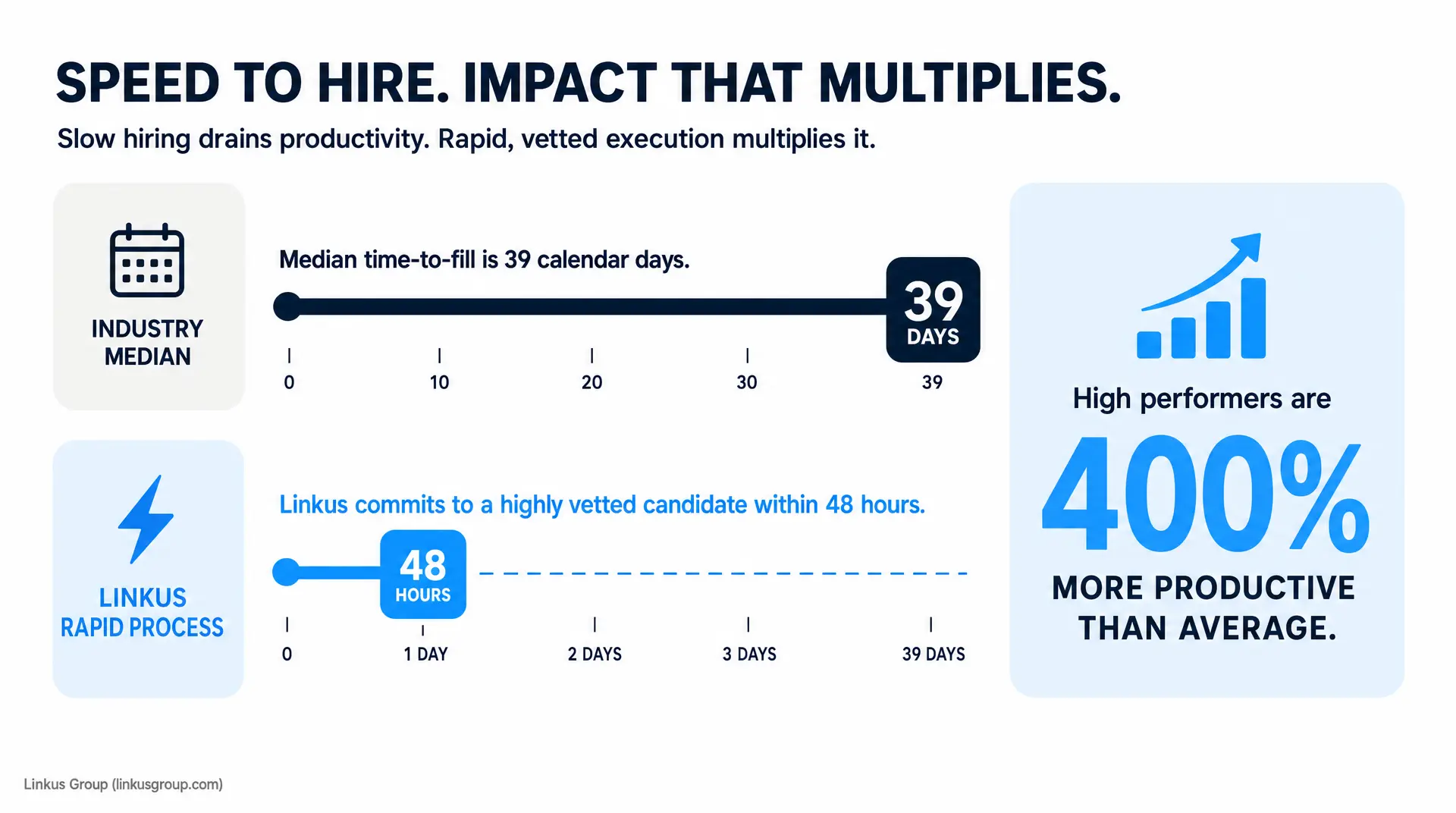
Look at what you're actually competing against. SHRM's 2026 benchmarking across 4,600-plus organizations puts median time-to-fill at 39 calendar days for nonexecutive roles. A passive candidate you've just pried loose from a comfortable job will not float in your process for 39 days. Her employer counters. Her doubt grows. Every extra interview round hands the advantage back to the company she already works for.
I watched a company win a major bank contract and then lose the entire project to a competitor because their interview process wasn't aligned to the project timeline. They needed three people and simply couldn't hire fast enough. The contract was already won. The hiring lost it.
How Does Vacant Role Cost Justify Rapid Hiring Speeds for Passive Candidates?
Take the role's annual salary and divide by 2,000 to get the hourly rate. Multiply by four or five, because every employee you get should be three to four times the salary anyways, and the great ones run higher – McKinsey found high performers are 400% more productive than average, climbing toward 800% in complex roles. Now that vacant seat has a daily price tag, and it's usually uglier than any recruiting fee.
This is why we commit to a highly vetted candidate within 48 hours at Linkus, and why companies usually hire the first person we send them. Speed doesn't kill quality. Not having clarity does – and the clarity work happened back when you stripped the role to one business problem.
How Can Startups Overcome Salary Gaps Using Equity and Leadership Structure?

Canadian founders, this one's for you. The wage gap you're fighting is documented: the U.S. median for software developers hit $133,080 in May 2024, while the Canadian median for software engineers works out to roughly CA$117,500 a year – before the exchange rate makes the American offer look even fatter.
You will not win a cash war, so stop fighting one. People leave leadership long before they leave salary bands. Gallup found managers account for at least 70% of the variance in employee engagement, and nearly one in two people have quit a job specifically to escape a manager. Your leadership structure is a retention lever that costs discipline instead of dollars.
Then do the equity math honestly. Say you need a $200,000 operator and can only pay $100,000 in cash. That person is handing you $100,000 of hard-earned money every single year, locked behind vesting and startup risk. The equity should map to roughly double the sacrifice, about $200,000 in value, because nobody trades cash for paper at face value. Present it as that explicit trade and senior operators respect it. And if money is genuinely someone's number one motivator, they'll take the US offer no matter what you say. Let them go. Repelling the wrong fit is half of what good recruiting does.
Why Is Proper Onboarding Crucial for Retaining Passive Candidate Hires?

90% of recruiting is the onboarding process, and passive hires are uniquely fragile here. She gave up a stable role, a known manager, and a comfortable trajectory on your word. Gallup found only 12% of employees strongly agree their organization does a great job onboarding, still people who do get an exceptional landing are 2.3 times as likely to say the job is as good as or better than expected. For someone who left security behind, "as good as promised" is the entire deal.
When the landing matches the pitch, the compounding is unreal. We've placed candidates who went from a $70,000 salary to $500,000 and an exit – and when that founder started his next company, he hired that same person back as a co-founder. I've watched an executive assistant placement grow into a head of people and keep climbing from there. Our 96% retention rate at 18 months comes from alignment on the way in and delivery after the start date, nothing fancier than that.
What Are the Core Strategies for Recruiting Passive Candidates in 2026?
After two decades of this, my one unshakeable conviction is that the person who does best in the job is usually the person you'd least expect, and that person is almost never sitting in your applicant pile. We spend 90,000 hours of our lives at work. The hire who changes your company is out there right now, employed, ignoring job boards, waiting for someone to present the right opportunity in the right way.
In 2026, every inbox is drowning in automated noise, which makes a real founder with a clear problem, a specific hook, and a fast process stand out more than ever. Stop overcomplicating it. Define the problem, make the call, vet for trust, attitude, and grit, and move like a free agent just hit the market. And if you want a partner embedded in your Slack who does this all day and answers on weekends, you know where to find me. Either way, your next best hire isn't applying. Go get her.
Frequently Asked Questions
How do I calculate equity when offering a passive candidate a lower base salary?
Nobody trades cash for paper at face value. If you need a $200k operator but only have $100k in cash, they risk $100k of real income. Your equity grant must map to roughly double that sacrifice – around $200k in vested value. Make this trade explicit. Senior operators respect honest math, not delusion.
Why do traditional recruiting agencies fail at placing zero-to-one startup talent?
Massive transactional agencies treat your search like a volume game, spamming redacted resumes before ghosting you when the placement gets hard. Zero-to-one founders don't need a broker. You need an embedded partner who strips your delusional job description down to one metric and pitches your raw vision directly to off-market talent.
Should we offer unlimited PTO to lure passive candidates away from corporate jobs?
Absolutely not. Fragile early-stage economics cannot support toxic modern HR demands like unlimited PTO. If a candidate's primary focus is massive perks, they aren't built for a zero-to-one environment. High performers care about ownership and solving real business problems. Always filter out candidates who prioritize endless vacation over trajectory and grit.
How do I stop passive candidates from using my startup offer as leverage?
Move significantly faster than their current employer. SHRM data puts the median time-to-fill at 39 days. If you float a passive candidate for weeks, you are begging for a counter-offer. Vet them strictly for trust and grit, present a highly-vetted offer within 48 hours, and force a decision. Speed kills counter-offers.
How can a Canadian startup compete with US companies paying massive cash salaries?
You cannot win a cash war against the U.S. software median of $133,080. Stop trying. Compete on leadership instead. Gallup notes half of employees quit to escape bad managers. Sell your startup's autonomy. If money is their sole priority, let them walk away. Repelling the wrong fit is a massive win.