

Every safeguard a board trusts to de-risk an executive hire – the impressive logo, the decade in the exact niche, the personality test that came back green – is really a device for distributing blame once it fails.
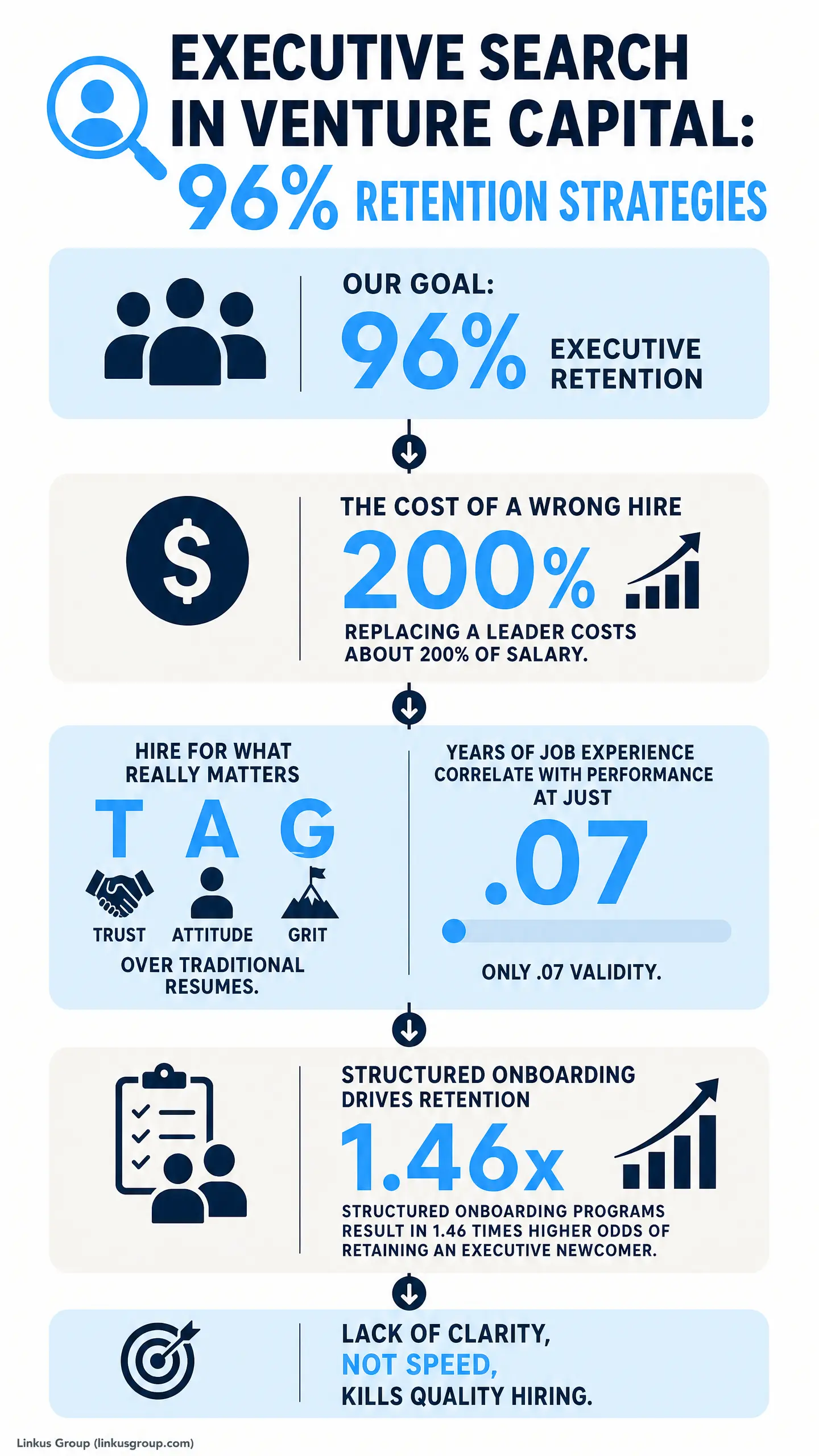
None of it predicts the work. Years of job experience correlate with performance at .07, and the executive who actually thrives is usually the one your board would never let past the resume screen.
Top candidates can smell that machinery, and they decline. My 96% retention rate starts the moment a founder stops hiring to cover themselves.
Key Takeaways
- A 2022 Journal of Applied Psychology reanalysis indicates that years of job experience correlate with performance at just 0.07, demonstrating that exact-niche tenure poorly predicts executive success.
- Providing realistic job previews that expose a startup's operational realities lowers voluntary executive turnover by increasing candidate perceptions of organizational honesty across 17,000 evaluated individuals.
- Startup founders substituting executive cash compensation with equity must offer roughly double the sacrificed cash value on a realistic vesting timeline to effectively offset the candidate's financial risk.
- Executives completing structured onboarding programs demonstrate 1.46 times higher retention odds, prompting scaling startups to hire dedicated HR leaders instead of junior job-board recruiters.
- Hiring managers differentiate executives who built departments from those who merely inherited them by requiring candidates to explain how they would train new hires to run their proprietary systems.
- Carta data shows startup hiring ratios dropped from 1.75 hires per departure in 2022 to 1.06 in 2024, signaling a structural shift away from raw headcount growth toward methodical seat planning.
What Does a 96% Executive Retention Rate Mean in Venture Capital Hiring?
I can't control your product-market fit, your runway, or what your board does next quarter. Humans change, and no recruiter on the planet can predict that.
A biometrics company hired a top performer out of Microsoft through us. Twelve years there, wanted a change, believed a startup was the right move. Every signal lined up. Eventually they told the founder they were built for a bigger organization, and Microsoft hired them back. That's how good they were. The placement still didn't work, and I own that.
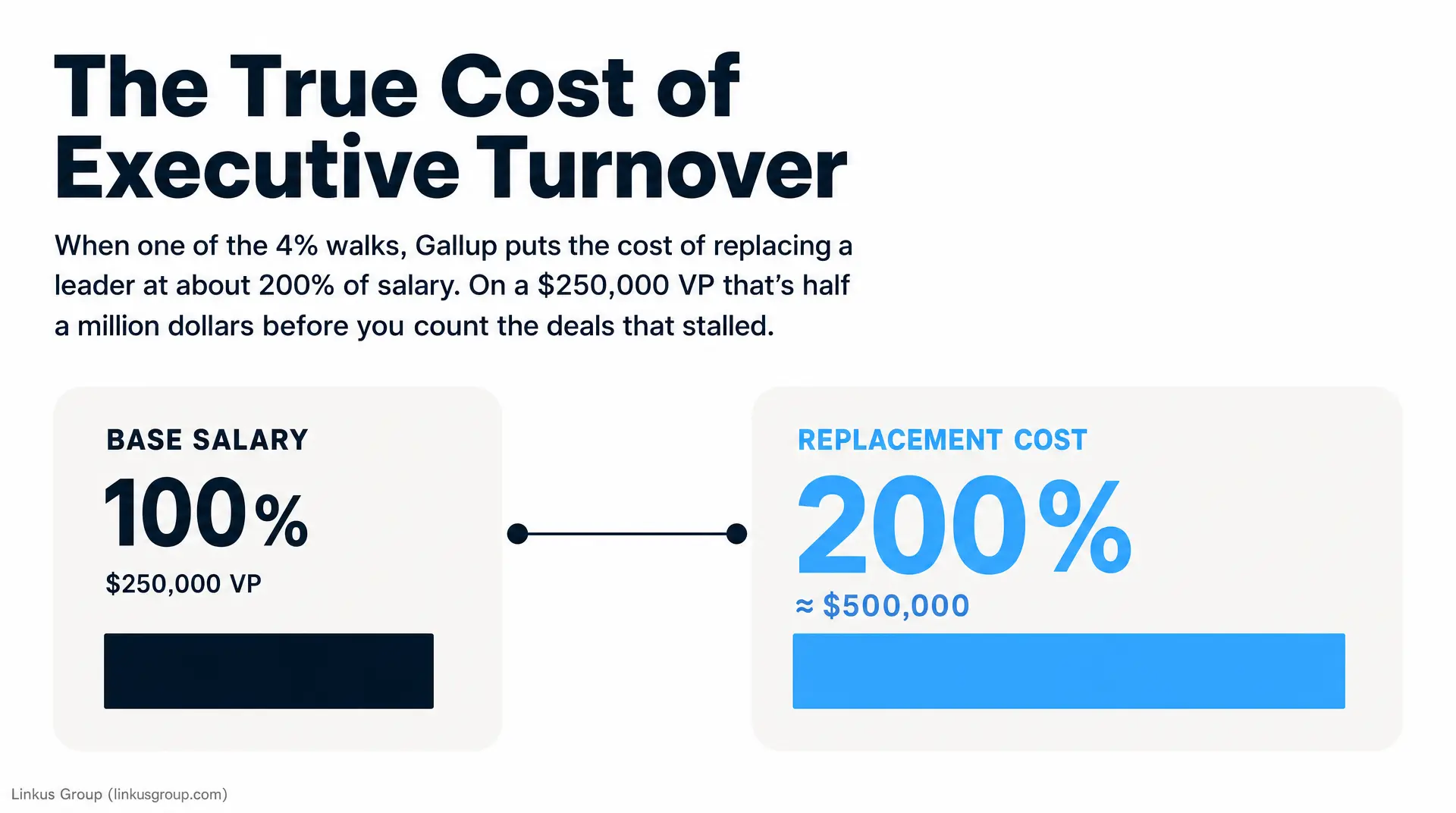
So treat 96% as what happens when you reduce risk everywhere you can touch. When one of the 4% walks, Gallup puts the cost of replacing a leader at about 200% of salary. On a $250,000 VP that's half a million dollars before you count the deals that stalled while the seat sat empty.
The retention I actually care about shows up years later, in career trajectory. We've placed people at $70,000 who went to $500,000 and an exit, then got hired back as a co-founder when that founder started the next company. That's what fit looks like.
How Should Founders Manage Board Expectations Regarding Startup Headcount and Executive Hiring?
When a founder tells me the board wants 15 hires this quarter, my first words are "whoa, whoa, whoa, let's plan." Maybe you need 15. Maybe you need four. You won't know until you write down what each seat has to produce.
A 30-person, founder-led legal tech company came to me ready to triple headcount. I pushed the other way. Hire one high-performing salesperson and one strong product manager, then move methodically. They stayed highly profitable, and when competitors went bankrupt, they were the ones able to absorb the best people those companies let go. The market already moved this way. Carta's data shows startups made 1.06 hires for every departure in 2024, down from 1.75 in 2022. A board still pushing raw headcount is running a 2021 playbook.
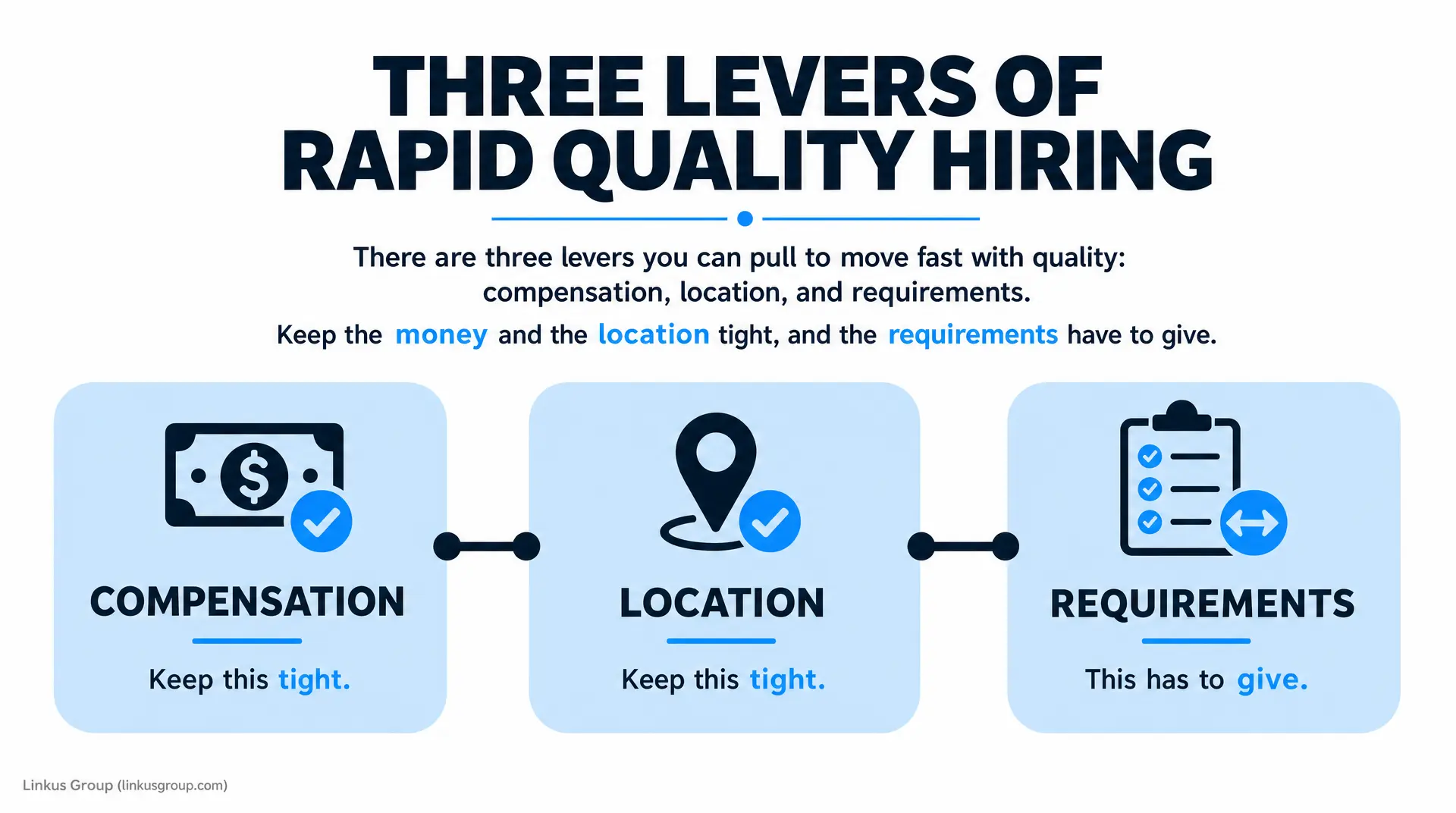
Look, I never tell a founder to drag out a search. An e-commerce client had to hit numbers in a brutally competitive space. I didn't tell them to wait, I told them to get realistic. There are three levers you can pull to move fast with quality: compensation, location, and requirements. Pay somebody a million dollars a year and you have access to pretty much the entire market. Keep the money and the location tight, and the requirements have to give, because great candidates have options. That's just a matter of fact. When the panic hit, I told that founder one thing. You can still make the right hire not long from now.
Why Do Big-Company Executive Hires Often Fail at Scaling Startups?

An 88-employee education tech company hired an executive used to big-company resources, and it blew up. The founder never accounted for what that person had leaned on before, mainly a monthly marketing budget that didn't exist here. Strip away the budget, the brand and the SDR team, and you find out fast whether somebody can sell an unknown logo. The cousin of this mistake is hiring the $10-million-to-$50-million operator before you've cleared $5 million. Their playbook assumes a product-market fit you don't have.
When I screen an enterprise executive for a scaling company, I listen for three things: self-awareness, realism instead of pure optimism, and a desire to understand rather than a need to be right. Then I get brutally honest about the environment. More autonomy, more ambiguity, a fraction of the budget, and mistakes a hundred times more visible because there's nowhere to hide.
Everyone hates surprises. A meta-analysis of realistic job previews covering roughly 17,000 people found the candidate's perception of organizational honesty was the main reason those previews lowered voluntary turnover. Tell the good, bad and ugly up front, and a hard job stops being a reason to quit.
Why Do Unconventional Executive Candidates Outperform Traditional Hires in Venture Capital Startups?

After two decades, the conviction I'll stake my reputation on is this: the person who does the best in the job is usually the person you'd least expect. Most hiring teams walk in biased. The referral must be good because a friend vouched. The personality test came back green, so nobody has to take the blame, which is really all personality tests are for. Top candidates can smell it.
I once pushed a technology client to interview a CTO whose resume had no obvious fit with their industry. That CTO helped the company raise a Series A and a Series B, then co-founded new ventures with the same team. Another founder ignored my pick for a founding salesperson over a lack of industry experience. Their preferred candidate turned down the offer, they hired mine, and that salesperson thrived.
Skills can be taught. Attitude and drive can't. A 2022 reanalysis in the Journal of Applied Psychology put the predictive validity of years of job experience at .07. So when a founder insists on 10 years in their exact niche, I turn it around. You didn't have that experience when you started the company. You learned it because you cared. If this person gets to 70 or 80% of the veteran's ramp, is that worth the salary?
It always comes down to TAG: trust, attitude and grit. We test it in unscripted, podcast-style conversations. I'll ask about a time someone had to work harder than everyone else on their team, and later about a time they found a way to work less. The second question gets the honest answer, and I'll ask it again a different way to see if the stories line up.
How Do Founders Evaluate If an Executive Candidate Built or Inherited a Department?

Every Series B candidate says they built the department from scratch. Plenty inherited a machine somebody else assembled. My diagnostic works backward from training. I ask how they'd train a new hire to run the system they built, then I reverse it: walk me through every stage of the build, why each decision got made, who was in the room. If it's under NDA, tell me who on your old team can verify it and let me call them. Then the scenario: if you were building this here, how would you start, and what do you need from me? People who actually built something start asking questions right away.
The same rigor tells you when a loyal seed-stage superstar has hit their ceiling. The signal is pain: you're redoing work, and things that should move forward keep landing back on your desk. Then you have three honest paths. Move them into a role that fits, hire the specialist above them, or have the candid, short conversation about parting ways.
How Do Startups Successfully Hire a VP of Engineering Over a Technical Co-Founder?

The hardest version is bringing a VP of Engineering in over a technical co-founder who built the MVP and can't scale the team. That conversation belonged on day one, with both founders agreeing on what stage triggers a transition, backed by a lawyer and a real HR structure. If you skipped it, engage an employment lawyer before you start the search. If a founder and their technical leader can't read each other's minds, that gap becomes the bottleneck for the whole company, so simulate living together: weekend conversations, shared meals, a look at how the two of them disagree. And decide in writing who owns the outcome of this hire. Searches that die at the finish line usually die from a veto by someone who was never accountable for the result.
How Should Startups Structure Executive Compensation and Equity to Maximize Retention?
Commission is a meter stick for motivation. For most revenue roles I start at a 50/50 split between base and variable, uncapped, and I raise the base if the person manages a team, because leadership pulls them away from direct revenue activity. Match the plan to your actual sales cycle, too. An enterprise health tech seller on an 18-month cycle needs a higher base and a real OTE, or they'll go six months without a commission cheque and leave.
On equity, my rule of thumb is simple. If you want a $200,000 executive but can only pay $100,000 in cash, that person is giving up $100,000 in hard-earned money every year. The equity should be worth roughly double that on a realistic vesting timeline. Cash for equity is never one for one.
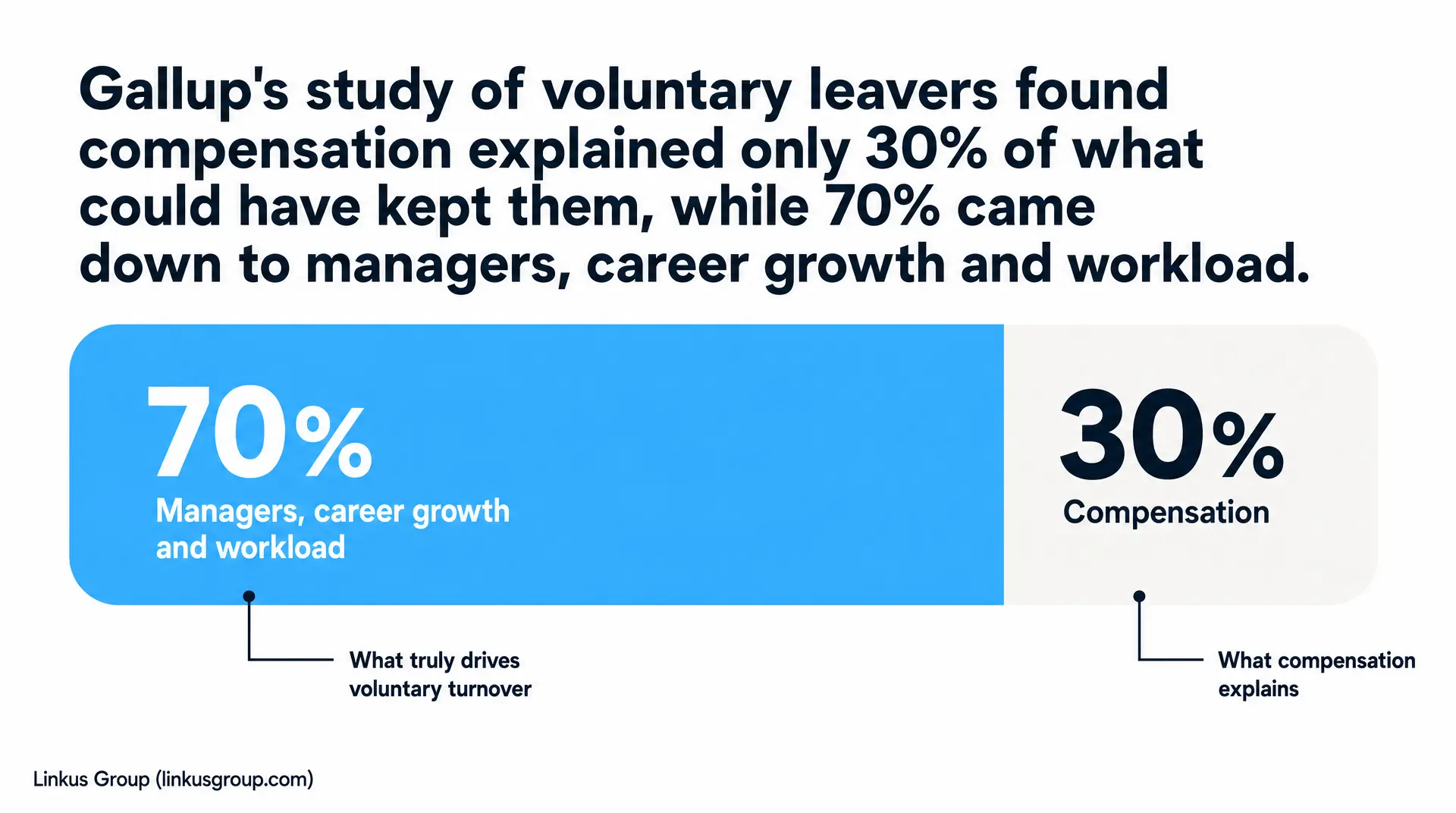
Growth is the number one driver for top sales talent, so spell out what's obtainable: comp, bonus and trajectory. When a US firm offers your VP 50% more cash, remember that people don't leave companies, they leave leadership. Gallup's study of voluntary leavers found compensation explained only 30% of what could have kept them, while 70% came down to managers, career growth and workload. Fix leadership first, then pull the location and growth levers.
How Does Structured Onboarding Impact Executive Retention Rates in Startups?

90% of recruiting is the onboarding process. Whether an executive is still with you at month 18 depends far more on their first 90 days than on any interview I ran. A meta-analysis of 83 field experiments found newcomers who went through a structured onboarding program had 1.46 times higher odds of staying.
That's why I tell scaling founders their first internal talent hire should be an HR leader, not a junior recruiter posting on job boards. It's also why we sit inside our clients' Slack and Teams, and why I won't work with your direct competitors. In a concentrated ecosystem like Toronto's that leaves money on the table, and it means I can wear your brand on my sleeve and recruit straight out of the companies you're fighting.
When a placement fails, my post-mortem is blunt. It could be the candidate, the company, or God. Then I ask the founder straight up: could this have been avoided in the interview process, and where? Is there a pattern of turnover here? Did the company lose product-market fit? I take my share. At the end of the day, the only metric I track is time to quality of hire, and the only KPI my business runs on is repeat business.
Why Are Speed and Role Clarity Critical Strategies in Executive Hiring?

"Hire slow, fire fast" is the biggest lie ever told in hiring. You never have to fire if you hire really well, and you can hire really well in 48 hours if the clarity work happened first. Usually our clients hire the first person we send.
I watched a company win a major bank contract and then lose the project to a competitor because their interview process couldn't produce the three people the project needed in time. Speed doesn't kill quality. Not having clarity does. Time kills all deals, and a great executive is a free agent with other offers on the table. Do the clarity work, and 96% stops looking like luck.
Frequently Asked Questions
How do shrinking startup runways alter our executive search strategy?
It forces ruthless prioritization. Half of VC-backed tech companies have under seven months of runway, per SVB. You cannot afford a six-month ramp-up. Stop hiring to appease your board's vanity metrics. Focus strictly on specialized operators who can aggressively extend that runway from day one.
Is the cost of an external executive search firm justified for a Series A startup?
Yes, because failure at this stage is fatal. SHRM data shows average executive cost-per-hire is $35,879, still incredibly, only 20% of companies track quality of hire. Internal teams excel at volume, but an external partner is your firewall against biased referrals, protecting your cap table.
Should we hire a VP of Sales before establishing our GTM playbook?
No. Hiring an enterprise rep to build your GTM from scratch is a trap. Carta notes sales roles are 19.9% of startup hires, still many fail because they lack the grit for raw outbound. Build your foundational playbook first, then hire the specialized executive to scale it.
Are unstructured, conversational interviews enough to vet venture-backed executive talent?
Absolutely not. 'Getting a good feel' is unconscious bias disguised as strategy. A Journal of Applied Psychology study found structured interviews predict performance at .42, versus .19 for unstructured. Without rigorous, backward-engineered diagnostic questions, you are essentially gambling your board's capital.
If a newly hired executive quits within six months, is compensation usually the issue?
Almost never. Founders love to blame the market, but Gallup reveals compensation accounts for just 30% of preventable turnover. The remaining 70% stems from management issues. If an executive walks, it is rarely about salary. It is a failure in role clarity or internal political dynamics.