

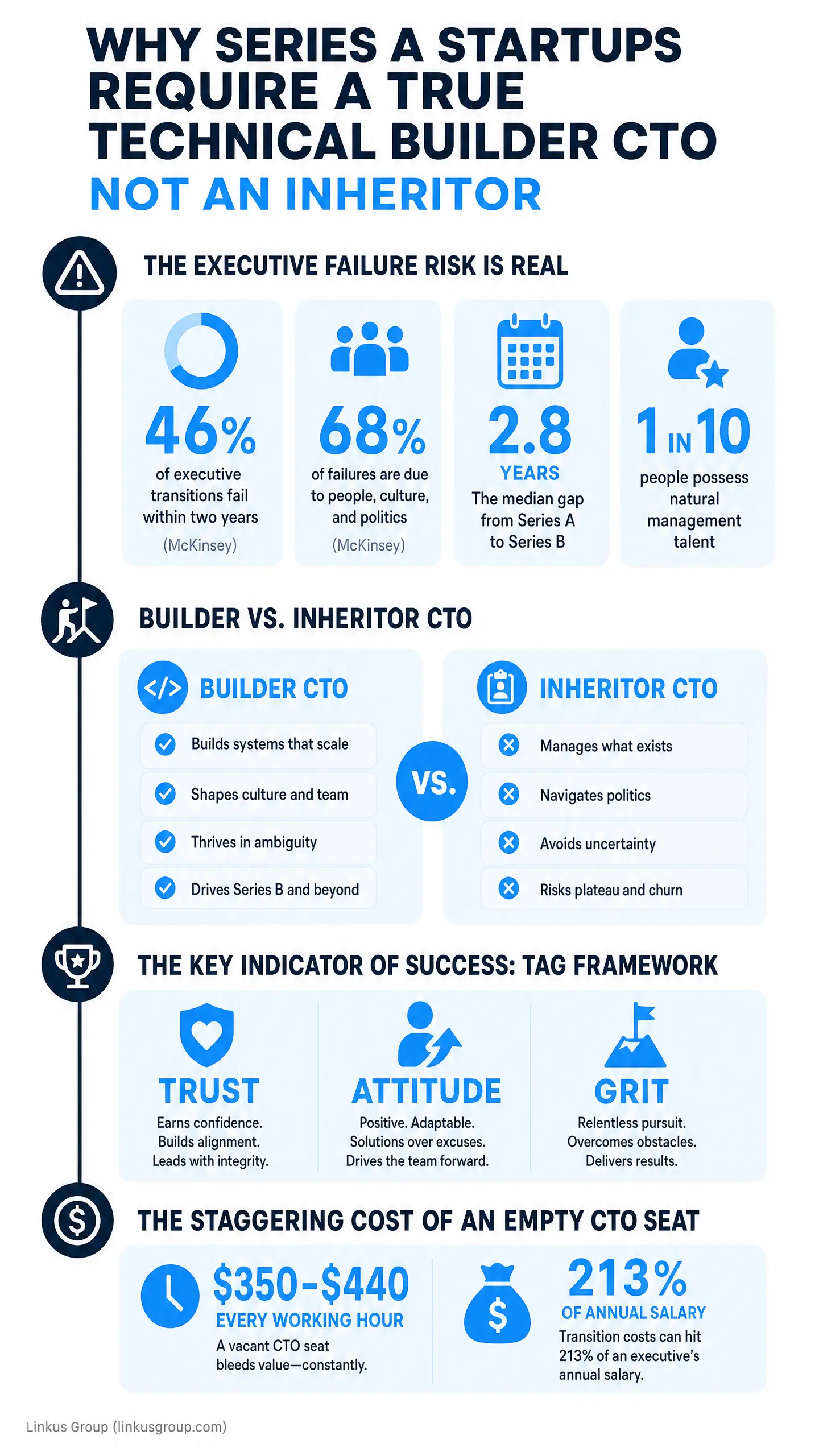
Almost no executive fails on the one skill you spent the entire interview measuring. McKinsey found that up to 46% of executive transitions fail within two years, and 68% of those collapse over people, culture, and politics – the areas boards examine least.
The pedigree that gets an investor's call taken was earned running a machine someone else already built. Taking a company from ten million to fifty million and building the machine itself are different jobs, and most of those resumes have only done the first.
You have product-market fit and no engineering organization that survives adding 30 people in 18 months. That is the seat, and the shiniest candidate on the slide has never once filled it.
Key Takeaways
- McKinsey research shows up to 46% of executive transitions fail within two years, with 68% of those failures caused by misaligned people, culture, and politics.
- Startup Genome research reveals 70% of high-growth startups scale prematurely with oversized teams, a risk that stage-appropriate CTOs mitigate by rigorously monitoring revenue per employee.
- Carta data indicates the median wait between Series A and Series B funding is 2.8 years, requiring early-stage CTOs to build resilient engineering systems capable of enduring long capital gaps.
- According to Schmidt and Hunter's meta-analysis, evaluating CTO candidates by watching them navigate practical system-building scenarios predicts future job performance twice as accurately as standard reference checks.
- Hiring engineering leaders who previously scaled companies from $10 million to $50 million often fails at early-stage startups because building initial infrastructure requires completely different skills than operating existing systems.
- McKinsey data demonstrates that placing a poorly integrated CTO over an existing engineering team lowers direct report performance by 15% and increases team attrition risk by 20%.
Why Is Founder and CTO Chemistry Critical in Executive Search?

Two people run this company now. If the founder and the CTO can't read each other's minds, if they aren't rowing in the same direction, if the vision isn't actually shared, it will never work. It becomes a massive bottleneck, because every rebuild-or-patch decision runs through those two people.
So we test chemistry by acting like you're already working together. Several deep conversations, not one. Lunch. Dinner, where you watch how they treat the server. A Saturday call about a real problem, say the migration that's three weeks late. Then watch what they do with it. Do they ask who's on the team, or do they start dictating a fix before they know a single name?
It's exactly like a relationship. You live together first. You learn each other's idiosyncrasies. By the time you sign, there are very few surprises, and everyone hates surprises. It's also why I work weekends. A decision this size never lands at 2 p.m. on a Tuesday. It lands on a Sunday, when the candidate is holding a competing offer.
Why Do Series A Startups Fail When Hiring $50 Million CTO Candidates?
This is the most expensive error I watch founders make. They hire someone who took a company from $10 million to $50 million when their own business isn't at $5 million still. It's a completely different animal. That operator walked into a machine that already worked and made it bigger. Building the machine is a different job, and a lot of them have never done it.
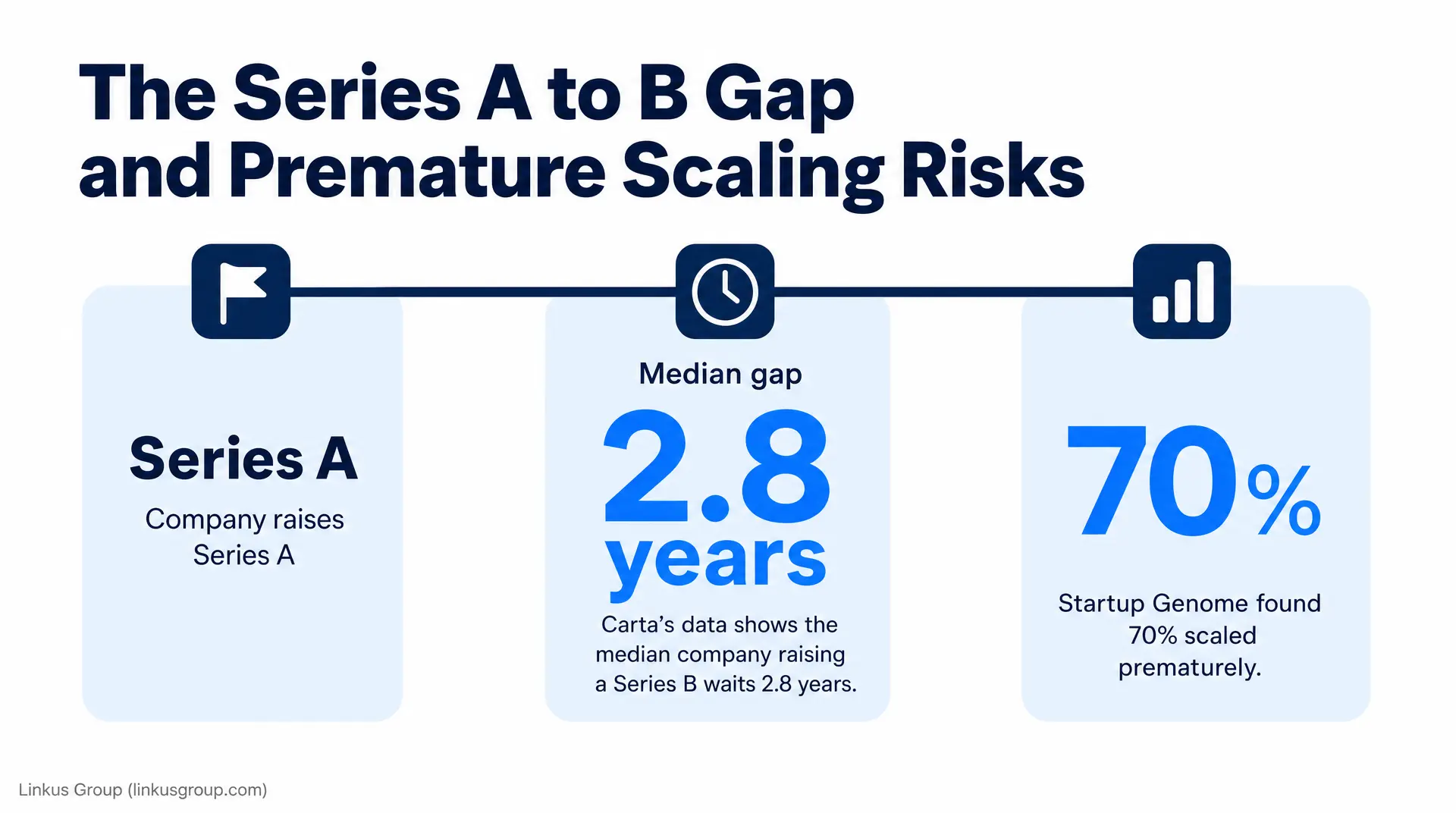
The stakes have gone up, too. Carta's data shows the median company raising a Series B had waited 2.8 years since its Series A, the longest gap on record. Whoever you hire now is your CTO for that entire stretch. Their systems have to hold for almost three years without a fresh round to paper over the cracks.
This is where I push back on investors. Startup Genome looked at more than 3,200 high-growth startups and found about 70% scaled prematurely, with teams three times larger than stage-consistent companies. A headcount milestone from your board is a premature-scaling machine unless somebody stands in front of it. Somebody has to ask what revenue per employee actually is. The stage-right CTO asks that question. The $50 million CTO's reflex is to rebuild the org chart from the last place.
Why Do Individual Contributor Developers Struggle as Series A CTOs?

Your lead developer from the seed round is probably a brilliant individual contributor. Leading is a different personality. Leaders have high EQ. Leaders care more about the team than they care about themselves. ICs, through no fault of their own, care more about themselves individually. They're wired to ship, and you needed that early on.
Gallup studied 2.5 million manager-led teams and found only about one in 10 people have the natural talent to manage, and one in two employees has quit a job to get away from a manager. Your CTO is the manager of your managers. Pick wrong and you've chosen your attrition rate.
You'll know it's time for a true exec when you feel the pain of the business not moving forward. You're redoing work. Something breaks every time you add a body. That's the specialist signal.
How Can Startups Verify If a CTO Candidate Built or Inherited an Engineering Organization?

Every CTO candidate says they've built engineering orgs from scratch. Plenty inherited something someone else built and ran it well. I find out fast.
If the system is public-facing, show it to me. If it's proprietary, walk me through every stage and every step. What did you build, why, how, and who was involved? I work backwards from training. How would you train someone to run this? Then reverse it. How did you decide what to build in the first place? Then references. Who on your team can verify this is what was built, and who worked on it that I can call?
Then the scenario. If you were going to build this at our company, how would you go about it, and what do you need to ask me to succeed? A builder asks about runway, the on-call rotation, and the two senior engineers who look ready to quit. An inheritor asks about reporting lines. Schmidt and Hunter's meta-analysis found that watching someone do the work predicts performance about twice as well as a reference check. References still matter, but they're one layer.
Why Do Google and Amazon Candidates Struggle in Series A CTO Roles?

I get the appeal, but I've sat across from a lot of these candidates, and many have zero idea how a lean business actually operates. Google and Amazon come with different resources, different brand recognition, a different team, a different energy. A legal department if things go wrong. Severance if things really go wrong. None of that exists at your company, and the mistakes are a hundred times bigger.
You can't walk into a five-star restaurant and expect your food in five seconds. You also can't expect it cheap. It's all about layering expectations, on both sides. Candidates need to understand what they're getting into, and frankly companies are just as bad at understanding what candidates deserve.
Groysberg, Nanda, and Nohria tracked 1,052 star stock analysts across 78 investment banks. When a firm hired an outside star, the star's performance dropped, the new team functioned worse, and the firm's market value fell. That's Wall Street, but I've seen the same movie here.
I lived it with a biometrics startup. We placed a top performer out of Microsoft. Twelve years there, wanted a change, thought a startup was the right next chapter. Everything seemed to align. It didn't work. The candidate realized they were built for a bigger organization and left on good terms. Microsoft hired them right back. That's how good they were, and it still wasn't a fit.
The ones who do make the jump always come down to TAG: trust, attitude, and grit. I'm looking for realism, not just optimism. Self-awareness. Someone well-read who seeks to understand rather than needing to be right. Those people can maneuver in situations they've never seen. And this is where the reference check earns its keep. Was the last environment right for this person? Was that a good reference or a bad one? How someone behaved in the last seat predicts how they'll behave in yours.
How Do Trust, Attitude, and Grit Predict Series A CTO Hiring Success?

After two decades, my one unshakeable conviction is that the person who's going to do best in the job is usually the person you'd least expect. Most people hire with a bias baked in. They keep putting in the same ingredients.
One technology client had a CTO candidate in front of them whose resume had no direct industry alignment. Nothing on paper said yes. I pushed them to take the interview anyway, because I look at where someone is going, not where they've been. They hired that person. That CTO helped the company raise its Series A and then its Series B, and later co-founded new businesses with the same team.
No board would have put that resume on a slide. Skills can be taught. Attitude and drive can't. If someone is smart, gritty, and aligned with the founder, you'll teach them your industry a lot faster than you'll teach an ego to shrink. It's the same reason we refuse to work with a client's direct competitors. You can't lift up every rock when some of the rocks belong to another client.
How Should Startups Manage Layering a New CTO Over an Early Lead Developer?

Now the politically charged part. You're bringing an executive in over the person who built your MVP. Maybe they're a co-founder. Maybe they hold real equity. Definitely they hold loyalty, and the team knows it.
The best version of this was solved before you had customers. Two founders agreeing that if we hit this stage, and this is the indicator, here's what we do. You set that transition plan up with a lawyer and an HR lead so the culture holds when the day arrives. Things get messy when you mesh everything together just to get going.
Most founders didn't do that. Fine. Engage an employment lawyer before the search starts. And understand your investors will push this whether you like it or not. Research on Silicon Valley startups found VC-backed firms professionalize faster and replace founders sooner, through both adversarial and mutually agreed transitions. Better you run this process than have it run on you.
Then the human part. When we've layered a CTO over a lead developer, we made sure that developer understood three things. This is in the best interest of the company. It's in their best interest too. And the person coming in operates at a different stage, knows what they're doing, and can mentor them. If you hired right, all of that is simply true.
Get it wrong and you pay in people. McKinsey found that under a leader who struggles through a transition, direct reports perform 15% lower and are 20% more likely to disengage or leave. Translate that to your company and it's your engineering team walking out during the longest A-to-B gap on record. Sometimes the early hire moves into another role, and sometimes it's a candid, short conversation that they're not the person for the next stage. Done with transparency, it doesn't have to poison anything.
How Can Founders Accelerate the Series A CTO Executive Search Process?
Everything above sounds slow. It isn't, if you're clear. Speed doesn't kill quality. Not having clarity does. Living together, the systems walkthrough, references with real depth, all of that is clarity, and clarity is what lets you move fast.
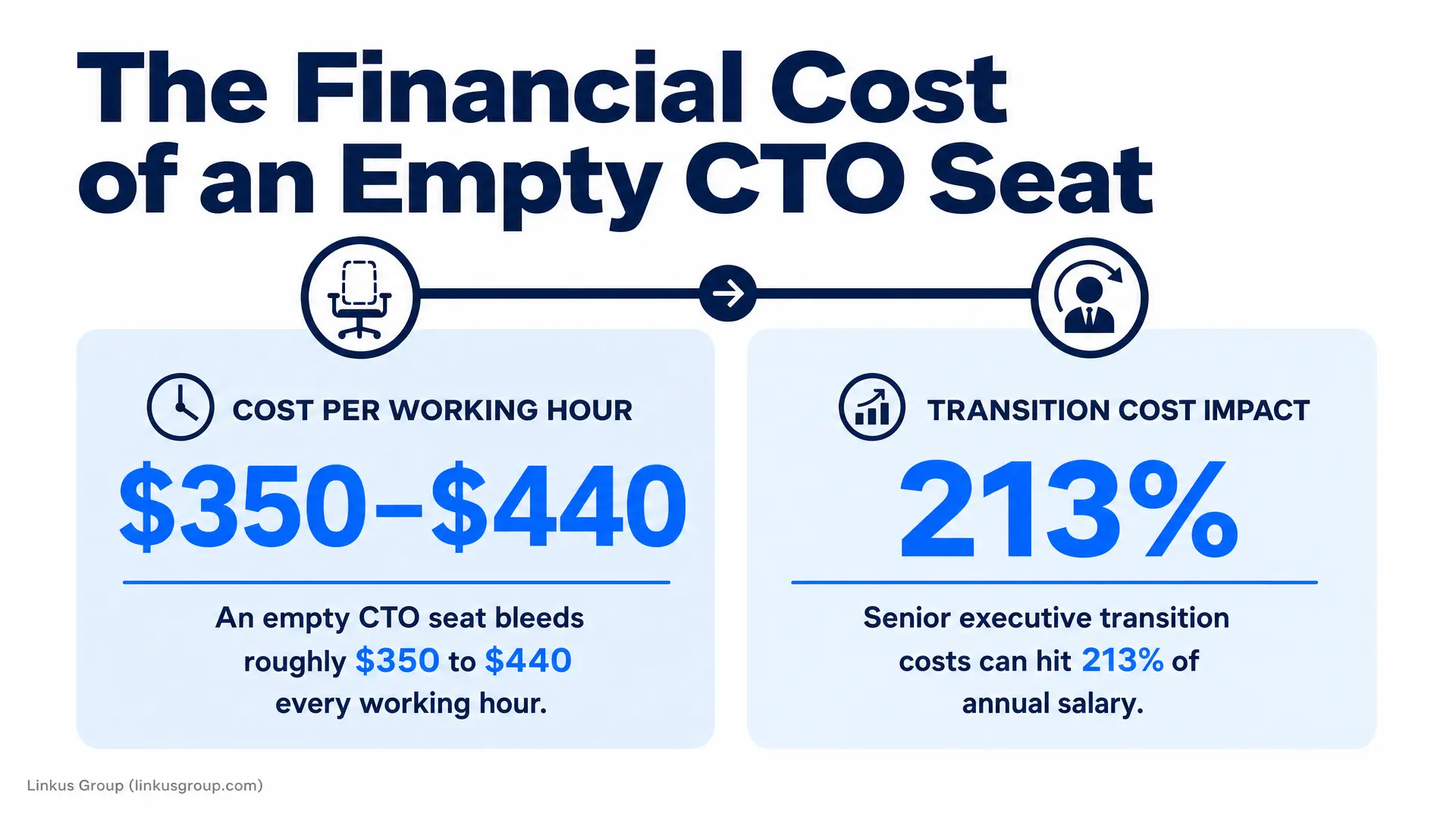
The math I run with every founder is simple. Take the seat's salary and divide by 2,000. Now you have the hourly cost. Multiply by four or five, since that's what a great hire returns. The BLS puts the median for computer and information systems managers at $175,140. Even at that median, an empty CTO seat bleeds roughly $350 to $440 every working hour. McKinsey estimates the direct outlays on a senior executive transition can hit 213% of annual salary before you count lost time. Do this search once.
Traditional retained firms will take a quarter and lock you into a fee while they do it. We take over a lot of those searches from frustrated founders. Know exactly what good looks like before you start. Decide who owns the final call, so nobody who doesn't own the outcome can veto the right person at the finish line. Skip the personality test. It's a stalling tactic. And when the right person shows up, do what a sports team does with a free agent. Jump. Time kills all deals.
Then remember that 90% of recruiting is onboarding. The day your CTO signs, the real work starts. Your investors will push headcount. I'll push the opposite. Fewer, better people, starting with this seat. Hiring is the biggest unlock in a company's business, and a Series A CTO is the biggest version of that unlock.
Frequently Asked Questions
How should Series A founders structure a CTO compensation package?
Base pay must reflect reality without draining cash. Top talent nears $300k, but the BLS puts the median at $175,140. Offset this by weighting compensation toward milestone-vested equity. This 50/50 split ensures their upside is explicitly tied to surviving the scaling phase and reaching Series B.
How do you shield a newly hired CTO from board-mandated headcount milestones?
Push back using hard data. Investors demand rapid hiring, still 74% of startup failures stem from premature scaling. Protect your CTO by anchoring board discussions to revenue per employee. Your mandate is hiring fewer, better people, completely rejecting the pressure to build a bloated org chart.
How does the current venture capital landscape impact Series A executive retention?
It brutally stretches the timeline. According to Carta's Q1 2025 data, the median wait for a Series B is now a record 2.8 years. Your new CTO must build durable engineering systems capable of surviving a massive runway gap without fresh funding. Hire for grit, or expect rapid burnout.
Why do data-driven CEOs prefer external CTO searches over promoting early managers?
Early hires rarely possess executive skills. Gallup shows only 1 in 10 people have natural managerial talent. Promoting unqualified developers guarantees bottlenecks. CEOs leverage external searches to bypass internal biases, securing verified playbook builders capable of navigating the complex transition to Series B.
How do rising Series A valuations affect the expectations placed on a new CTO?
Higher valuations demand flawless execution. With the median Series A hitting a $62 million valuation, investors expect institutional-grade scalability on day one. There is zero margin for error. Your CTO must instantly implement durable GTM playbooks and engineering systems that justify that massive premium.