

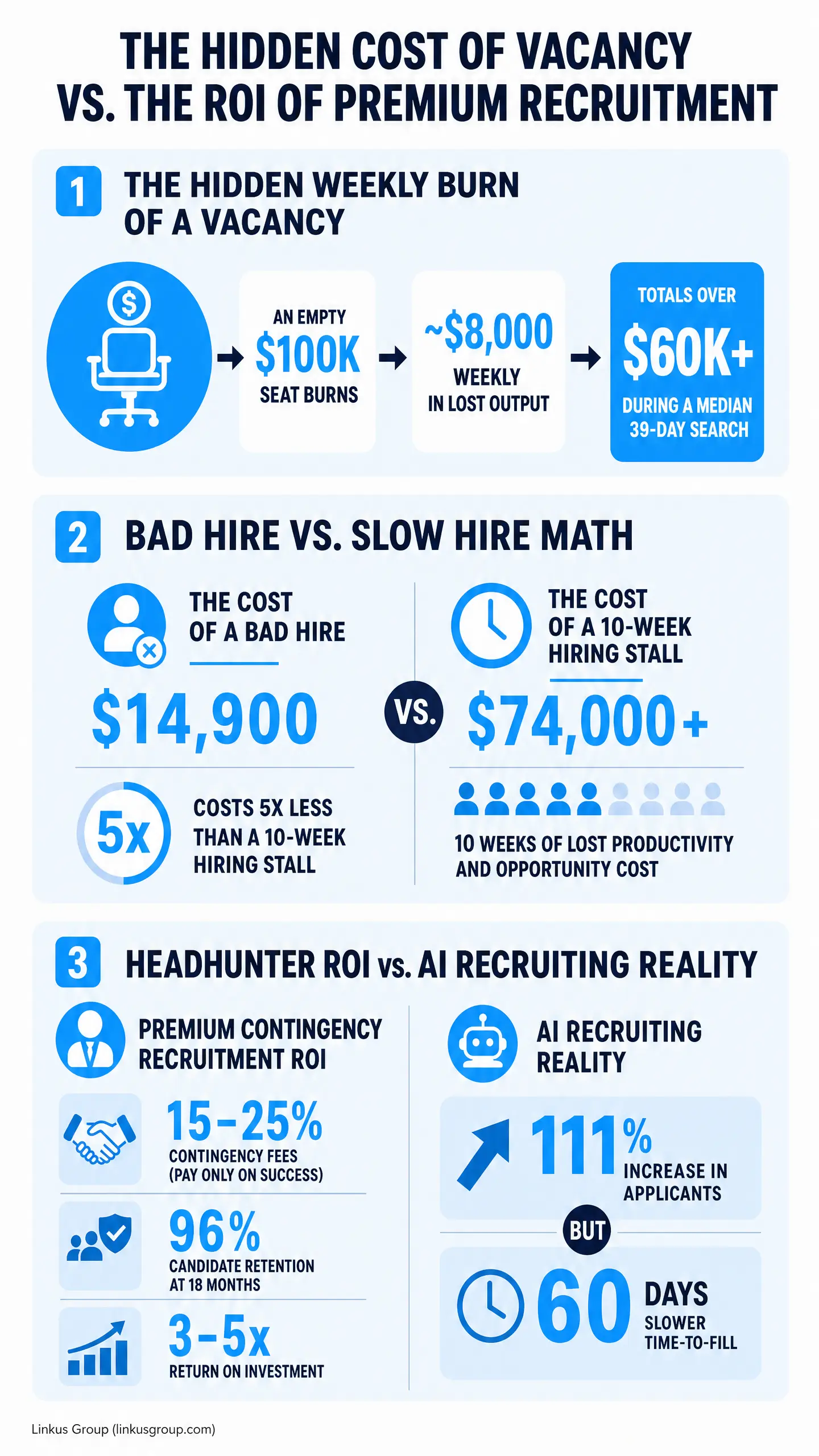
The empty seat is the most expensive position in your company. It produces nothing and still costs you around $8,000 a week.
It never sends an invoice, so you spend your energy haggling a recruiter down two points on fee while a 39-day median search quietly drains 60,000 dollars in output.
You run out the clock bracing for the $14,900 bad hire. The caution you exercise to avoid it costs five times more, and you authorize that expense by doing nothing at all.
Key Takeaways
- The $14,900 average cost of a bad hire is significantly less than the $80,000 in lost revenue output caused by a 10-week vacancy for a six-figure role.
- Greenhouse data reveals that while automated job applications increased 111% since 2022, the median hiring time-to-fill simultaneously extended to nearly 60 days.
- Public procurement agreements frequently establish contingency direct-placement fees for non-executive recruitment roles at 25% of the candidate's first-year salary.
- Linkus Group evaluates job candidates using the proprietary TAG (Trust, Attitude, Grit) and PREP (Potential, Research, Enthusiasm, Polish) behavioral screening frameworks.
- Startups offering below-market salaries must provide equity worth roughly double the foregone cash over the vesting period to successfully compete against higher corporate compensation packages.
- According to a Journal of Political Economy field experiment, employee referral programs reduce staff attrition by 15% while simultaneously lowering overall labor costs.
- SHRM data indicates that the average internal cost-per-hire for nonexecutive roles reaches $5,475, still only 20% of organizations actively track the quality of those hires.
What Are the Standard Headhunter Pricing Models and Fees in 2026?

At Linkus Group I've priced recruiting as hourly, flat-rate, subscription, and contingency. I didn't study these models. I ran them, with my own payroll on the line. Each one behaves very differently once the contract is signed.
How Much Do Contingency Headhunters Charge for Direct-Placement Fees in 2026?

You pay nothing until someone signs. And these percentages aren't invented for blog posts. Dig through public procurement files and you'll find a school board's staffing agreement pegging direct-placement fees at 25% of first-year salary. That's the real high end for non-executive roles, sitting in a signed contract.
We run contingency, and the reason is incentive math. If the candidate isn't quality, you don't hire, and we don't eat. My team doesn't even make outbound sales calls. Every person is on client delivery, because a model that only pays on results forces exactly the behavior you want from a partner.
What Are the Fees for Retained Headhunter Search Models in 2026?
The big firms take a retainer in installments. A chunk upfront, a chunk at shortlist, a chunk at hire. Heidrick & Struggles states it plainly in their own annual report: retained firms are generally paid regardless of whether you hire. Read that fine print before you sign anything.
I'll say the quiet part too. When a search firm sponsors a massive golf tournament, you're the one paying for it. A logo has never phoned a candidate on a Saturday night.
Why Are Hourly, Flat-Fee, and Subscription Headhunter Pricing Models Ineffective?

I ran all 3 dropped every one, because the problem is structural. Pay a recruiter for time and process becomes the product. Extra interview rounds, weekly status decks, activity theater. Layers get added so it looks like more work is happening.
On the cheap end, a discount is a preview of the effort. If you want high-performance output, you pay high-performance rates, the same way a salary-cap team still pays up for its top line. Nobody wins a championship on a discount roster.
What Is the Financial Cost of an Unfilled Job Vacancy in 2026?
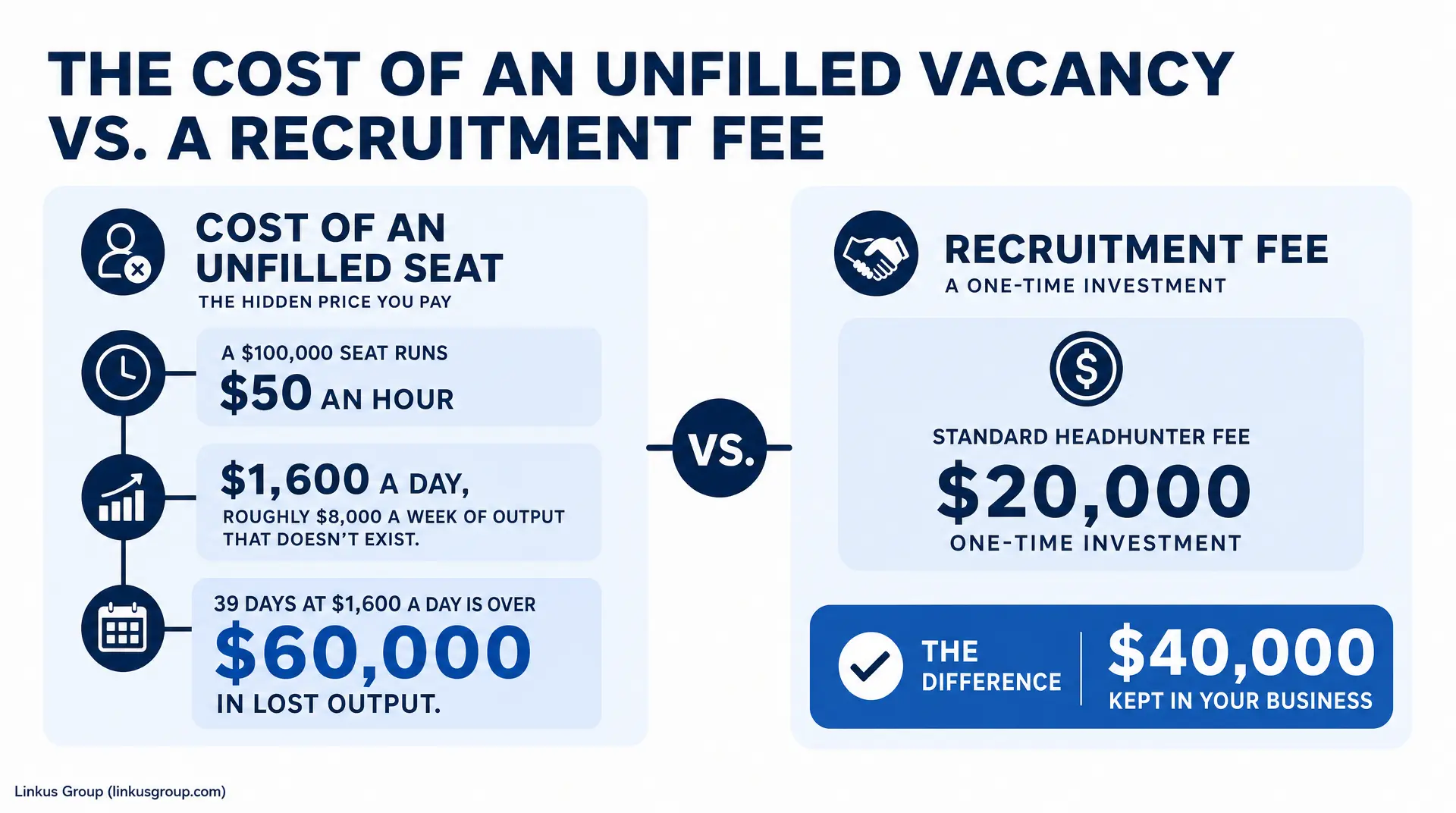
Now for the cost you actually control. Take the role's annual salary and divide by 2,000 working hours. A $100,000 seat runs $50 an hour. But you're not hiring to break even. The revenue-critical seats founders fill at this stage should return three to five times salary. Call it $200 an hour. That's $1,600 a day, roughly $8,000 a week of output that doesn't exist while the chair sits empty.
Now stack the market's pace against that burn rate. SHRM's 2026 benchmarking of 4,600+ organizations puts median time-to-fill at 39 calendar days, and more than two in three companies struggled to fill roles at all. Thirty-nine days at $1,600 a day is over $60,000 in lost output. On the median search. Before anyone has mentioned a fee.
I watched this play out with an Amazon e-commerce brand we supported. One unfilled manager seat put them at risk of inventory mistakes and hundreds of thousands of dollars in lost weekly revenue. One seat. And still, recruiting is the only department in the company that you try to throw less resources at to get it right. Nobody starves their sales tooling and expects more pipeline. Founders do exactly that with hiring, constantly.
How Does the Financial Cost of a Slow Hiring Process Compare to a Bad Hire?
CareerBuilder's survey found 74% of employers have made a bad hire, with the average damage pegged at $14,900. Founders treat that $14,900 like the monster under the bed. Run it against the vacancy math above. A 10-week stall on a $100,000 seat burns about $80,000 in lost output. The thing you're terrified of costs five times less than the thing you're doing to avoid it.
Hire slow, fire fast is the biggest lie ever told in hiring. You never have to fire if you hire really well. And the slowness doesn't even buy safety. Give a hiring team 10 weeks instead of 2 they don't reduce risk, they add rounds. Speed doesn't kill quality. Not having clarity does.
I watched a company win a major bank contract, then lose the entire project to a competitor because they couldn't hire the three people it required fast enough. Their interview process was never aligned to the project timeline. The recruiting fees they were avoiding were a rounding error against what that contract was worth.
Speed is the one advantage a small company has. You can meet a candidate Monday and put an offer out Wednesday. A 10,000-person enterprise cannot. When a free agent hits the market, the team that moves decisively signs them. The team scheduling a fifth interview reads about the signing in the news.
What Services Should a Premium Headhunter Recruitment Fee Include?
Anyone can source resumes. Anyone. If your recruiter's main output is a stack of PDFs, you're overpaying at any percentage. So let me spell out where the fee should go.
It starts with discovery, because jobs are really just business problems that companies need to solve. Most founders hand me a three-page unicorn description, someone who can code, sell, and run ops for a below-market salary. We strip it down to the single business problem the hire has to solve. Job descriptions suck. If they worked, I'd be out of a job.
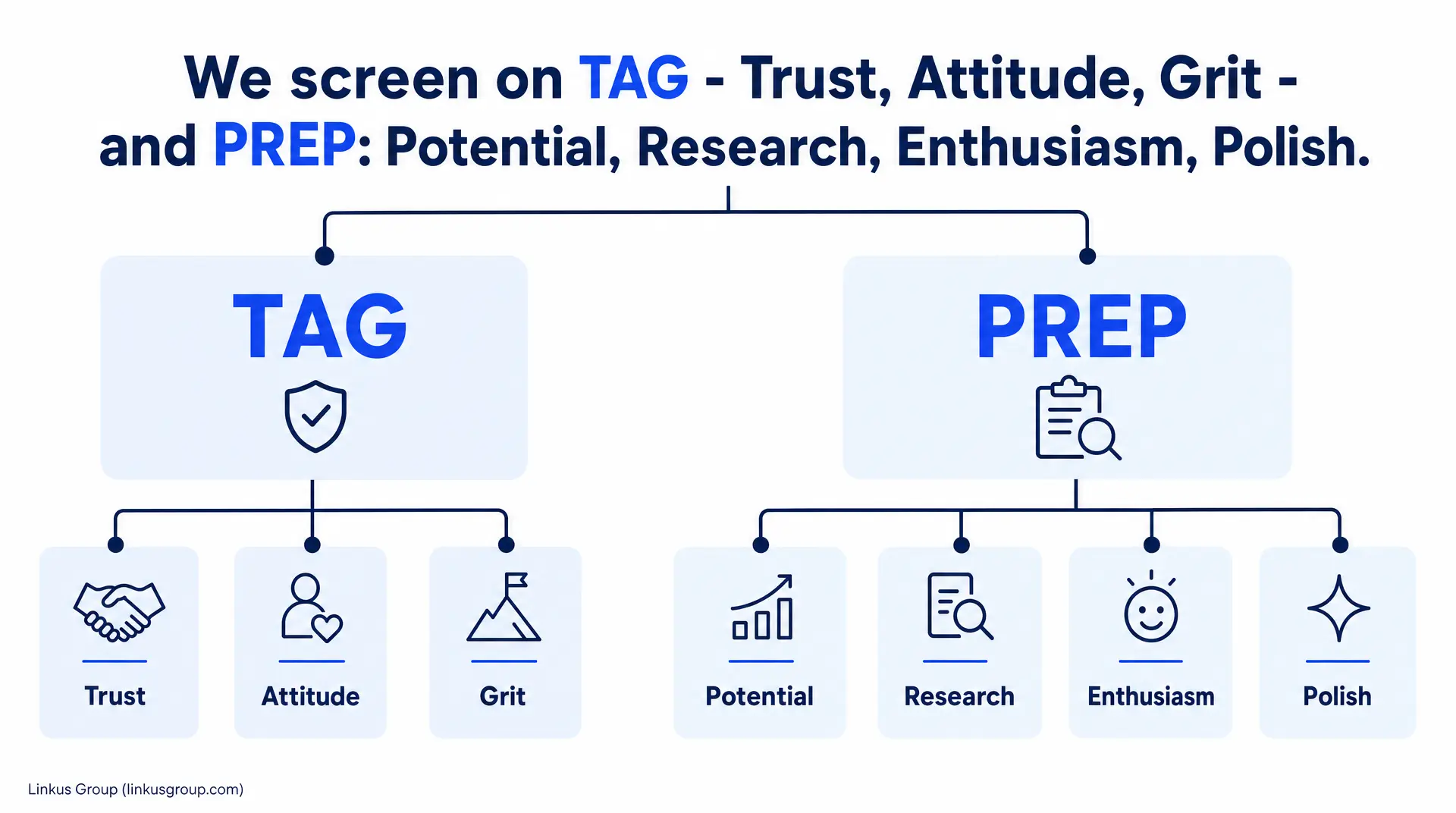
Then comes the vetting, which is where the actual skill lives. We screen on TAG – Trust, Attitude, Grit – and PREP: Potential, Research, Enthusiasm, Polish. The interviews run like a podcast, unscripted, with the same ground covered from different angles to see if the answers still line up. On trust, I'll tell a candidate straight: we handle salaries and sensitive customer information, so how do I know we can trust you in those situations? Give me examples. Twenty minutes later I'll circle back to the same territory from another direction, because rehearsed answers fall apart on the second pass. My favorite grit question is asking where they found a way to work less. People get candid, and candid tells you everything.
And then, one candidate. Not 30. Think of Don Draper pitching. You don't bring 10 ideas so the client gets confused, you bring the one you'd stake your name on. We deliver a vetted candidate within 48 hours, most placements close in under a week, and usually companies hire the first person we send them. Capisce?
The rest of the fee buys the partnership itself. We sit inside your Slack or Teams, answer on weekends when you're sweating an offer, and refuse to work with your direct competitors, which means we can recruit from them for you. We also grade ourselves on time to quality of hire, which apparently makes us weird. SHRM found only 20% of organizations track quality of hire at all. The industry measures speed and volume and skips the one outcome that matters.
What Is the Return on Investment for Hiring a Premium Headhunter?

A right hire in a revenue-critical seat should return three to five times salary. I'm talking about the seats founders fill at this stage, not every role in a giant org chart. On a $100,000 hire, that's $300,000 to $500,000 of value against a $20,000 fee.
And it compounds. Our placements hold a 96% retention rate at 18 months. I've watched candidates we placed go from a $70,000 salary to $500,000 and an exit with the company, and then the founder started their next business and hired that same person back as a co-founder. That's what alignment looks like over a decade.
Now the caveat I owe you. Hiring is never going to be 100% perfect. I once recruited a genuine top performer out of Microsoft for a biometrics startup. Twelve years at Microsoft, wanted a change, everything aligned. The startup environment wasn't for them, they left on good terms, and Microsoft hired them back. That's how good they were. You can run a million tests and still get one wrong, because humans are humans. The job is reducing your risk, and that reduction is what you're paying for.
One more thing no fee can buy: 90% of recruiting is the onboarding process, and that part belongs to you. Gallup finds only 12% of employees strongly agree their organization does a great job onboarding, and it can take a year or more for someone to hit full speed. Pay a premium fee and then throw the hire into chaos with no ramp plan, and you've torched your own investment.
How Can Startups Compete With High US Salary Offers Using Equity Levers?

Most zero-to-one founders I work with can't win a cash war, especially Canadians staring down US offers running 50% higher. Fine. Do the equity math honestly instead.
If you need a $200,000 operator and can only pay $100,000 in cash, that person is handing you $100,000 of hard-earned money every year on faith. The equity has to be worth roughly double the foregone cash over the vesting period. Offer less and the strong operators finish that math in their heads before you finish the pitch. Then they take the US offer.
You have three levers: location, compensation, and requirements. Pull at least one. I had a client with terrible Glassdoor reviews who wanted to underpay for very specific experience after burning bridges across their own industry. We told them straight: change one of those three levers or we're not the right fit to help you, and come back if anything changes. That conversation cost us short-term revenue. It was still the right call, because no fee structure on Earth fixes an offer the market has already rejected.
As for keeping people once you have them: they don't leave companies, they leave leadership. A US firm can beat your salary. It can't beat a leader people want to build with, real ownership, and a growth path you've made crystal clear.
When Should a Company Avoid Hiring a Headhunter for Recruitment?

Check your network first. A field experiment in the Journal of Political Economy found employee referral programs cut attrition by 15% while lowering labor costs, and that matches two decades of what I've seen. Referred candidates come in on trust, not a polished resume. If a strong referral exists, take that meeting before you call anyone.
Don't pay a headhunter if you won't compromise, either. When the requirements are delusional for the budget, a fee fixes nothing, and I'll say so before taking your money. And don't hire us if you need 30 resumes to feel safe. That's a volume game, we don't play it, and frankly it wastes your calendar more than ours.
Just don't confuse skipping the fee with hiring for free. SHRM pegs average internal cost-per-hire at $5,475 for nonexecutive roles, before you count a single founder hour. Posting a job and trying to do hiring internally is just the bare minimum, a salesperson making 10 calls a day and calling it a strategy. A founder running their own search is a founder cutting their own hair. You can do it. It shows.
Why Do AI Recruiting Tools Fail to Replace Human Headhunters for Passive Talent?
A founder with a scraping tool can message 10,000 candidates in 30 seconds. I know, because we use the same tools. Access isn't a moat, it's distribution.
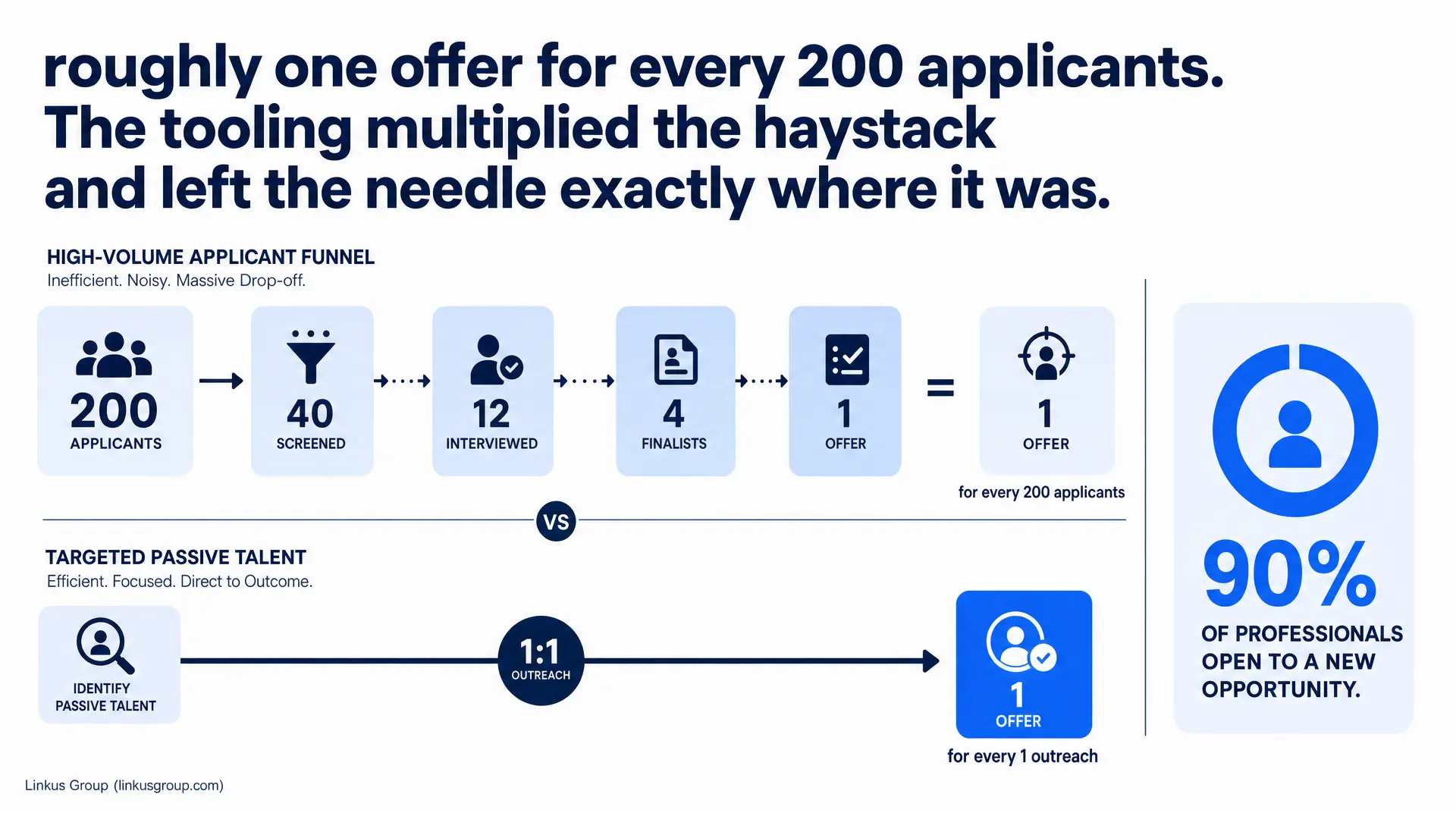
Look at what all that distribution actually produced. Greenhouse analyzed 640 million applications and found applications per job jumped 111% since 2022 while time-to-fill still stretched 37%, to nearly 60 days. More noise, slower hires. Gem's funnel data shows roughly one offer for every 200 applicants. The tooling multiplied the haystack and left the needle exactly where it was.
Meanwhile, the people you actually want are rarely in the applicant pile. LinkedIn's research showed 90% of professionals open to a new opportunity as far back as 2016, and that matches my daily reality. But they say yes to a person they trust, often on a weekend call, because they're deciding where to spend a chunk of the 90,000 hours of their working life. A bot doesn't get invited to that conversation. We bring the tools plus 15 years of judgment, and the second half is what the fee is for.
What Is the Cost-Benefit Analysis of Hiring a Headhunter Versus an Unfilled Vacancy?
Budget 15 – 25% of first-year salary for contingency, about a third for retained executive search. On a $100,000 hire, expect around $20,000, paid only when someone signs if you pick the right model.
Then run the numbers that matter more. The empty seat burns roughly $8,000 a week. The median search drags 39 days. The right hire in a critical seat returns three to five times salary and, at our shop, sticks around 96% of the time at the 18-month mark.
The whole idea of great hiring has never changed: the best person for the job, in the shortest amount of time, for the lowest cost. Hiring isn't free and never will be. But the empty chair isn't free either. It just bills you quietly, every single week, whether you notice or not.
Frequently Asked Questions
Can I negotiate a lower contingency fee percentage?
You can try, but a discount is just a preview of the effort. If you haggle a recruiter down two points, they prioritize clients paying full freight. Nobody wins a championship on a discount roster. If you want high-performance, fast output, pay the market rate.
Do headhunter fees apply to the equity portion of a compensation package?
No. Fees are calculated on first-year cash. Korn Ferry benchmarks fees at one-third of first-year cash. If you leverage equity to offset a low base salary to compete with US firms, your placement fee scales down with that cash number, preserving your runway.
How much more expensive is an executive search compared to an early-stage role?
Executive placements demand a massive premium. SHRM data shows executive direct recruiting costs are nearly 7x higher than standard roles. Retained firms charge a one-third fee. It is expensive, but a bad executive hire will definitively destroy a small startup's culture.
What happens to my fee if the new hire quits after 30 days?
A premium partner provides a replacement guarantee, usually for 90 days. If the candidate sneaks around hard work or quits, a true partner refills that seat at no extra cost. We vet ruthlessly to prevent this, but humans are unpredictable. Demand this clause before signing.
Should I use a temp-to-hire model to avoid paying a full placement fee upfront?
No. It feels safer, but it severely limits your talent pool. An elite, passive operator will not leave a stable role for a trial run. Plus, contract-to-hire conversion fees often start at 25% anyway. Commit to the hire, or don't hire at all.