

Every logo hire is an alibi. Founders reach for the famous name because failure attached to it is forgivable, while failure attached to an unknown ends the career of whoever signed off.
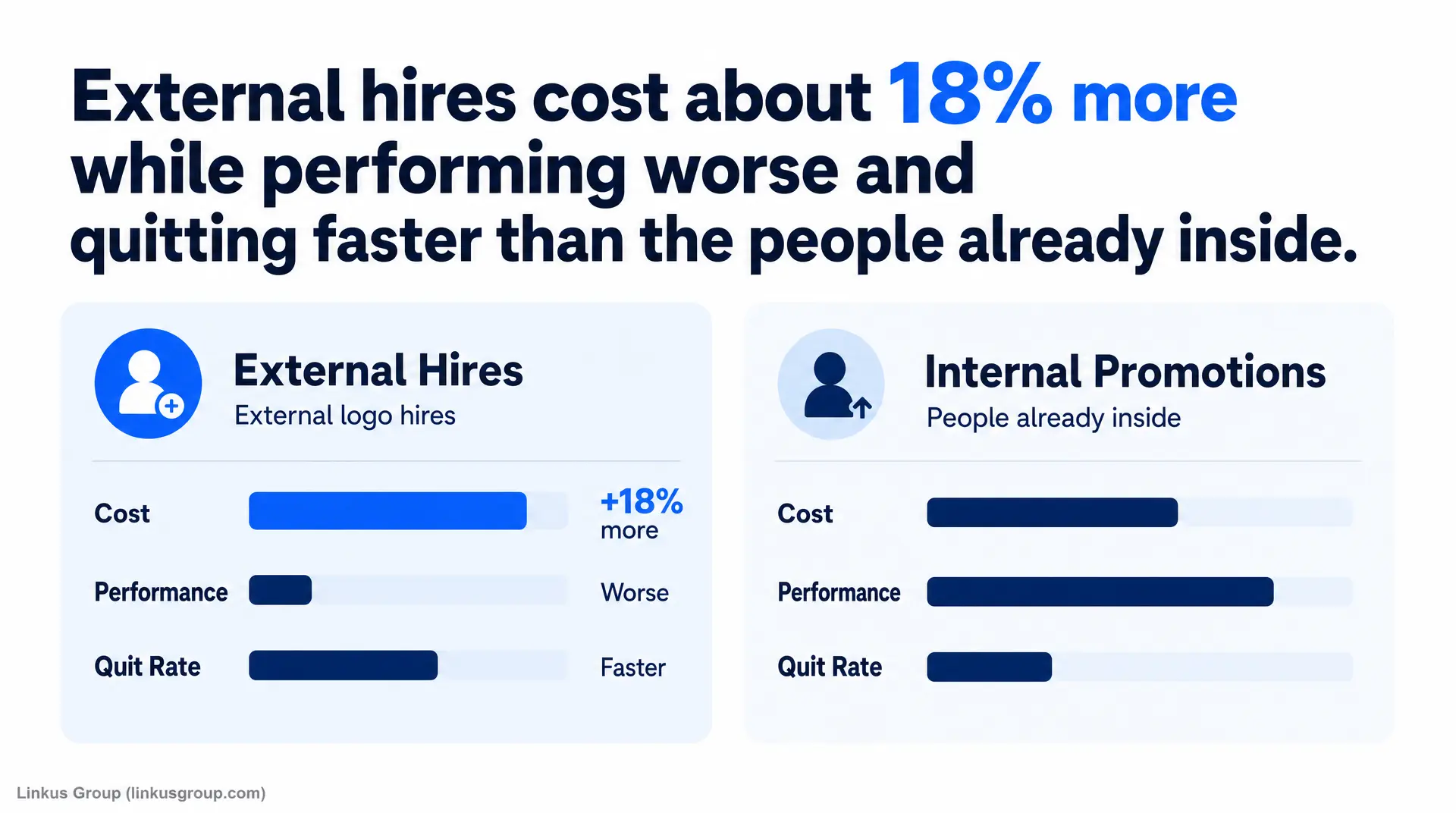
The board calls this de-risking, though bank personnel records show external hires cost about 18% more while performing worse and quitting faster than the people already inside.
The operator you imported to buy safety will spend your entire scaling window asking for the budget and the brand they used to have, and you will pay for it in the one currency you cannot raise more of.
Key Takeaways
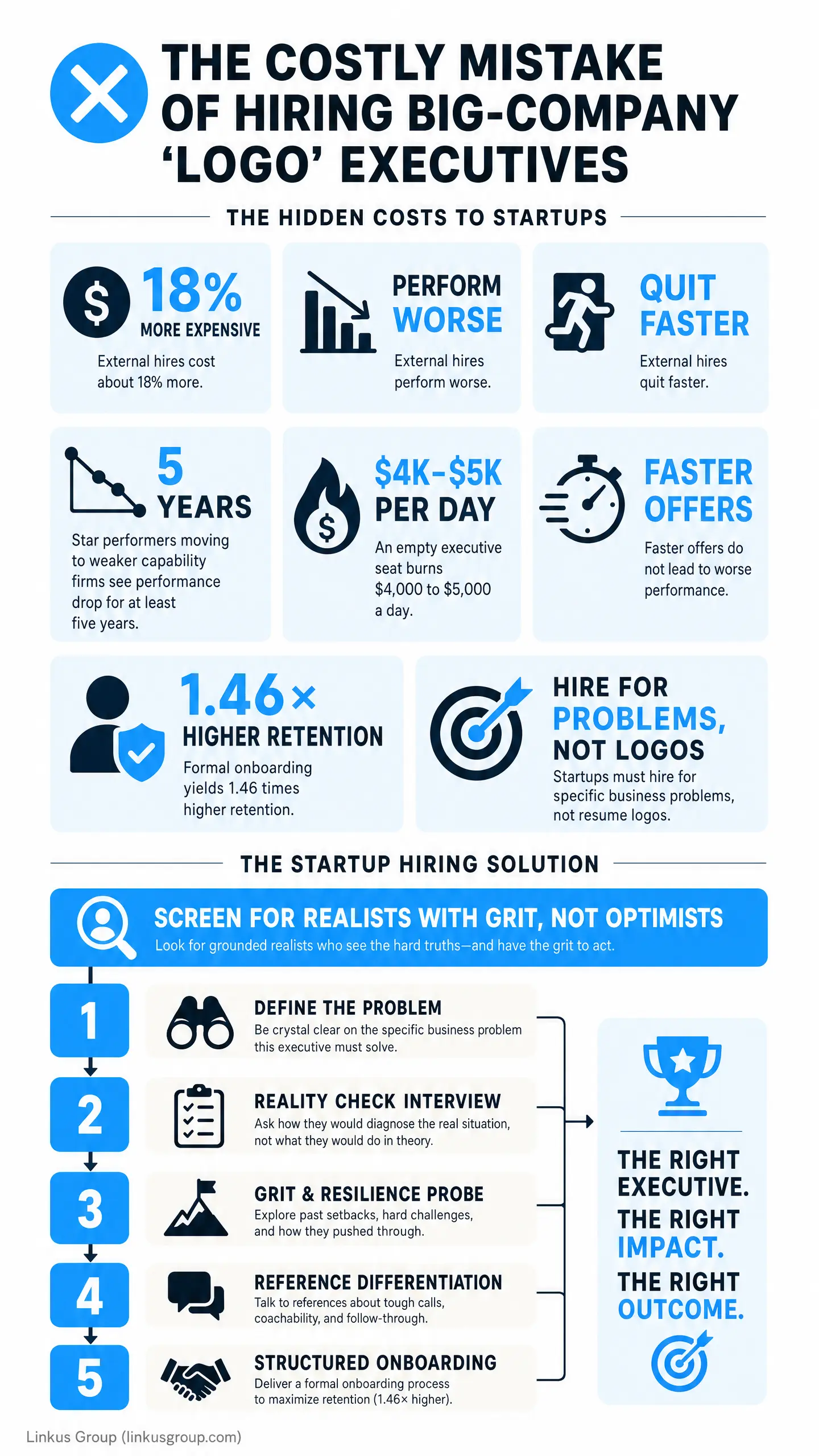
- External executive hires cost approximately 18% more while performing worse and quitting faster than internal promotions.
- Leaving an executive seat empty while pursuing a high-profile candidate costs startups between $4,000 and $5,000 per day in lost return on investment.
- Star Wall Street analysts who switch to firms with weaker capabilities experience a performance decline lasting at least five years.
- Extending faster job offers increases candidate acceptance rates without negatively impacting employee performance or turnover, based on a field study of 3,012 candidates.
- A study of 600,000 employees demonstrates that individual output follows a power law, supporting the strategy of hiring fewer exceptional operators over expanding headcount.
- Implementing formal onboarding programs provides newly hired startup employees with 1.46 times higher odds of long-term retention.
- Hiring managers can screen executive candidates by requiring them to reverse-engineer a previously built system and detail how they would train new employees to run it.
Why Do Big-Company Executive Track Records Fail in Tech Startups?
There's a term for what a big-company operator does well. I can never remember it. What it means is the ability to move something forward when the company is already established and the logo is already known. They've got warm pipeline, real budgets, a brand that opens doors, and a system big enough to absorb a mistake.
That skill is real. It also stays behind when they leave.
Researchers tracked star Wall Street analysts who switched firms. Performance fell immediately and stayed down for at least five years. The steepest drops hit analysts who moved alone or moved to a firm with weaker capabilities. A Series A startup is, by design, a firm with fewer capabilities than Google. That study is describing you.
Jobs are really just business problems companies need to solve. A big-logo resume tells you what problem someone solved with a big logo's resources. It's like signing a free agent who put up huge numbers on a stacked roster and expecting the same stat line on an expansion team. Everything is contextual. That was the whole ed tech lesson.
What Is the True Financial Cost of a Bad Executive Hire at a Tech Startup?
Look, I tell every founder this and most don't believe me until they've lived it: you lose more money spending more time than hiring the wrong person. The logo hire does both at once.
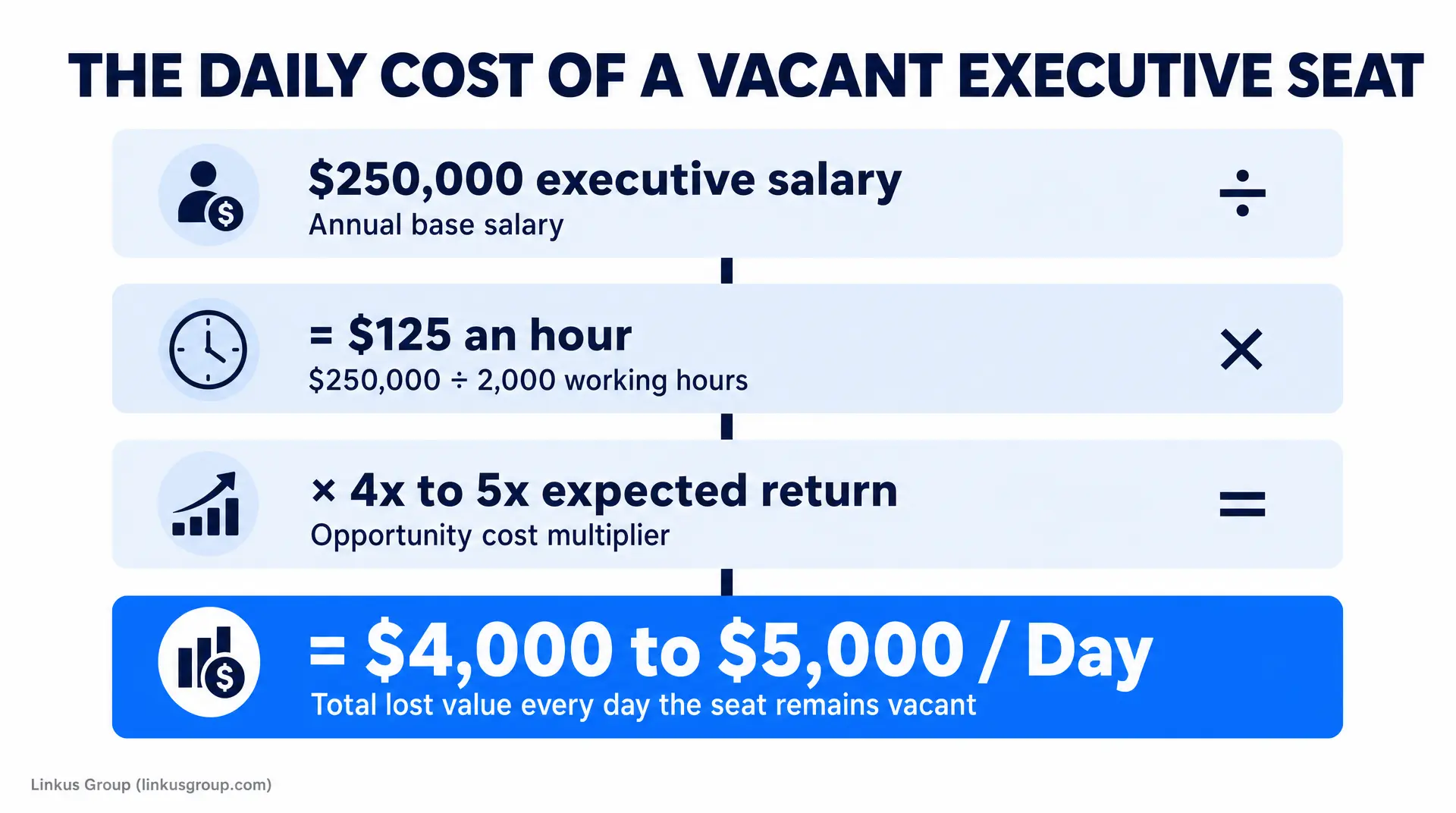
Run the math with me. Take a $250,000 executive. Divide by 2,000 working hours and you're at $125 an hour. Every hire should return three to five times their salary, so multiply by four or five. That empty seat costs you $500 to $625 an hour, call it $4,000 to $5,000 a day. An executive search that drags for a quarter has burned six figures before your logo hire has a laptop.
Now run the clock through the whole life of the mistake: months of ramp while they ask for budget you don't have, the quiet exit, the restart. Your best people cover the gap the entire time, and that exhaustion is exactly what pushes good employees out the door. One empty seat becomes three.
A study of investment-bank personnel records found external hires earned about 18% more than people promoted from inside, performed worse for their first two years, and were more likely to quit or get let go. Pay more, get less, start over.
Why Do Tech Startup CEOs Continue to Make Bad Executive Logo Hires?
I've seen this a thousand times, and it usually comes from two places.
The first is your board. When investors say logos, logos feel like insurance. Nobody wants to be the person who hired the risky candidate who failed. Everyone's fine being the person who hired the safe candidate who failed.
The second is bias dressed up as rigor. Internal managers walk in tied to an outcome, whether that's a referral from a buddy or a resume so strong the decision was made before the first call. Or they lean on a personality test, which I think is mostly a stalling tactic so nobody has to own a mistake. Most people come into hiring with a bias and keep putting in the same ingredients.
Then the whole thing falls apart at the very end, because someone who won't live with the outcome of the role gets a veto.
This is how it usually starts at your stage. Your seed-stage superstar, the generalist who thrived in chaos, has hit a ceiling. You need a specialist, and the safest-looking one has the biggest brand on LinkedIn. That's the overcorrection. You skip the builder who has done this at your stage and reach for the operator who has only done it with 10 times your resources. I watch founders hire the executive who took a company from $10 million to $50 million when their own business hasn't cleared $5 million.
How Can Tech Startups Screen Executive Candidates Without Slowing the Hiring Process?

Your instinct after a bad logo hire is to add process. More rounds, a case study, a personality test. Don't. In my experience, time doesn't improve candidate quality. Give a hiring team a longer runway and they expand the process to fill it, then take the same risk later. A field study of 3,012 candidates found faster offers were accepted more often and did not lead to worse performance or higher turnover. Speed has never killed a hire for me. A lack of clarity has killed plenty. Get clear on context, then move.
How Can Startups Screen Executive Candidates by Working Backwards From Training?

If a candidate claims they built a department or a playbook, have them show you the system. If it's public-facing, pull it up on the call. If it's under NDA, have them walk you through every stage of what they built, why they built it that way, and who was involved.
Then flip it. Ask how they'd train someone to run it. Someone who built the thing can reverse-engineer it on the spot. Someone who inherited a functioning machine gets vague fast. Follow with "who on your team can verify this?" and actually make the call. Then hand them a live scenario: "If you were building this here, how would you go about it? Ask me the questions you'd need." The questions they ask tell you more than any answer.
For a sales leader, the equivalent is a mock call or a seat in a real customer meeting. Ask them to close you on why this move is right for them. You need salespeople that can sell an unknown logo, and one real conversation tells you whether they can.
Why Should Tech Startups Screen for Realist Executive Candidates Over Optimists?

Skills can be taught. Attitude and drive can't. When I test whether someone can jump from a giant to a startup, I look for self-awareness, realism over pure optimism, and a desire to understand instead of a need to be right.
The optimist says, "Oh, I can definitely do this." The realist asks what the marketing budget actually is, how many people are on the team, and what happens when the first quarter misses. I want the realist. Then it always comes down to TAG: trust, attitude, and grit. At your stage, grit means persevering inside a company that's harder than the one they left.
Why Must Startups Eliminate Expectation Surprises Before Making an Executive Job Offer?

Everyone hates surprises, so say it out loud before the offer. This role needs a lot of autonomy and a lot of ambiguity. The budget you had isn't here. The teammates aren't here. Mistakes are a hundred times bigger and you can't hide behind them.
For an executive seat I push founders to simulate living together first. Weekend conversations, a shared meal, watching how they treat the server. If the chemistry isn't there when it's easy, it won't survive a tight payroll month.
Who Should Tech Startups Hire Instead of Big-Name Executive Logos?

The person that's going to do the best in the job is usually the person you'd least expect. I'll stake my reputation on that.
I had to push a technology client hard to interview a CTO candidate whose resume didn't match their industry. That CTO helped them raise a Series A and a Series B, then co-founded new ventures with the same team. I've also watched a hiring team dismiss someone for short tenures and a lack of specific schooling, then meet them and realize those exact things were the candidate's biggest strengths. Potential is about where someone is going, far more than where they've been.
These people are usually employed, often at your competitor, and they aren't scrolling job boards. That's why we refuse to work with our clients' competitors. We need to lift up every rock.
How Should Tech Startup Founders Discuss Headcount and Hiring Strategy with Board Investors?

When investors push headcount, I say the same thing to every founder: whoa, whoa, whoa. Let's plan. Do you actually need this many people? Maybe. Maybe not. Maybe you're hiring too few. Know your revenue per employee before you know your headcount, and define the structural outcome before you decide who fills it.
I advised a 30-person, founder-led legal tech firm to hire single, high-performing salespeople and product managers instead of tripling headcount. They moved methodically, stayed highly profitable, and picked up top talent when competitors went bankrupt. I've told a 55-person health tech company to slow its hiring pace and focus on quality. And I use a food tech company as my standing warning: hire a large volume of salespeople without the right leadership in place and every new rep loses you money.
The research says the same thing. An analysis of performance data on more than 600,000 people found individual output follows a power law. A small number of people carry the results. Hire less better people, pay them properly, and show your board what one exceptional operator returns against what three average ones cost you.
How Should Tech Startups Handle a Failing Big-Company Executive Hire?

I've been on this side of it. I placed a 12-year Microsoft top performer at a biometrics company. Everything seemed to align. They left on good terms, and their own read was simple: they were built for a bigger organization. Microsoft hired them back. That's how good they were. Hiring is never going to be 100% perfect. All you can do is reduce your risk.
When a placement fails, assume a portion of all three causes: the candidate, the company, and the unpredictable. Then ask straight up: could this have been avoided in the interview process? What did we miss, or what did you see and not raise? Is there a pattern in your past hires?
Be honest about the answer, then be fast. At the end of the day, 90% of hiring success comes after the start date. Newcomers who went through formal onboarding programs had 1.46 times higher odds of staying. Audit your onboarding as hard as your vetting. But don't let the seat sit while you process it. That clock from earlier never stopped.
Why Should Tech Startups Hire for Specific Business Problems Rather Than Resume Logos?
No recruiter has a back pocket of candidates. Every candidate is accessible, including the logo. What you have to decide is whether the logo is actually the problem you need solved.
So go get the person who can do this job with your budget, your team, and your stage. When your board pushes back, remind them the most expensive hire in the company is the one who spends your scaling window asking for the resources they used to have.
Frequently Asked Questions
Beyond base salary, why is an enterprise logo the most expensive hiring mistake?
Salary is just the floor. Labor data shows benefits add 30% to carrying costs. Factor in the turnover cost of replacing them, the burned runway, and the opportunity cost of them demanding budgets you lack. It quietly bleeds your startup's margins.
How can we structure interviews to prevent the most expensive hiring mistake?
Stop relying on unstructured chats. Research proves structured interviews predict performance far better, hitting a .51 validity score versus .38 for unstructured formats. Combine structured, scenario-based vetting with cognitive tests to verify actual system-building skills, not just their resume.
If hiring big-company reps is the most expensive hiring mistake, who builds our GTM playbook?
You hire agile playbook builders, not executors. Enterprise reps crash without a massive brand. You need gritty operators who thrive in raw outbound environments. Individual performance follows a power-law distribution. Hire fewer, exceptional builders who can actually close unknown logos.
How do we replace an original co-founder without making the most expensive hiring mistake?
Handle it with extreme discretion and zero surprises. Seed-stage superstars often break the company at Series B. Treat the political transition delicately, but prioritize the business mandate. You need specialized executives who can build scalable systems, not chaos-thriving early generalists.
Does moving fast on an executive offer increase the risk of the most expensive hiring mistake?
No. Speed is your leverage. Lack of clarity is your enemy. A field study of 3,012 candidates proved faster offers secure talent without increasing turnover. Define the structural outcome, verify they can build it without enterprise crutches, and make the offer immediately.