

Every firm that has ever filled a seat for you got paid before anyone knew whether the hire actually worked. The fee clears at the offer letter. Whether that person is still there and still performing a year later is a question you carry alone.
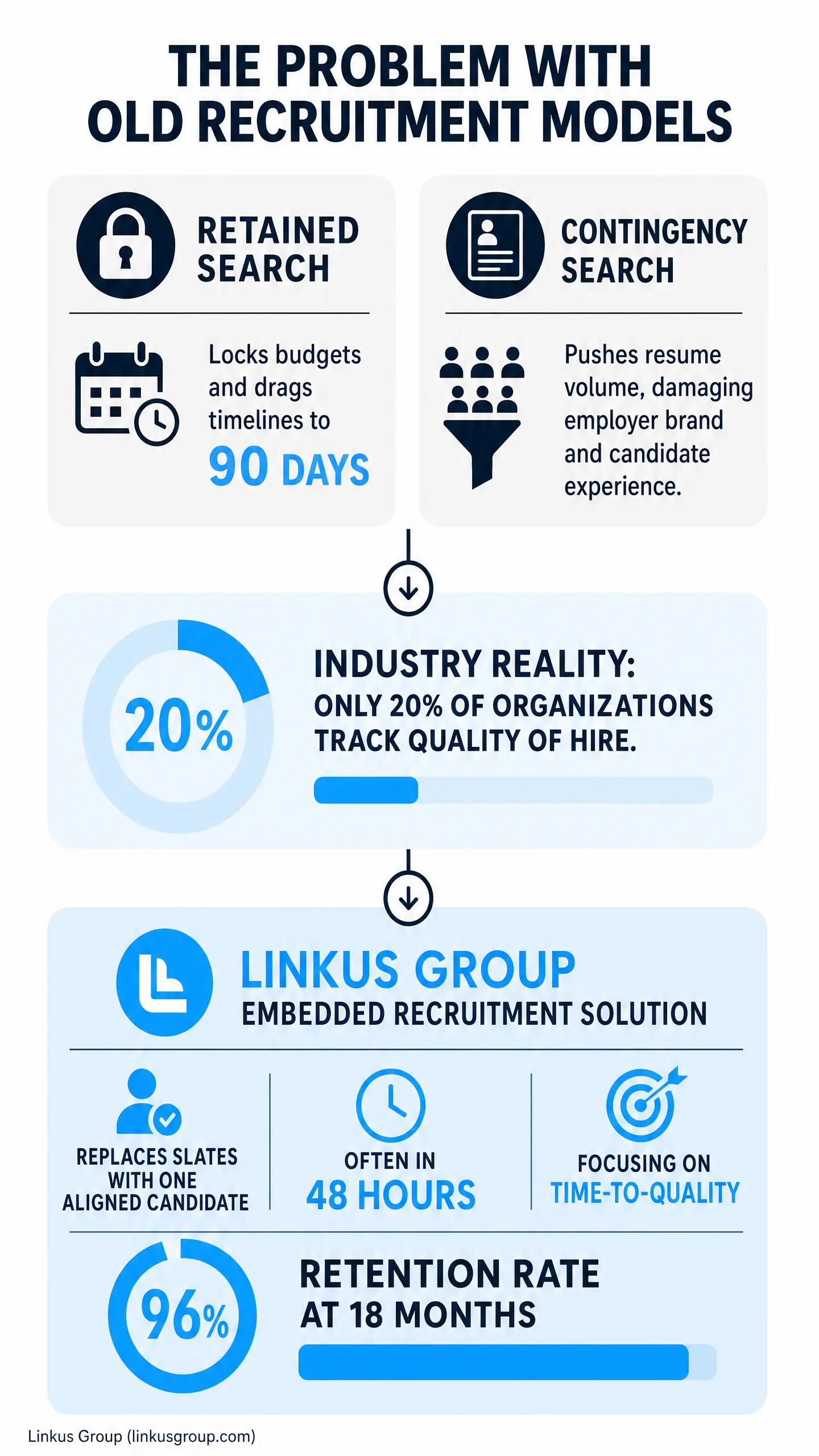
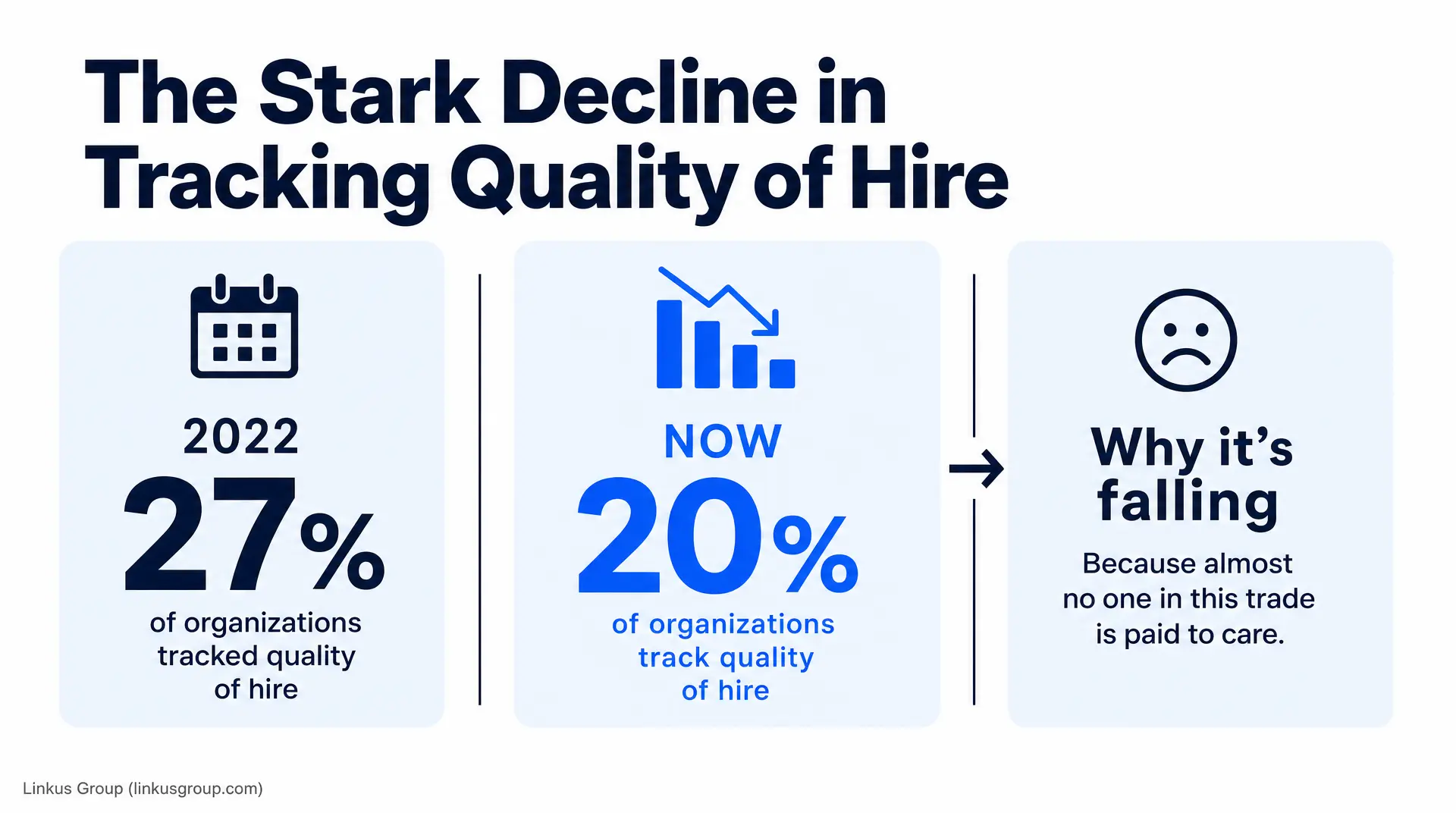
That single gap explains the padded 90-day timeline, the inbox of 30 resumes that miss the brief, and the reports that quote every metric except the one that counts. Only 20% of organizations track quality of hire, down from 27% in 2022, because almost no one in this trade is paid to care.
So you keep getting burned, then keep walking through the same two doors, never noticing that both were engineered around the agency's economics and the delay you end up defending to your board.
Key Takeaways
- SHRM's 2025 benchmarking report reveals that only 20% of organizations track quality of hire, as traditional recruitment models prioritize activity metrics over long-term retention.
- Retained executive search firms often prolong the recruitment cycle to 90 days with unnecessary process layers to justify upfront fees, despite the median executive time-to-fill being 45 days.
- Volume-based contingency recruitment agencies can actively damage a company's customer pipeline, as iCIMS data shows 51% of candidates are less likely to purchase from a brand following a poor application experience.
- Linkus Group's embedded recruitment model replaces traditional 90-day executive search timelines by operating directly inside internal Slack channels, typically presenting a single fully vetted candidate within 48 hours.
- Recruitment agencies that refuse to simultaneously work with a client's direct competitors eliminate the conflict of interest regarding which organization receives priority access to top off-market executive talent.
- Linkus Group achieves a 96% candidate retention rate at the 18-month mark by tying agency compensation to successful placements and transferring comprehensive candidate motivation data into the employer's onboarding process.
What Are the Primary Disadvantages of Retained Executive Search Firms?

Let me be fair first, because I actually respect the retainer in theory. You pay upfront, and in exchange the firm dedicates itself to you. A retainer should mean one thing: hey, you're just focusing on me.
The delivery is something else. Clients who come to us from retained executive firms tell me the same two things every time. The firm dragged on the process. And the fee locked them in, so they couldn't make a change without eating the money.
Think about what that does to your position. Your budget is committed. Day 50 arrives, you're holding three lukewarm profiles, and the founder wants to know why the seat is still empty. You can't fire the firm without writing off the retainer. You can't defend the delay without wearing it yourself in front of the board.
There's a mechanic behind this that most talent leaders never get told. A lot of agencies get paid to do process. Paid to take time. Paid to add layers so you think they're doing more work. The calibration phase, the market map, the weekly steering call. A chunk of that exists to justify the invoice, not to find your candidate.
The 90-day executive search is a billing convention dressed up as rigor. SHRM's 2025 benchmarking puts median time-to-fill for executive roles at 45 days. The market moves in half the time these firms budget for.
And look, some of the old firms have real experience and know-how. But what once made them successful doesn't make them successful anymore. Companies buy the brand because it was marketed well. Maybe the firm sponsored a massive golf tournament, and the assumption becomes that the name guarantees the outcome. We're in a new generation of speed, experience, and quality now. A logo on a leaderboard doesn't source your VP of Engineering.
How Do Contingency Recruitment Agencies Negatively Impact Employer Brand and Candidate Experience?

So you swing to the other door. Contingency. No upfront risk, pay on results. Sounds aligned.
Except most contingency agencies are set up to fail from day one. Their recruiters get paid on volume KPIs. Submissions sent. Redacted resumes pushed out the door, often while racing three other agencies on the same req. The game becomes getting a resume in front of you before the other shop does. Whether it matches what you need barely enters the equation.
You've lived the outcome. Thirty resumes land, none of them fit, and now you're spending your evenings screening an agency's homework while your hiring managers quietly lose faith in external partners altogether.
While that's happening, something worse is going on out in the market. That agency is spraying outreach in your company's name, then dropping candidates cold when they don't fit the next req. Criteria's 2024 candidate experience research found 51% of candidates have abandoned a hiring process over poor communication, and about a third assume they've been ghosted after a single week of silence. iCIMS found 51% of people are less likely to buy from a brand after a bad application experience. So the transactional agency is burning your employer brand and your customer pipeline at the same time, and you're the one who repairs both.
My honest read on the volume game might sting a little. People that want resume pushers are solving a different problem. When a hiring manager demands 15 candidates, they usually want to see more people for the sake of seeing more people, or to keep their internal staff busy. Neither of those fills the seat.
It's like dating. You'll get further going deep with two people than spreading yourself thin across five. If the discovery work was done properly, you shouldn't need 30 resumes to make a decision. You shouldn't need 10.
Why Does a Prolonged Recruitment Process Fail to Improve Candidate Quality?
Retained and contingency firms disagree on almost everything except one belief: that more time and more process reduce risk. Hire slow, fire fast is the biggest lie ever told in hiring. You never have to fire if you hire really well.
Time does not improve candidate quality. I've watched this for two decades. Give a hiring team 90 days instead of 30 they don't get more rigorous. They expand the process to fill the calendar. More rounds. More stakeholders. More chances for someone who doesn't even own the outcome of the role to veto a great candidate at the finish line.
Meanwhile, candidates read your speed as a signal. Move slow and you're telling them they're not your priority, or that you don't know what you're doing. Would you stay excited about a company that showed up unorganized, clearly leaned toward other candidates, and was slow to get you anything you asked for? Neither will they.
I watched this on a Head of Sales search. The candidate came fully prepared. Showed up to a product meeting, provided references, did everything asked of them. The company stalled and said they were too busy with other things. That one sentence told the candidate exactly where hiring sat on the priority list, and top salespeople don't wait around for companies that treat them like an afterthought.
The cost side is even uglier than the signal side. I worked with a company that won a major bank contract and then lost the entire project to a competitor. Their product was fine. Their interview process simply couldn't hire the three people the project needed inside the project's timeline, so revenue they had already won walked out the door.
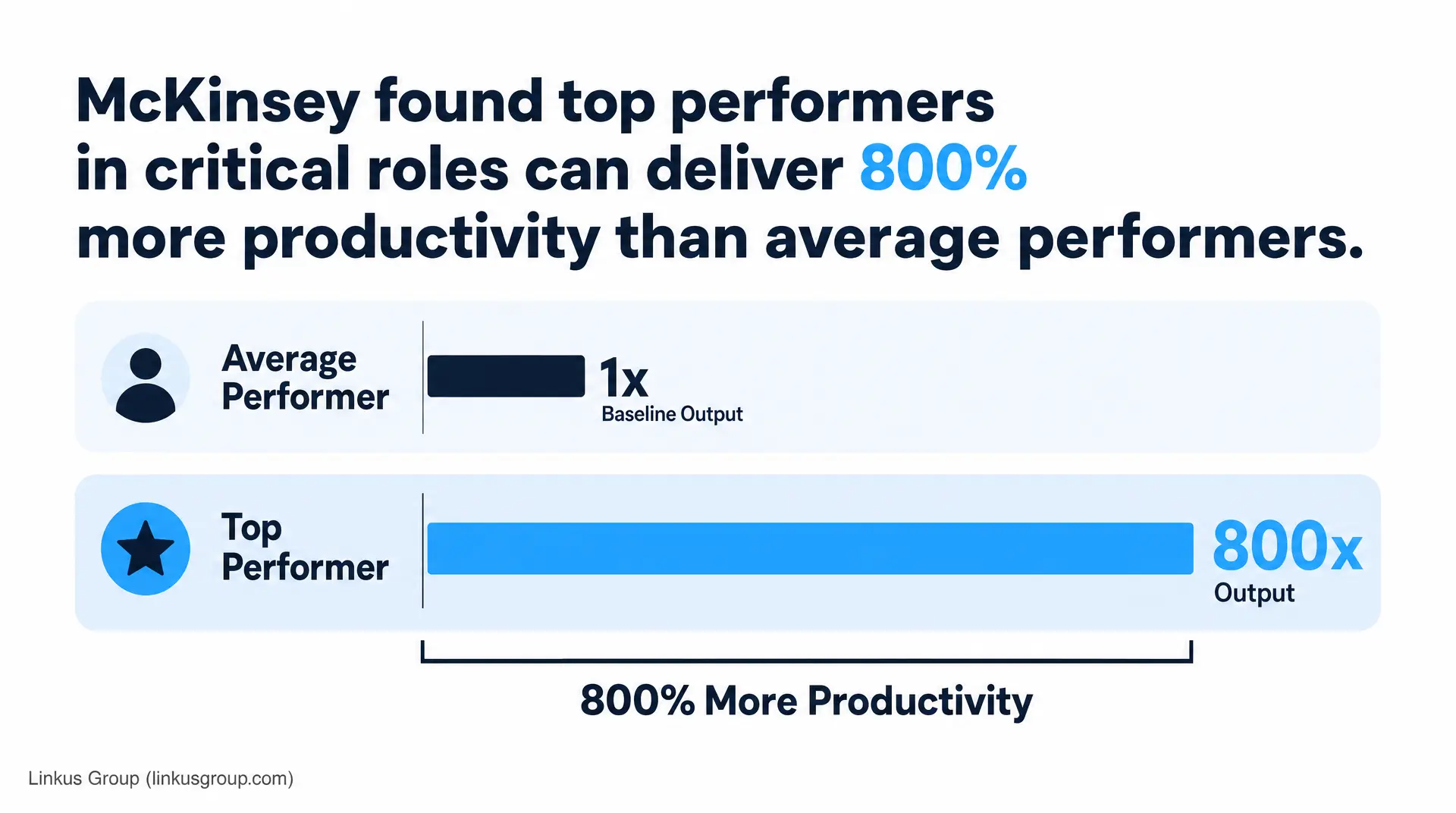
Run your own number on this. Take the role's annual salary, divide by 2,000 to get the hourly rate, then multiply by four or five, because a good hire should generate three to five times their salary in value. That's your daily bleed for an empty seat. On leadership roles it's usually worse – McKinsey found top performers in critical roles can deliver 800% more productivity than average performers. And none of that math counts the burnout of the team covering the gap, which is exactly how you lose the strong people you already have.
Why Is Time to Quality of Hire the Most Important Executive Recruitment Metric?
The deepest failure of both models shows up in what they report to you.
Retained firms report process milestones. Contingency firms report submission counts. Both will happily quote time-to-fill. Almost nobody reports what happened to the hire 12 months later, because almost nobody is accountable for it. SHRM found only 20% of organizations track quality of hire, down from 27% in 2022. The industry is drifting toward activity metrics at the exact moment it should be running the other way.
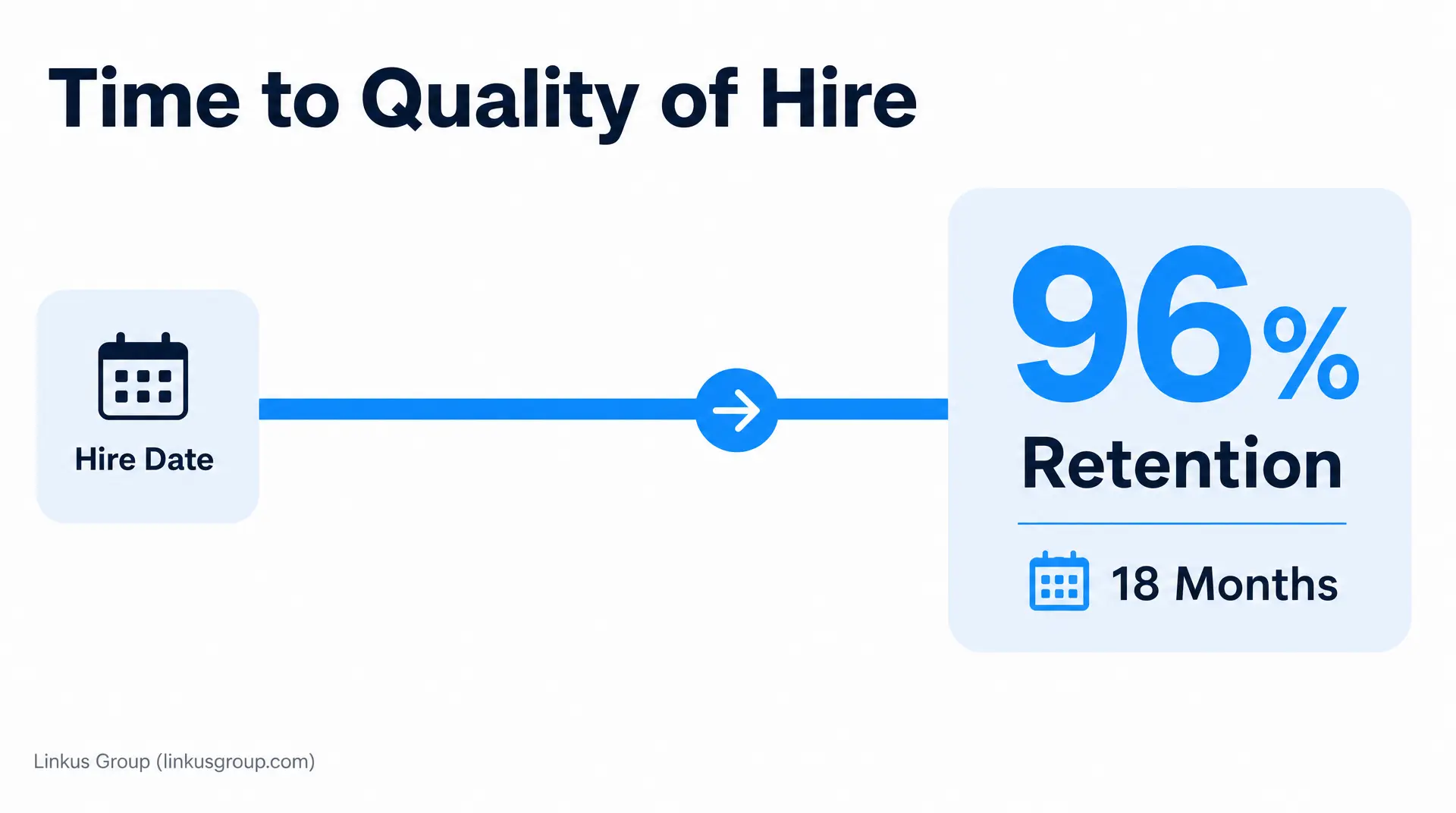
The metric I run my business on is time to quality of hire. How fast did you get someone who is still there and still performing at the 18-month mark? Our placements sit at 96% retention at 18 months. You only hit a number like that when the recruiter has skin in what happens after the offer letter. Which brings me to how we actually work.
How Does Linkus Group's Embedded Recruitment Model Improve Executive Candidate Quality?
I didn't land here from theory. I've tried every single model out there. Hourly, flat rate, subscription, all of it. What I learned is that the choice between retained and contingency was always a false one. You can have retained-level focus with contingency-level accountability. You just have to rebuild the incentives from scratch.
At Linkus Group, we only get paid when you hire. If we don't deliver quality, we don't eat. But we deliver it embedded, the way a retained firm claims to. We work inside your Slack or Teams channels, so a feedback loop that takes a traditional agency a week takes us an hour. When the role shifts mid-search, and it always shifts, we adjust the same day. My team makes zero outbound sales calls. They're 100% dedicated to the clients we already have. And I'm reachable on weekends, because that's when candidates wrestle with career decisions and when your founder texts you in a panic.
None of this competes with the engine you're building internally, by the way. The strongest outcomes I've seen come from pairing your cultural knowledge with our market intelligence. We act as a second set of eyes, go after the passive executives who ignore job posts and InMails, and feed back what candidates are actually saying about your employer brand out in the market. That intelligence alone makes you sharper in front of your founder.
We also refuse to work with your competitors. That rule costs us real revenue, and I'd make the same call tomorrow. If I'm working with your competitor, I can't headhunt from them for you, and there's always a quiet question about whose search gets the best candidate first. Removing the conflict is the only honest way to be a partner instead of just marketing yourself as one.
Instead of a slate, we send one candidate. When you see a finished product, whether it's an Apple device or the plate at a Michelin-star restaurant, there was an enormous amount of invisible work behind it. Somebody vetted the ingredients, tested the menu, threw out what didn't belong. We do that work behind the curtain, then present the one person who is actually aligned, usually within the first 48 hours. And usually, companies hire the first person we send them. Speed doesn't kill quality. Not having clarity does.
Clarity is the unglamorous part, and it happens before we ever touch the market. A founder once asked us for an operations manager who could own P&L management and also operate at CPA-level accounting depth. Two or three people bundled into one job description, and you've watched your own hiring managers write the same req. We didn't debate philosophy with him. We showed him the actual market, who exists at his budget and in his location, and reality did the convincing. He narrowed to the person who solved his single biggest constraint. Jobs are really just business problems that companies need to solve.
One more piece, and from your seat it might be the biggest one: 90% of recruiting is the onboarding process. Gallup found only 12% of employees strongly agree their organization does a great job onboarding, which tells you where most so-called placement failures are actually born. A partner who vanishes at the offer letter did half the job. We hand over everything we learned during the search, what motivates the candidate, what worried them, what they need in the first 90 days, so your onboarding starts warm instead of cold. And if a placement ever goes sideways, we run the post-mortem straight. Could this have been caught in the interview process? Was it onboarding? Did the person's life simply change? No finger-pointing. You can't diagnose the next search honestly if the agency is busy protecting its fee.
What Questions Should Talent Leaders Ask to Evaluate Executive Recruitment Agencies?

When the next agency pitches you, skip their deck and go straight at their incentives.
Ask what keeps them urgent on day 60 if the money landed on day one. A retained firm should have a sharp answer, and most don't. Ask whether they work with your competitors, and if the answer is yes, ask how they plan to headhunt out of a client. Watch how long that answer takes. Ask how many candidates they intend to send, because anyone promising volume is selling activity, not alignment. Ask what they do after the start date, since that's where most of the outcome actually lives. Then ask for their retention rate at 18 months. If all they can quote is time-to-fill, they just told you which metric they're really managed on.
Any talent leader can ask these questions in a first call. Most agencies just aren't used to hearing them.
Why Is Repeat Business the Most Critical Key Performance Indicator in Recruitment?

The retained model fails because the fee arrives whether or not the right person ever does. The traditional contingency model fails because it rewards submission speed over match quality. Both were designed around the agency's economics, and you've been living with the consequences: locked budgets, dragged timelines, flooded inboxes, and an employer brand you keep having to patch.
You don't have to pick between them. Demand the focus one model promises and the accountability the other pretends to have.
My only real KPI is repeat business. Everything I described, the embedding, the competitor rule, the single candidate, the onboarding handoff, exists because of that one number. I want to still be your hiring partner in year 10, when the internal engine is humming and you're the talent leader who made executive hiring look easy.
Hiring is the biggest unlock in a company's business. Stop paying for models that were built to fail you.
Frequently Asked Questions
At what requisition volume should an internal talent team outsource executive searches?
Your breaking point arrives fast. SHRM reports in-house recruiters manage a median of 20 requisitions annually. Piling a complex C-suite search on top of that volume guarantees burnout. Outsource specialized leadership roles so your internal engine can focus on scaling without failing the candidate experience.
How do you justify the cost of an executive search firm to a founder?
Stop defending the fee and quantify the empty seat. McKinsey reveals top performers in critical roles deliver 800% more productivity than average ones. When founders stall on search costs, remind them that a prolonged leadership vacancy bleeds business value and burns out the team covering the gap.
How does a slow recruitment cycle impact passive executive candidates?
It kills your credibility instantly. Around 70% of the global workforce is passive talent. These off-market executives aren't desperate for your job. If you stretch the process to 90 days, they read it as organizational chaos. Top-tier leaders won't wait for a company that treats them like an afterthought.
Why are structured interviews critical for evaluating C-suite executives?
Founders love to go with their gut, which is how bad hires happen. A 2022 review in the Journal of Applied Psychology ranked structured interviews as the top predictor of job performance. Clarity and consistent evaluation guard against unconscious bias, eliminating the need for endless, disorganized interview rounds.
How should an external search partner support executive onboarding?
A search firm vanishing at the offer letter did half the job. Gallup found only 12% of employees strongly agree their organization does a great job onboarding. A true partner hands over the candidate's exact motivations, friction points, and leadership style so you can launch them warmly instead of cold.