

The empty chair is the most expensive employee in your company. It produces nothing, and an open engineering seat still costs you around $2,400 a day.
Founders drag the search out to avoid a bad hire, never seeing that the caution is the expense: six weeks of that empty seat quietly burns past $70,000 before a single offer goes out.
You anchored on the recruiter's $5,475 fee and missed the number that was actually bleeding you.
Key Takeaways
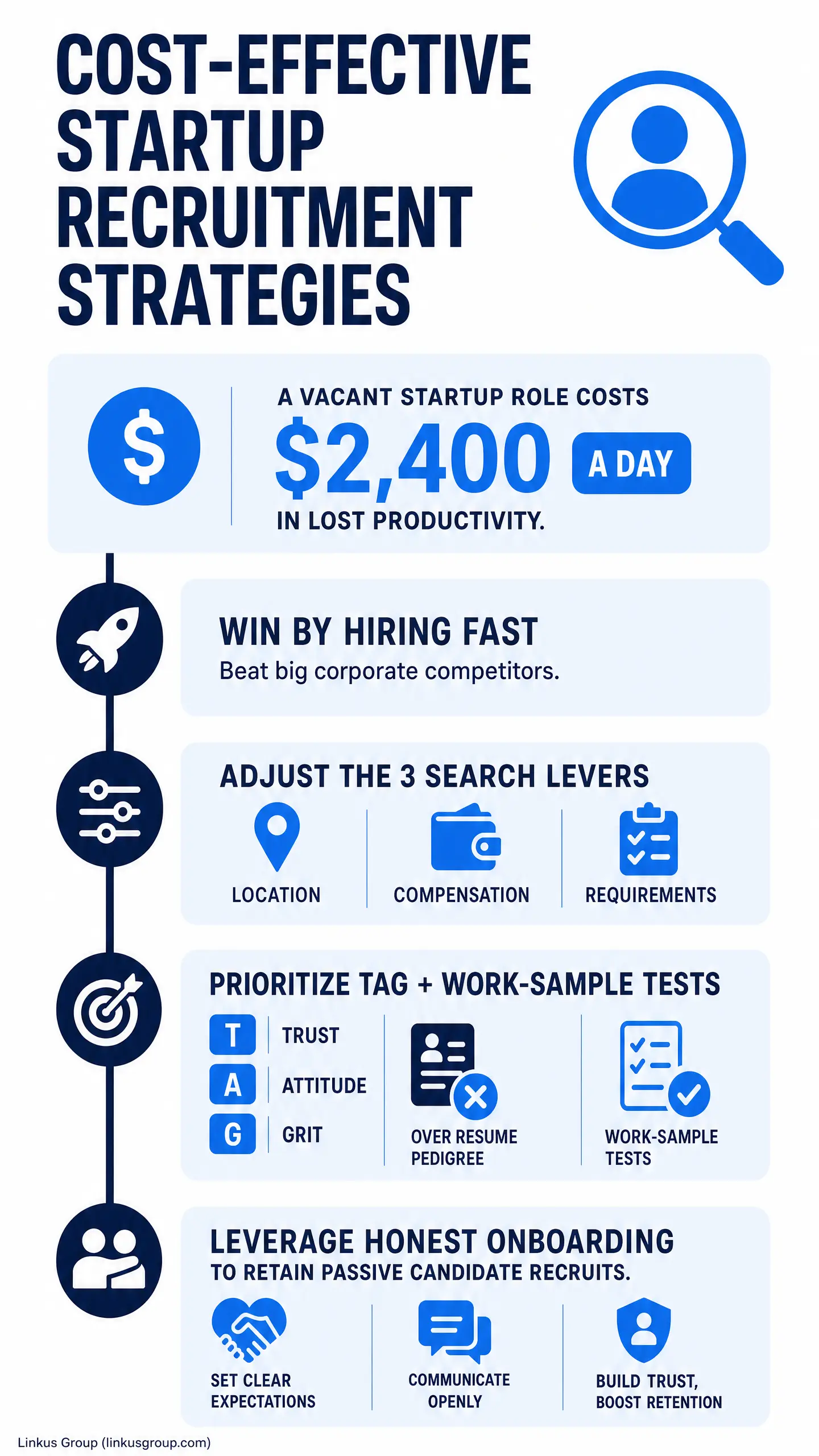
- An unfilled software engineering role costs startups approximately $2,400 a day in lost productivity, burning over $70,000 during an average six-week search before an offer is signed.
- Glassdoor research shows the average U.S. interview process takes 22.9 days, and adding group panels or background checks introduces up to ten extra days of delay that costs startups top candidates.
- Startup founders offsetting a $100,000 below-market cash salary deficit must offer equity valued at roughly $200,000, doubling the candidate's foregone compensation, to make the financial trade-off credible.
- Eighty-five years of personnel selection research indicates that work-sample tests predict candidate job performance roughly twice as effectively as standard reference checks.
- While half of senior outside hires fail within 18 months, setting brutal alignment through realistic job previews helps specialized recruiting firms like Linkus achieve a 96% retention rate over the same period.
- While only a quarter of employed professionals actively seek jobs, LinkedIn research reveals nearly 80% of the United States talent pool remains approachable for new employment opportunities.
How Much Does an Unfilled Job Vacancy Cost a Startup in Lost Productivity?
Recruiting is the only department in the company that you try to throw less resources at to get it right. You would never starve your product team and expect a better product. But with hiring, people just kind of throw common sense out the window. SHRM benchmarks average cost-per-hire at $5,475 for nonexecutive roles, and founders anchor hard on numbers like that. Meanwhile, the cost actually eating them never shows up on an invoice.
Run this math with me. Take the annual salary of your open role and divide it by 2,000, the working hours in a year. That's the hourly rate of the empty chair. Now multiply it by four or five, because a good hire should generate three to five times their salary in value. That's what the vacancy costs you every working hour.
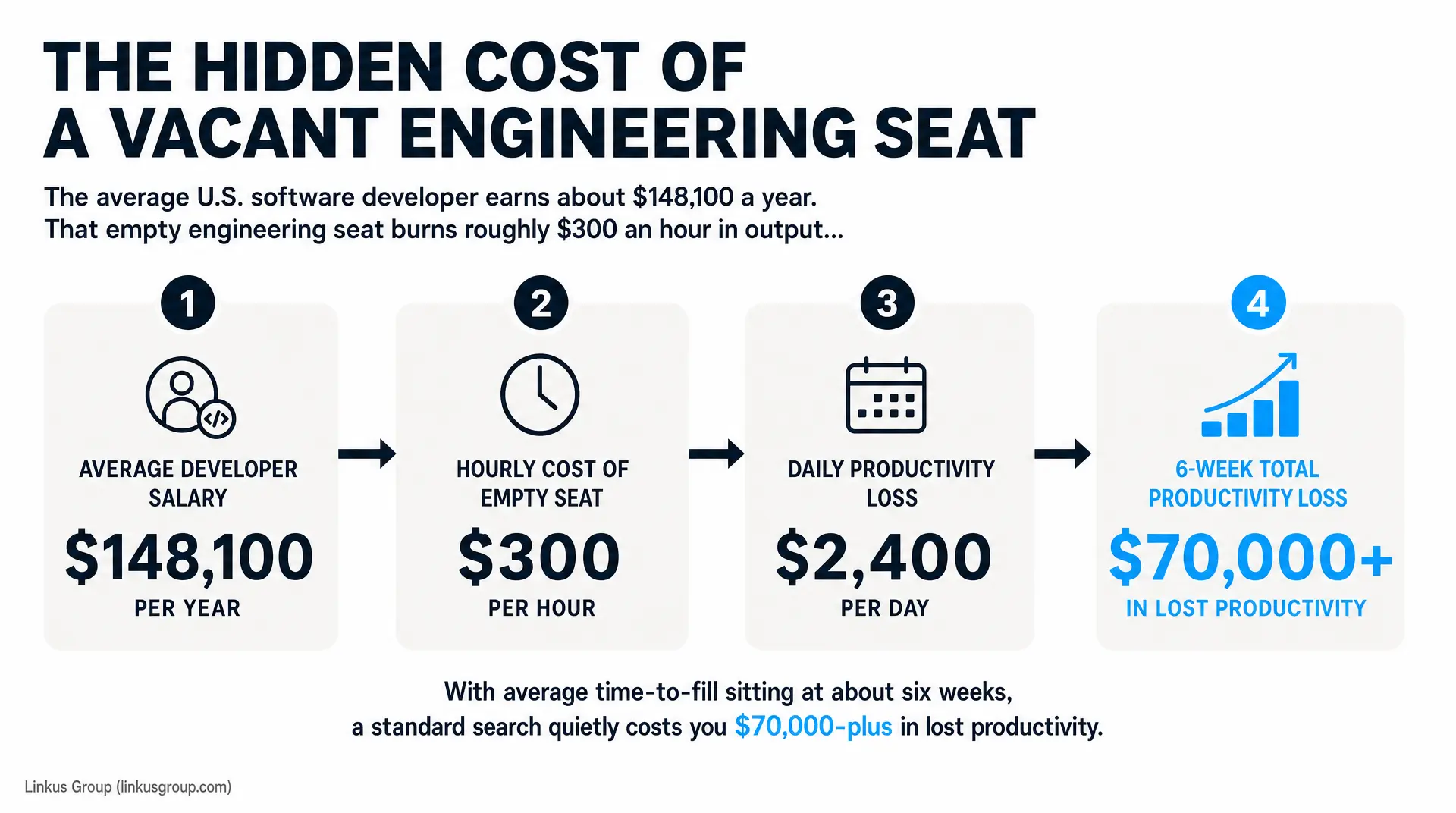
The average U.S. software developer earns about $148,100 a year. Divide by 2,000 and you're at $74 an hour. Multiply by four, and that empty engineering seat burns roughly $300 an hour in output you're not getting. Call it $2,400 a day. With average time-to-fill sitting at about six weeks, a standard search quietly costs you $70,000-plus in lost productivity before anyone signs an offer.
I've watched this play out in physical inventory. I worked with an Amazon e-commerce brand where an open manager seat wasn't on anyone's budget sheet, still without that person they were one mistake away from hundreds of thousands in lost weekly revenue. You lose more money spending more time than hiring the wrong person. I've been saying that for two decades, and the math has never once disagreed with me.
Why Does Searching for Unicorn Candidates Drain Startup Runway and Recruitment Budgets?

The most expensive habit in early-stage hiring is cramming three jobs into one description. You want somebody who can code, sell, manage, and write copy, all for a below-market salary. That person either doesn't exist or won't work for what you're offering. And while you hunt for them, the vacancy math above keeps running. I've watched founders spend what feels like their whole lives chasing a profile they invented, when a real person hired months earlier would already be fully ramped.
Jobs are really just business problems that companies need to solve. So name the problem before you write a single requirement. If deals die because nobody follows up within 24 hours, that's the hire. Everything else on the wish list is fluff, and fluff is expensive. Sometimes the honest answer isn't even a full-time hire. A fractional operator or someone on an hourly basis can solve the immediate problem while you build the case for the permanent seat. Most recruiters won't tell you that, because most recruiters get paid on headcount. I care about being in business with you for 15 years, so I'll tell you.
You also have more room to flex than you think. The World Economic Forum found 63% of employers cite skills gaps as a key barrier through 2030, which means everyone is fishing the same shallow pool for finished-product candidates. Loosen one requirement and hire for learnability, and you're suddenly fishing alone.
What Are the Three Levers to Adjust When a Startup Candidate Search Stalls?
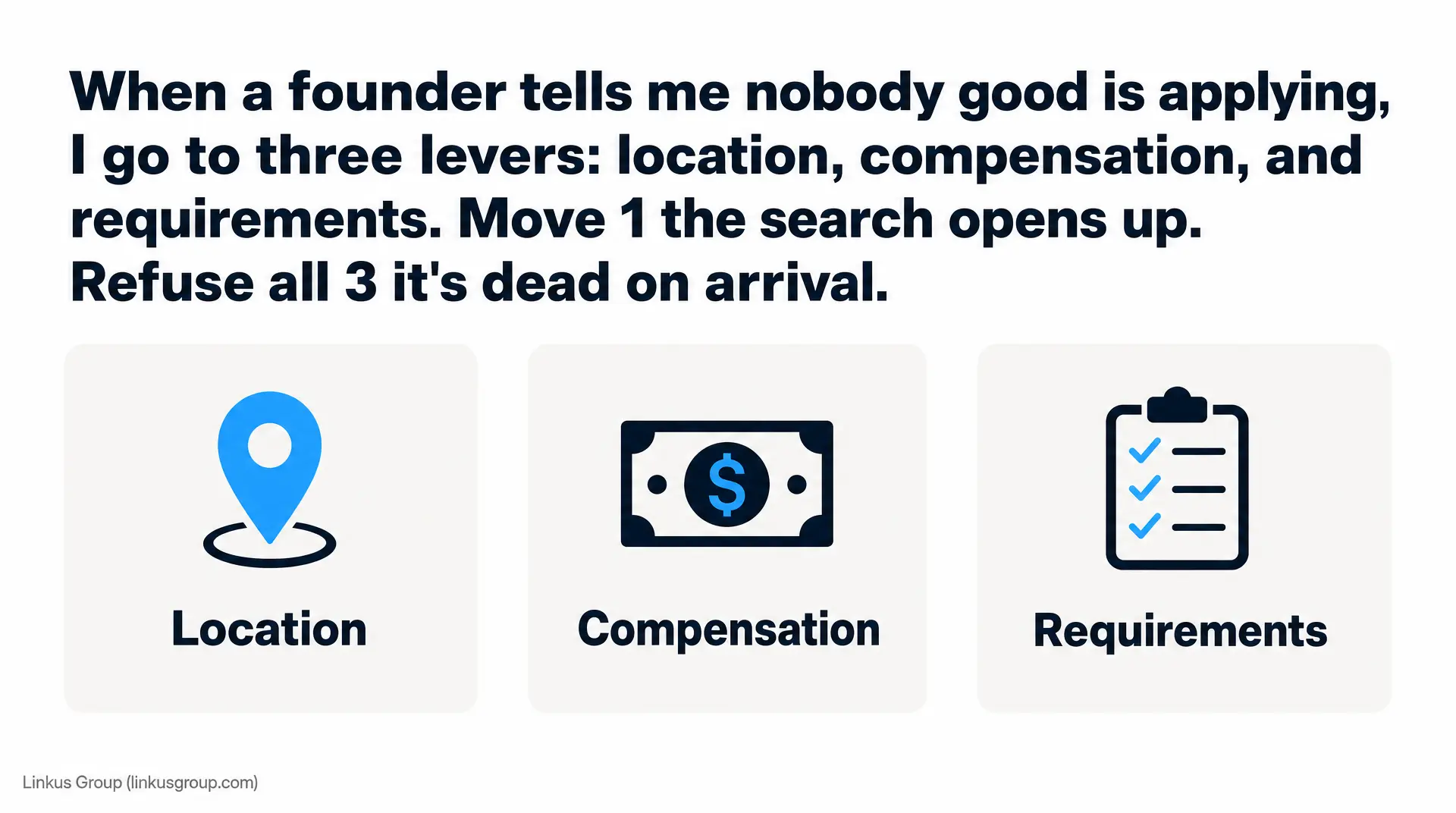
When a founder tells me nobody good is applying, I go to three levers: location, compensation, and requirements. Move 1 the search opens up. Refuse all 3 it's dead on arrival. We had a client with a rough reputation, bad Glassdoor reviews, known for working people hard, bridges burned across their industry, who also wanted to underpay for very specific experience. I told them straight: we appreciate the business, but unless you move on one of those levers, we're not the right partner to help you. They didn't love hearing it. Pretending otherwise would have burned six months of their runway.
And while we're being honest: job descriptions suck. If they worked, I'd be out of a job. Posting one is taping a single flyer to a lamppost and hoping your perfect hire happens to walk past it.
Why Is Hiring Speed a Crucial Competitive Advantage for Startups Against Large Corporations?
Hire slow, fire fast is the biggest lie ever told in hiring. You never have to fire if you hire really well. And if you're slow, you don't get to hire well, because the best people are gone before your third interview round.
I watched a company win a major bank contract and then lose the entire project to a competitor. They needed three people, their interview process didn't match the project timeline, and they couldn't hire fast enough. Revenue they had already won, handed to a rival over interview scheduling.
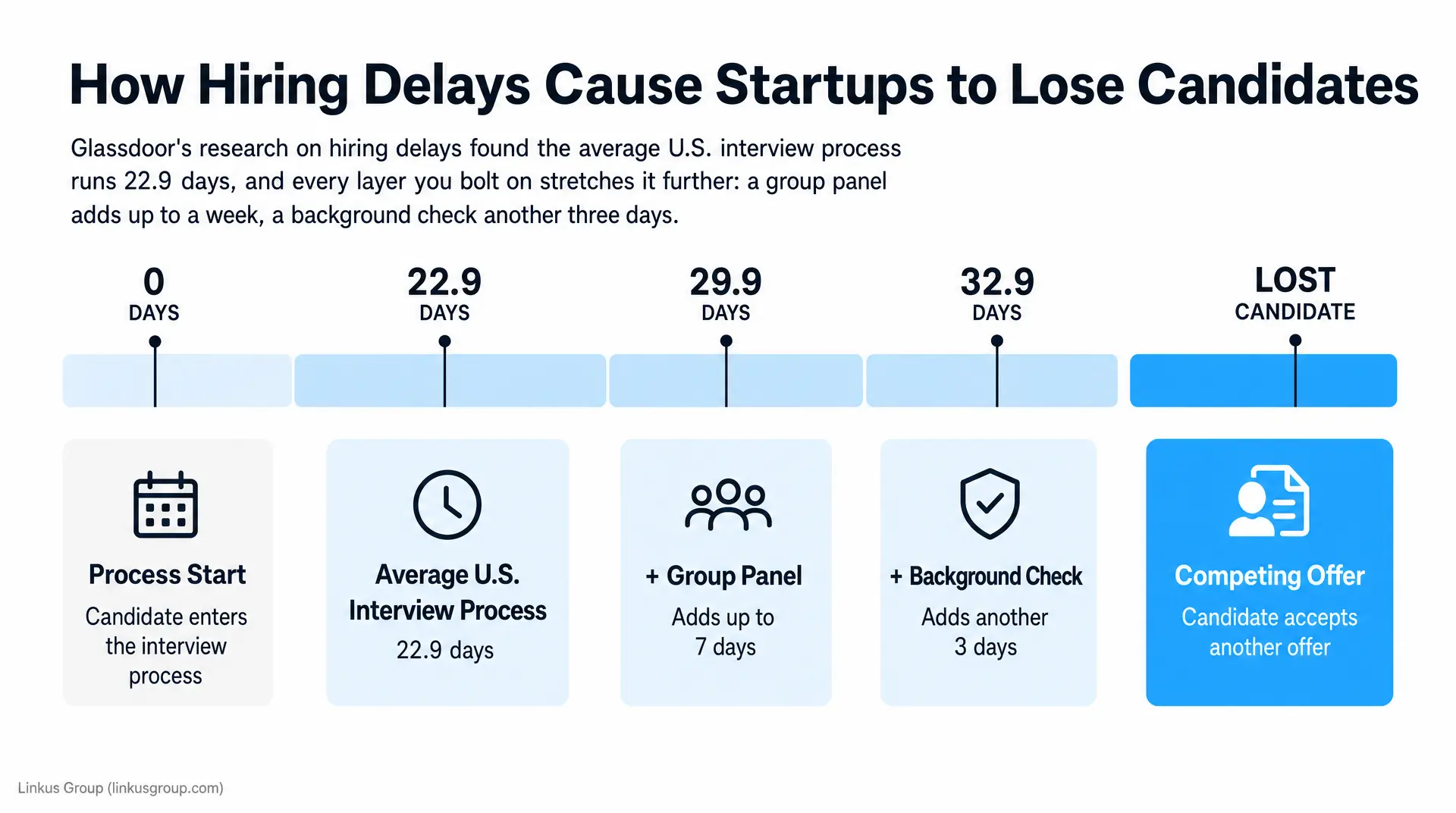
Founders add rounds because more process feels safer. The data says the opposite. Glassdoor's research on hiring delays found the average U.S. interview process runs 22.9 days, and every layer you bolt on stretches it further: a group panel adds up to a week, a background check another three days. All those extra days really accomplish is giving a competing offer time to land while exhausting the candidate you wanted most.
Big companies beat you on brand, budget, and benefits. Speed is the one advantage that scaling companies have, and most founders voluntarily hand it back. Two coffee shops open across the street from each other. The one that knows exactly what a great hire looks like and moves decisively wins, the same way the sharpest teams jump first on a free agent.
The pushback I always get: "Adam, if we move fast, we'll make mistakes." Speed doesn't kill quality. Not having clarity does. At Linkus we deliver a highly vetted candidate within 48 hours of a mandate, and usually companies hire the first person we send them. We can only do that because the clarity work happens before anyone gets sourced. Do the discovery properly and one aligned candidate beats a stack of 30 keyword-matched resumes every time. And if you're bringing in outside help after being burned by a retainer, structure it so you can't be ghosted. We run on contingency, meaning nobody pays us until they hire.
One last note on scoreboards. Instead of time to fill, the true metric is time to quality of hire. Only 20% of organizations even track quality of hire. Nearly everyone is optimizing for a body in a chair without ever checking whether it was the right body.
Why Are Work-Sample Tests and TAG Attributes Better Startup Hiring Predictors Than Resume Pedigree?

If I had to compress two decades into one conviction: the person that's going to do the best in the job is usually the person you'd least expect. Most hiring decisions are bias with a checklist attached. The brand-name employer. The perfect resume. Pedigree is the most expensive thing on the market, and it tells you almost nothing about survival in your environment.
I learned this on a placement I still think about. I recruited a genuine top performer out of Microsoft for a biometrics startup. Twelve years at Microsoft, hungry for a change, everything aligned on paper. It didn't work out. The ambiguity, the missing infrastructure, the pace: none of it was their game. They went back to Microsoft, and Microsoft happily rehired them. That's how good they were. The placement still failed, because thriving at a startup is its own skill and no resume line certifies it.
Then there's the other side. The hires I've watched go from a $70,000 salary to $500,000 and an exit, including one who got hired back by the same founder as co-founder of the next company, rarely checked every box on day one. I've placed an executive assistant who grew into a head of people, then took that title at far bigger companies. Skills can be taught. Attitude and drive can't. That's why I screen on TAG, meaning Trust, Attitude, Grit, before I look at anything else. Nobody's ever been let go from a job for working too hard.
If you want a cheap, reliable way to test for the real thing, stop interrogating the resume and watch the person work. Eighty-five years of selection research ranks work-sample tests as the strongest predictor of performance, roughly twice as predictive as reference checks. That matches what I see daily. Run a mock call. Bring the sales candidate into a live client meeting. Ask the systems-builder to walk you through every stage of what they built, who was involved, and who can verify it. Rehearsed answers collapse fast in that kind of conversation.
How Should Startup Founders Calculate Candidate Equity to Offset Below-Market Cash Salaries?

You need a $200,000 operator and you have $100,000 in cash. Solvable, if you do the math honestly. That candidate is giving up $100,000 a year in hard-earned cash, vesting over four or five years. The equity has to be credibly worth roughly double the foregone salary, around $200,000, for the trade to make sense. Founders who offer cash-for-cash swaps insult exactly the smart operators they're trying to land.
For the Canadian founders getting picked apart by U.S. offers paying 50% more: you will not win a cash fight, so stop fighting it as one. People don't leave companies, they leave leadership. The levers that actually hold high performers cost you almost nothing. A leader worth following. Real ownership. Flexibility on location. A growth path you can say out loud. For sales talent especially, growth is the number one driver, so be crystal clear about obtainable earnings, bonus structure, and where the role goes in two years, and you'll beat richer offers more often than you'd expect.
How Can Startups Successfully Recruit Passive Candidates and Leverage Employee Referral Programs?

Posting a job and trying to do hiring internally is just the bare minimum. It's a salesperson making 10 phone calls a day and wondering why the pipeline is dry. And there's a phrase I genuinely can't stand: "you had that candidate in your back pocket." People are not sitting around waiting for your job. You go get them, or somebody else does.
The pool you're ignoring is enormous. LinkedIn's own research found only about a quarter of employed professionals actively job hunting, while nearly 80% of U.S. talent was approachable about the right opportunity. In my experience, present the right role in the right way at the right time and that number climbs even higher. The hook doesn't need to be clever: "I've got something I think you're going to want to hear about, and here's why. Are you open to giving me 30 seconds?" Getting a great person into a first conversation is easy. Keeping them interested through an honest process is where the craft lives.
Work your referrals harder than any job board, too. A randomized field experiment at a grocery chain found referral programs cut attrition by 15% while lowering labor costs. Referred candidates rarely arrive with the perfect resume. They arrive vouched for on the things that matter, trust, attitude, and grit, which is exactly why they outperform the polished applicants.
Why Are Honest Onboarding Processes and Realistic Job Previews Critical for Startup Employee Retention?

Now the least glamorous part of the whole strategy: 90% of recruiting is the onboarding process. Across the market, half of senior outside hires fail within 18 months. Our placements at Linkus sit at 96% retention at that same 18-month mark, and the gap comes down to alignment set brutally early, not magic.
Everyone hates surprises. When someone joins and the job isn't what was described to them, you pay for the search twice, the ramp twice, and the morale damage in between. So talk about the good, the bad, and the ugly before the offer goes out. A meta-analysis of 40 studies found realistic job previews lower turnover and raise performance. Honesty is literally a retention strategy, and it costs nothing.
One more contrarian note for when you bring hiring in-house: don't make your first internal talent hire a recruiter. People typically get this wrong. Make it an HR leader who can build onboarding, candidate experience, and employer brand from scratch. A recruiter fills seats. An HR leader makes the seats stick, and sticking is where the ROI lives.
What Are the Most Effective Strategies to Reduce Recruitment Risk at a Startup?

Hiring is never going to be 100% perfect, and anyone who guarantees you a hire is selling something. What you can do is reduce your risk. Get ruthless clarity on the business problem. Run the vacancy math. Screen for trust, attitude, and grit. Watch people actually work. Be honest to the point of discomfort before the offer, not after.
Then, when the right person shows up, move. A ball thrown at you in the final seconds doesn't reward hesitation. The founders I've watched exit fastest treated speed and quality as one discipline instead of a trade-off. Hiring is the biggest unlock in your business and the most underrated way to accelerate it. Stop overcomplicating it, and it gets cheap in every way that counts.
Frequently Asked Questions
How do we counter competitors poaching our candidates with massive cash offers?
You don't win a cash war against corporate giants. Instead, sell what they cannot offer: high-velocity growth, real ownership, and a leader worth following. If a candidate is solely optimizing for base salary, they lack the grit required for your zero-to-one startup anyway. Walk away.
How can I leverage my current team to find better talent cheaply?
Work your referrals ruthlessly. Trust is a massive shortcut. Research shows referral programs reduce attrition by 15% while lowering labor costs. Referred candidates bypass the resume filter because they arrive already vetted for grit and attitude, directly solving your business problem.
Is base salary the only financial metric I should use when budgeting for a hire?
Not even close. Budgeting only for base salary hides your true labor cost. U.S. data reveals benefits average 30.1% of total compensation costs. Factor in these hidden expenses. Define the exact business problem upfront so you stop paying a premium for resume fluff.
What should I do when a candidate demands unlimited PTO or massive lifestyle perks?
Walk away immediately. If a candidate's priority is maximizing vacation days while you are fighting to survive the zero-to-one phase, they lack the required attitude. Your cost effective recruitment strategies must focus entirely on finding builders hungry for equity and growth, not early retirement.
Should I add a group panel interview to ensure my whole team approves the hire?
Absolutely not. Consensus kills speed. Data shows group panels add 5.6 to 6.8 days to hiring. Every day you delay, a competitor is closing your top choice. Define the role clearly upfront, run a live work-sample test, and move decisively.