

You can look up average time to fill by industry all day. It still won’t tell you what your empty seat is costing you right now.
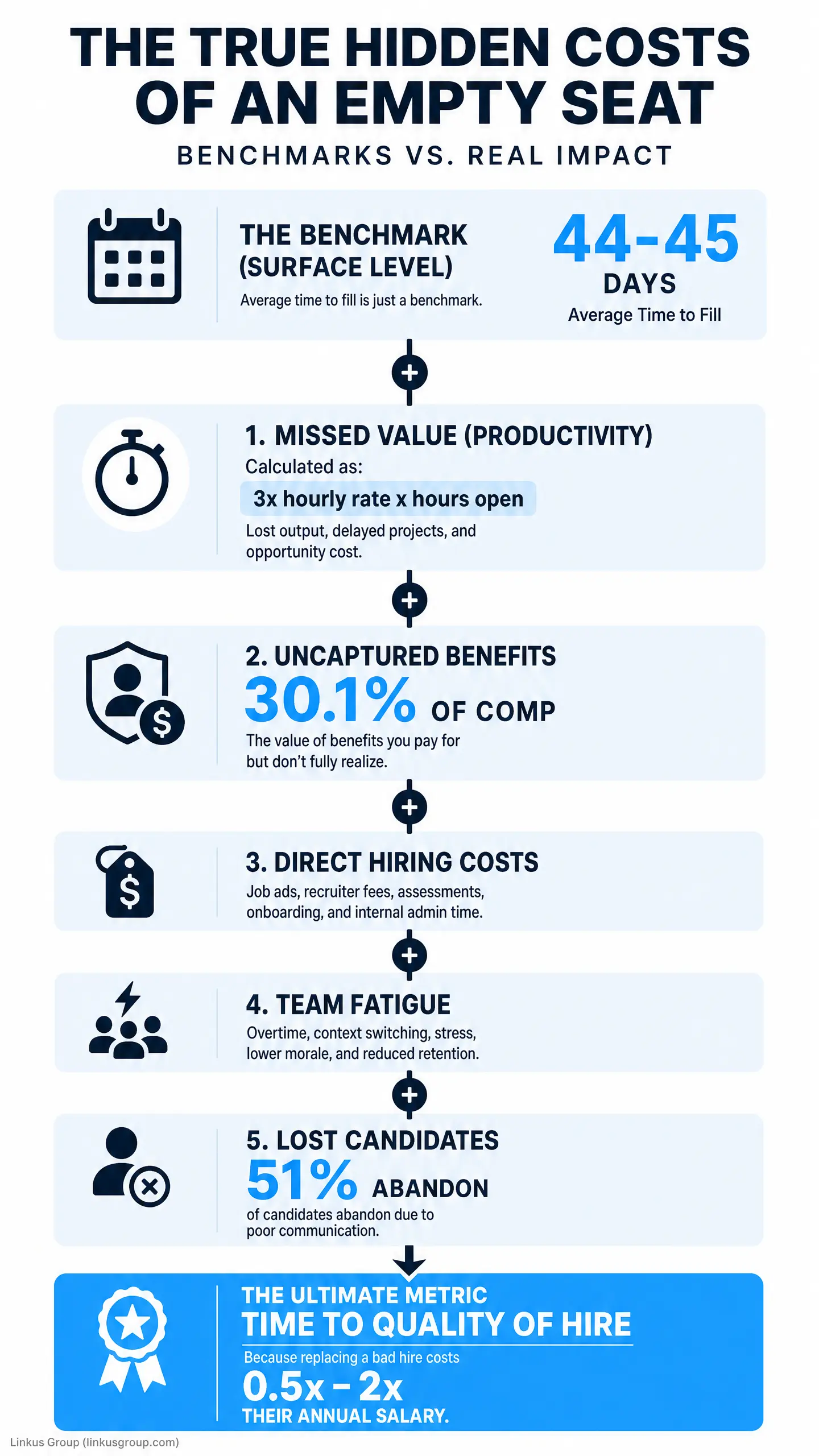
In 2025, SHRM put the median time to fill at about 44 days for nonexecutive roles and 45 days for executive roles. Fine. That gives you a benchmark. It does not tell you whether the process is healthy, whether the hire is right, or whether your team is quietly getting crushed while you wait.
I’ve spent 15+ years hiring thousands of people for startups and SMBs. Through Linkus Group, I’ve supported 500+ founder-led businesses and helped make 1,000+ hires across executive, operations, tech, sales, marketing, human resources and finance. Our retention rate past 18 months is 96%. I care about that a lot more than whether a search looked busy for six weeks.
That’s why I keep coming back to the same point. Instead of time to fill, the true metric is time to quality of hire. Can you find the right person fast, get them in the seat, get them ramped, and have them stay? That’s the metric that matters.
Key Takeaways
- Calculate the hidden cost of an open role by dividing the annual salary by 2,000 for the hourly rate, multiplying by three, and multiplying by vacant hours.
- Criteria research reveals 51% of candidates abandon hiring processes due to poor communication, while 52% consider four to five interview rounds excessive.
- The Office of Personnel Management reports work sample tests and structured interviews predict job performance at three to five times the rate of experience or education.
- Greenhouse data indicates that a 412% increase in annual applications per recruiter between 2022 and 2025 extended the average time-to-fill to nearly 60 days.
- Scaling companies with 50 to 250 employees must hire an HR leader to establish onboarding infrastructure before adding junior recruiters to handle job postings.
- Gallup estimates replacing a manager costs approximately 200% of their annual salary, whereas replacing a technical employee costs about 80% of their salary.
- While SHRM reports the 2025 median time-to-fill at 44 days for nonexecutive roles, only 20% of organizations actively measure the quality-of-hire metric.
The Benchmark Is Useful, but It Hides the Real Problem

Most companies track activity. They track resumes, applications, interviews, and pipeline volume. Leadership sees motion and feels better. Ego gets soothed. The business problem is still sitting there.
SHRM found only 20% of organizations measured quality-of-hire in 2025. That should bother you. It means most companies are measuring speed and cost more carefully than whether the person actually performs and sticks.
I see this all the time with scaling companies. Especially VC-backed ones. They drag out hiring because they’re scared to get it wrong. So they add rounds. They pull in more interviewers. They ask for more resumes. They wait for more data. Time keeps moving. The team keeps stretching. And everyone tells themselves they’re being thorough.
They’re usually just being slow.
Hire slow, fire fast is the biggest lie ever told in hiring. You never have to fire if you hire really well. The issue is not speed. The issue is clarity. Speed doesn’t kill quality. Not having clarity does.
The Hidden-Cost Math Is Simpler Than People Think
Here’s the math I use with founders.
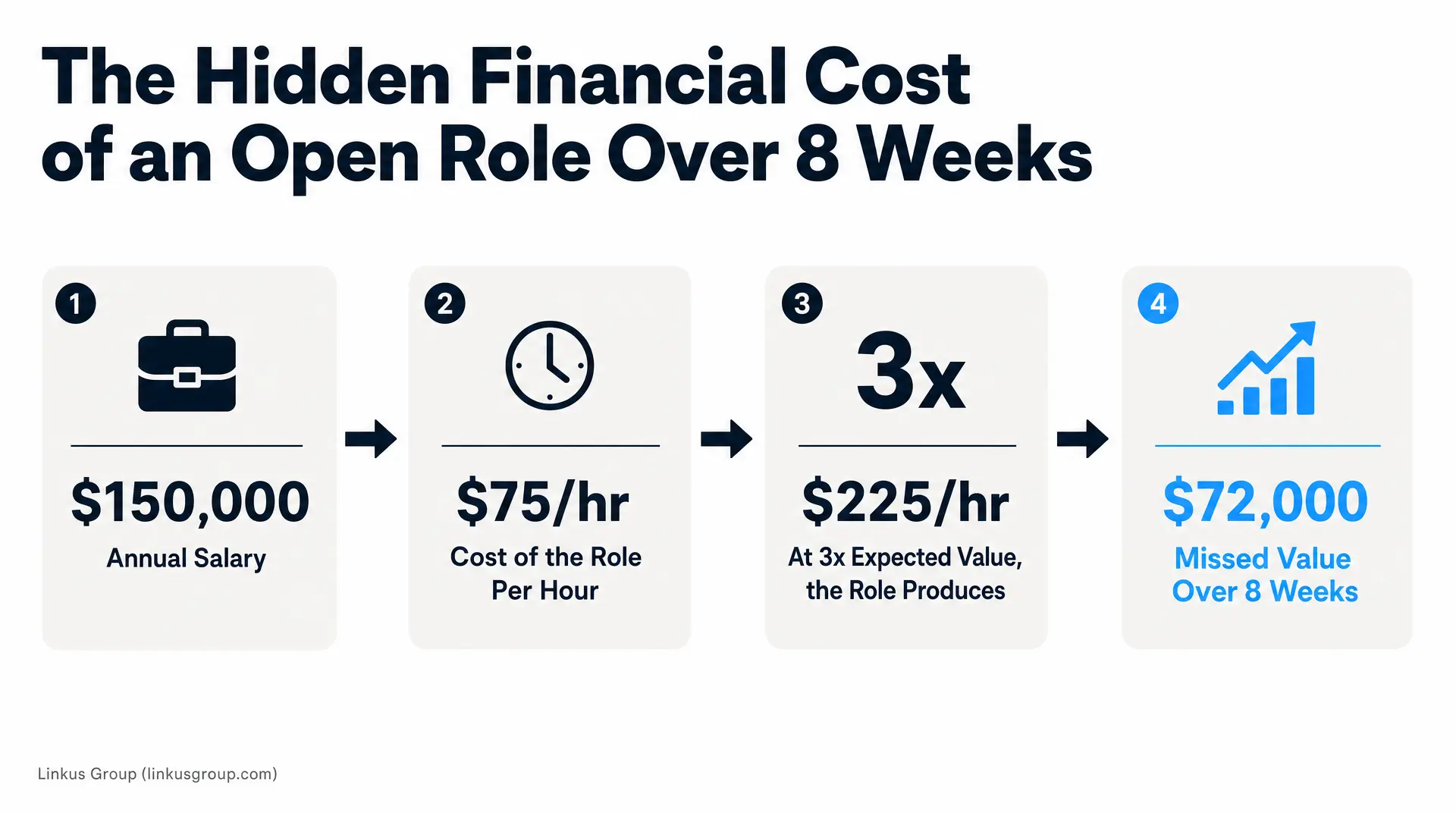
Take the annual salary and divide it by roughly 2,000 hours. That gives you the hourly rate. Then multiply that by three. I use 3x because a great hire should generate a return of three to five times salary. I’d rather stay conservative. Then multiply that by the hours the role stays open. After that, remember the ramp. Most people need six to nine months to really get up to speed.
So let’s use a $150,000 role. That’s about $75 an hour. At 3x value, that role should be producing about $225 an hour for the company. Leave it open for eight weeks on a normal work schedule, and you’re already looking at roughly $72,000 in missed value. That number moves fast.
And salary still understates the cost. The U.S. Bureau of Labor Statistics reported that benefits made up 30.1% of total compensation in private industry in March 2026. So when you think you’re doing simple salary math, you’re still not seeing the whole picture.
Then add the direct hiring cost. SHRM put average cost-per-hire at $5,475 for nonexecutive roles and $35,879 for executive roles. That’s before vacancy cost, before lost output, and before the onboarding runway.
This is why I say jobs are really just business problems that companies need to solve. If the role is open, the business is already paying for it. It’s paying in slower execution, missed revenue, delayed product work, and team fatigue.
The Part Finance Rarely Captures
The open seat hurts your existing team first. That’s usually where the pain starts.
Most hiring is reactive. The story 99% of the time is, “I needed this person yesterday.” So while the seat stays open, someone else picks up the work. Your engineer absorbs product pressure. Your sales leader covers pipeline gaps. Your customer team handles escalations they should never own. Good people get tired. Then they get frustrated.
That cost is real. Gallup’s Q12 meta-analysis found top-quartile engagement teams had 23% higher profitability, 14% higher productivity, and 51% lower turnover in low-turnover organizations. So when an open role starts dragging your team down, you are not dealing with a soft issue. You are dealing with business performance.
The second cost is leadership distraction. Long searches eat executive time. A founder, VP, or department lead can lose weeks interviewing people who were never right in the first place. They review resumes. They sit in debriefs. They run restarts. All of that time comes out of sales calls, product decisions, customer relationships, and team leadership.
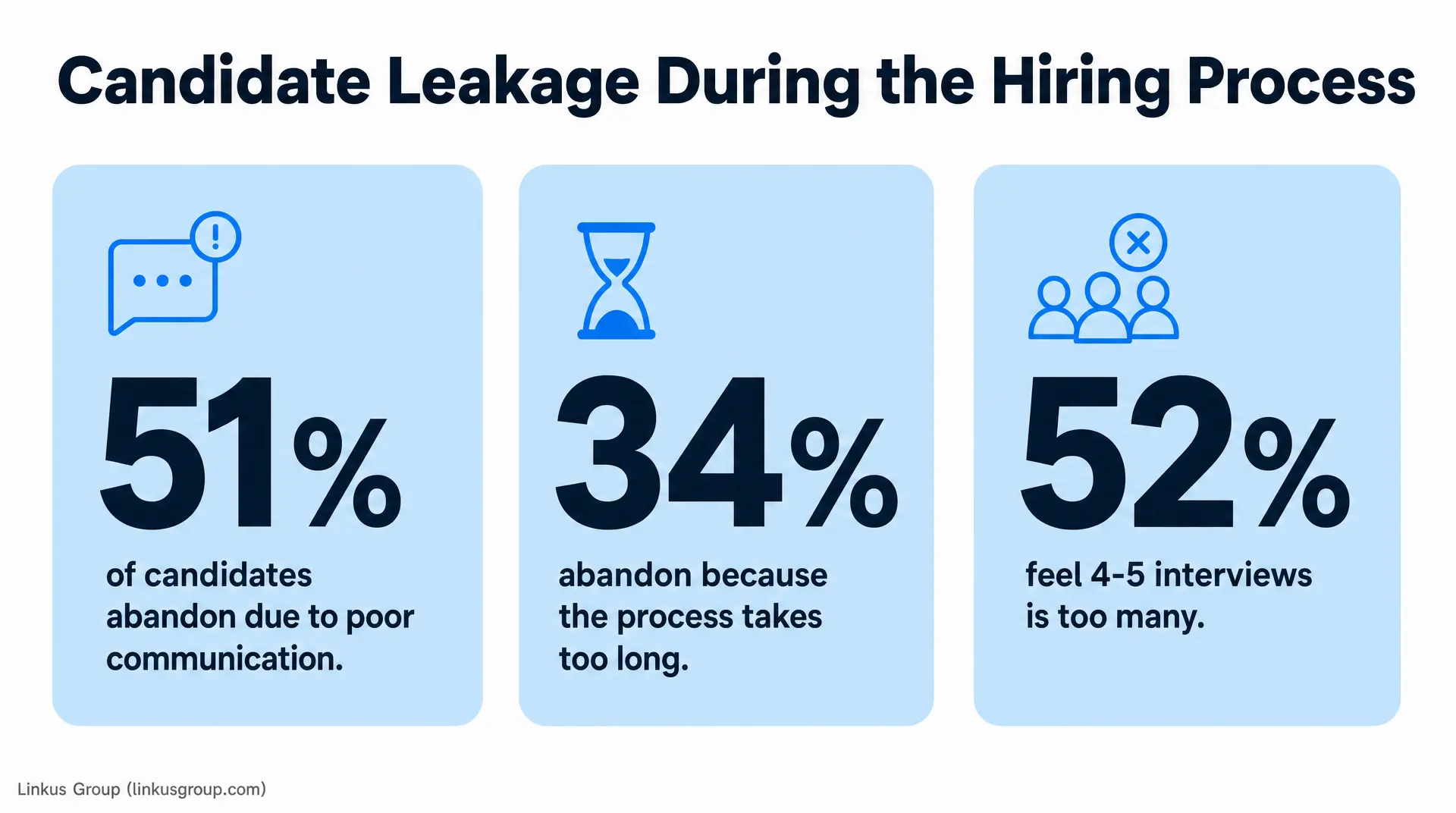
Then comes candidate leakage. This part gets missed all the time. Criteria found 51% of candidates had abandoned a hiring process because of poor communication. Another 34% walked away because the process took too long. You do not get infinite patience from strong candidates. The market keeps moving while you hesitate.
Even interview tolerance has a ceiling. Criteria found 52% of candidates think four to five interviews is too many. Only 11% are willing to tolerate six or more. So if you are still adding rounds because it makes the team feel safer, you are probably pushing away the very people you want.
Why Hiring Drags Out in Scaling Companies

The biggest reason is fear. Fear of making a mistake. Fear of overpaying. Fear of picking the wrong profile. Fear of backing a candidate who doesn’t look exactly like the last one. I understand that fear. I just don’t let it run the process.
Volume makes it worse. Greenhouse found applications per job rose 111% from 2022 to 2025, while time-to-fill still climbed from 43.64 days to 59.67 days. More applications did not make companies faster. They made companies noisier.
The same report showed recruiter workload exploded too. Greenhouse found annual applications per recruiter rose 412%, while average recruiters per organization fell 56%. That is a recipe for rushed screening, slower decisions, and a lot of false confidence built on volume.
Big-company process is another trap. SHRM showed extra-large organizations take 61 days to fill nonexecutive roles and 60 days to fill executive roles. Why? More layers. More approvals. More complexity. If you’re a 100-person company borrowing that process, you’re borrowing the drag too.
And then there’s the worst part. Teams confuse time with quality. They think a search improves just because it lasted longer. It doesn’t. If you give a team three months, they’ll use three months. If you give a disciplined team two weeks and they know exactly what they want, they can make a great hire. I believe that completely.
Hidden Costs Look Different by Industry, but the Pattern Is the Same
Fintech and Crypto

When I work with fintech and crypto businesses like Coinsquare, KOHO, Bench, or Notch, the drag usually comes from risk and compliance. Those concerns are real. You should care about them. But I’ve seen plenty of companies let those concerns turn into slow motion.
A compliance-heavy environment still needs speed. If engineering, security, or product sits open too long, the cost shows up in delayed launches, overworked senior people, and decisions getting kicked down the road. You need risk-aware operators. You do not need a three-page wishlist for a unicorn who can do three jobs for one salary.
This is where companies get themselves twisted up. They want a startup builder with enterprise-grade controls, a perfect background, a low salary, and instant availability. That’s when the process starts slipping. One of the three levers usually has to move. Compensation, location, or requirements. If none of them move, time-to-fill stretches and the business pays for the gap.
HealthTech and Healthcare Enterprise
In healthtech, the cost of waiting is different. It is slower, but it still hits hard.
Companies like Medchart, IDENTOS, and League deal with long buying cycles, sensitive data, and a lot of stakeholders. If a GTM or product role stays open, you don’t just lose a few weeks. You lose relationship momentum. You lose enterprise learning. You lose patience inside the team.
This is why I care so much about alignment. Some candidates are wired for long-cycle environments. Some are not. If someone is too transactional, they get frustrated. They want quick wins. They get bored. Then the search has to start over. In healthcare, that kind of restart can cost you months of progress.
Vertical SaaS and Niche B2B
With companies like LumiQ, Cognota, Xello, and Citylitics, I see a different problem. Founders often want exact industry experience. They want the sales rep who has sold to CPAs before, or L&D leaders before, or a very narrow buyer. I get the instinct. Startups don’t have endless time to train.
But this is a classic hiring trap. Skills can be taught. Attitude and drive can’t. If someone is smart, curious, and coachable, they can learn an industry a lot faster than most founders think.
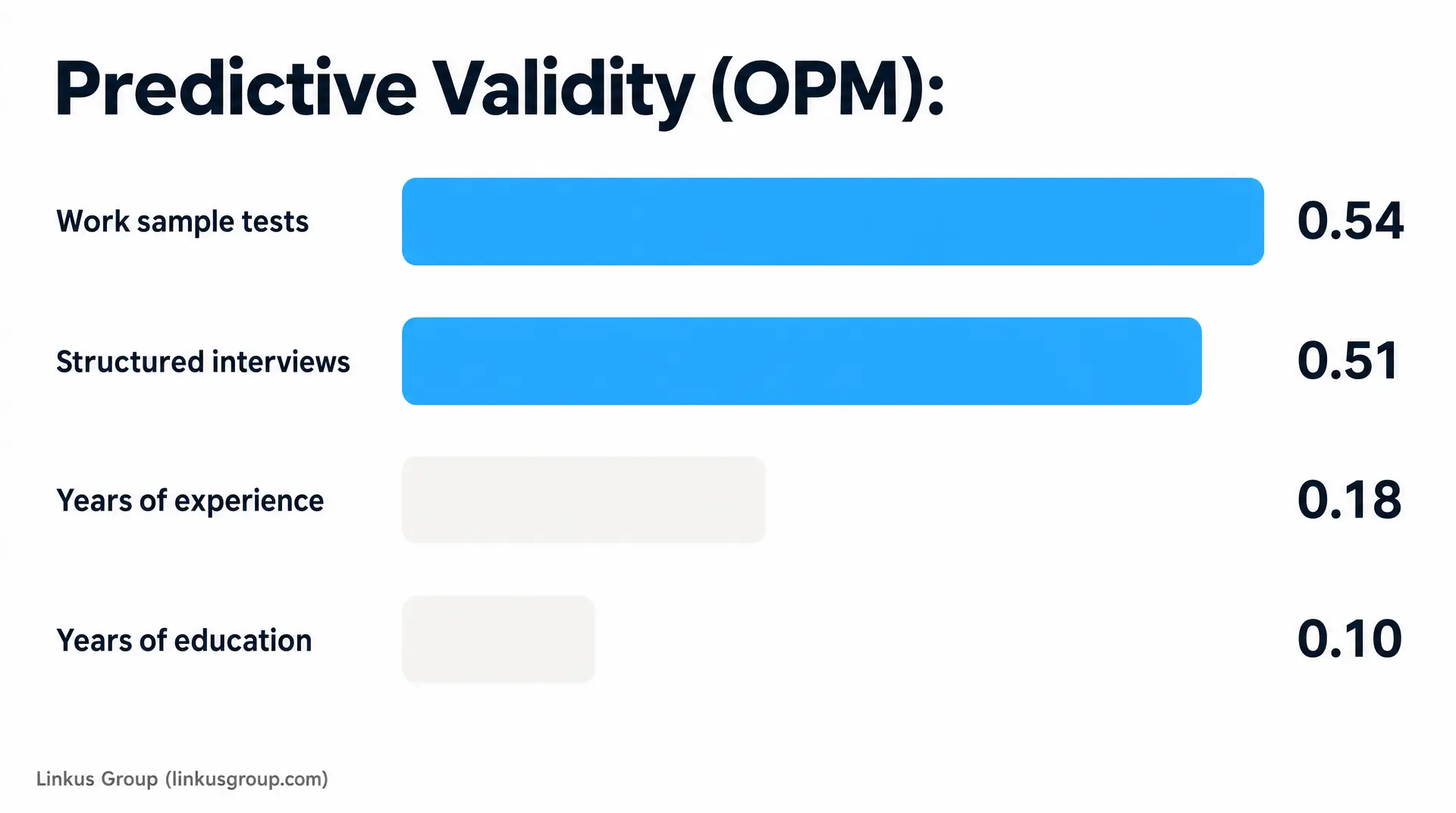
OPM’s assessment guidance puts work sample tests at .54 validity, structured interviews at .51, years of job experience at .18, and years of education at .10. That lines up with what I see every day. Resume boxes and pedigree look safe. They are weak predictors on their own. The person that’s going to do the best in the job is usually the person you’d least expect.
Startup GTM and Executive Hires
For Series A and B companies, the enterprise rep failure is one of the most expensive mistakes I see. A founder hires someone from Salesforce, AWS, Google, or another big logo and assumes that person will build the startup playbook. Sometimes it works. A lot of times it doesn’t.
Why? Because startup survival is different. There is no big brand carrying the meeting. There is no huge SDR bench. There are fewer resources, more ambiguity, and a lot less room to hide.
I’ve seen the same kind of fit issue from another angle. I once helped a biometrics company hire a strong performer from Microsoft. Smart person. Solid background. The hire looked aligned. In the end, they chose to go back to Microsoft because the bigger environment fit them better. That’s part of hiring. Humans are humans. But the lesson is clear. Company-stage fit matters more than logo safety.
At the executive level, the hidden cost gets political too. A seed-stage superstar can become a bottleneck when the company needs systems. You usually feel this pain before anyone wants to say it out loud. Work gets redone. Teams keep running into the same wall. That’s when you need a specialist. Waiting too long because of loyalty or discomfort is expensive.
How I Compress Time Without Lowering the Bar

I start with the business problem. What does this person need to fix, build, lead, or unlock? Not the fluffy version. The real version. Hiring should actually be very easy. It shouldn’t be overcomplicated. The moment you get clear on the problem, the search gets faster.
Then I align the decision-makers before the search starts. Who’s involved? What are they evaluating? What does great look like? What happens if the right person shows up tomorrow? If those answers aren’t clear, the process expands. Every time.
After that, I go after passive talent properly. Top people are usually working. They’re not sitting around waiting for your job. LinkedIn reported that 90% of professionals were open to new opportunities if the right one came along. I believe that. I’ve built businesses around that idea, including Hipo, because off-market talent is where a lot of the upside sits.
You still need to vet deeply. At Linkus Group, we use TAG and PREP. I look hard at Trust, Attitude, and Grit. I look at Potential, Research, Enthusiasm, and Polish. We do conversational deep dives, almost like a podcast. We ask questions from different angles. We look for consistency. We look for how someone thinks, not just how polished they sound.
And yes, I prefer sending one highly vetted candidate instead of flooding a founder with resumes. Founders do not need more confusion. They need confidence. If the discovery work is strong, you should be close enough to make a fast decision.
Job descriptions suck. If they worked, I’d be out of a job. They can help you clarify the role internally. Fine. They are not enough to attract top passive talent on their own.
If You Fill the Role and Lose the Person, You Still Lost

This is the part too many teams ignore. 90% of recruiting is onboarding.
Gallup says onboarding should be treated as a year-long process. It also found employees are 3.4 times as likely to feel onboarding was successful when managers take an active role. That matches what I’ve seen for years. If the company cannot absorb the hire, your search did not succeed. It just ended.
A bad hire or early turnover wipes out any speed benefit. Gallup estimates replacing an employee can cost one-half to two times annual salary. Manager replacement can reach about 200% of salary. Technical-role replacement can hit about 80%. So yes, move fast. But be honest, be clear, and set the person up to win.
This is also why I tell scaling companies not to build the talent function backward. If you’re around 50 to 250 employees and trying to scale, your first internal hire in talent should usually be an HR leader, not a junior recruiter posting jobs. You need onboarding, structure, candidate experience, and process. Then you build the recruiting engine around that.
What I’d Do if I Were in Your Seat This Week

I’d start by putting a weekly vacancy cost beside every open role. Just do the math. Salary to hourly rate. Multiply by three. Multiply by hours open. Then ask who is absorbing that missing work today. You’ll see very quickly where the real pain is.
Then I’d get brutally honest about whether each role is a real business need or a headcount fantasy. Investors push numbers. Boards love plans. Fine. But hiring less better people often creates far more value than hiring at all costs.
After that, I’d simplify the process. Strip out extra rounds. Get the decision-makers aligned. Decide what lever can move if the market pushes back. Compensation, location, or requirements. Most stalled searches come back to one of those three things.
And finally, I’d make sure the company is ready to catch the hire once they land. If your manager is not engaged, if onboarding is weak, and if the role is being sold one way and lived another way, the cost of the vacancy will just turn into the cost of turnover.
Final Thought
Average time to fill by industry is a benchmark. It is not a strategy.
The real question is much sharper. What is this empty seat costing you every week in lost output, team strain, slower execution, and delayed ramp? Once you start looking at it that way, the conversation changes fast.
Hiring is the biggest unlock in a company’s business. The whole idea about great hiring is to get the best person for the job in the shortest amount of time for the lowest cost. If you keep that in front of you, you’ll make better decisions.
So yes, use the benchmark. Then move past it.
Calculate the hidden cost. Get clear. Move fast. And hire with enough honesty that the right people can actually stay.
Frequently Asked Questions
How do I justify a prolonged executive search to impatient VC board members?
Stop debating the calendar and start debating the ROI. Remind your board that filling a seat fast with the wrong leader kills cap tables. Gallup shows replacing a bad manager costs roughly 200% of their salary. Show them the vacancy math, present a vetted shortlist, and refuse to hire for ego.
If our Series A startup is seeing massive inbound applicant volume, why is time-to-fill increasing?
Because volume creates noise, not clarity. Greenhouse data shows applications jumped 111%, but time-to-fill stretched to almost 60 days. Your recruiters are buried under unqualified resumes, rushing screens, and slowing down actual decisions. You don’t need more inbound pipeline. You need targeted outbound headhunting.
How many interview rounds should we run to de-risk a senior hire without losing them?
Cap it at three or four tightly structured rounds. If you need six rounds, your team lacks alignment, not data. A Criteria report proves 52% of candidates consider four to five interviews too many. You are bleeding top passive talent to competitors while you hesitate.
Why do our safe enterprise GTM hires keep turning over and inflating our vacancy metrics?
Because a big logo on a resume does not equal startup survival skills. You are hiring reps used to massive SDR benches. OPM research shows years of experience is a weak predictor of success. Vet for grit, structural building capability, and agility, not just a pedigree.
Should our scaling operations track average time to fill as our primary talent metric?
Absolutely not. It is a baseline, not a strategy. Astoundingly, SHRM data reveals only 20% of organizations actually measure quality-of-hire. Track time to quality instead. If you prioritize speed over 18-month retention and post-onboarding performance, you are just renting an employee and paying for the restart.