

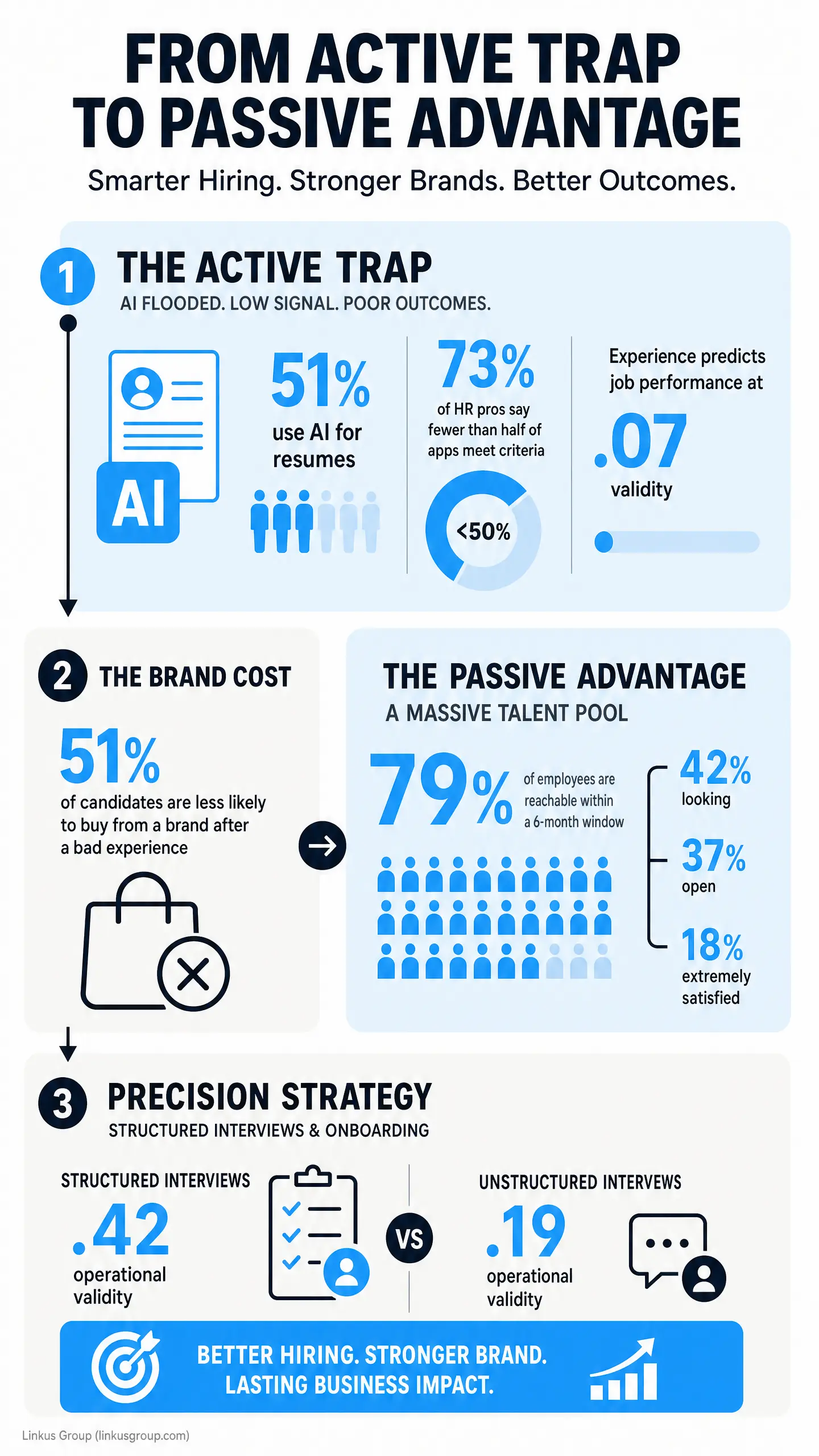
Years of experience – the line hiring managers scan first and weight hardest – predicts actual job performance at an operational validity of .07. That is a rounding error from zero.
You built your entire screening process around the metric that matters least, and AI has now taught every applicant to counterfeit whatever was left.
The people who could genuinely move your business feel no need to prove any of it to you. They are employed, excelling, and will never see your posting.
Key Takeaways
- Years of job experience predicts actual job performance with an operational validity of just .07, making it a statistically poor metric for screening candidates.
- Because 51% of U.S. candidates now use AI to write resumes, traditional keyword-based screening filters consistently fail to identify genuinely qualified active applicants.
- According to iCIMS data, 51% of consumers are less likely to purchase from a brand after experiencing a bad job application or interview process.
- Passive recruiting targets the largest reachable talent pool, with 2024 Greenhouse data showing 79% of U.S. employees are either actively hunting or open to new opportunities.
- Employee referral programs severely limit workforce diversity by perpetuating affinity bias, highlighted by a 2025 Swedish field study where 75% of men referred male candidates.
- Structured candidate interviews predict future job performance with an operational validity of .42, significantly outperforming unstructured assessments that score only .19 in validity.
Why Does Relying Exclusively on Active Job Seekers in Recruitment Pipelines Fail?

I call the old way "post and pray." You put the job up, then you pray the right person likes your marketing, sees your post, has some affinity to your brand, or sits inside your close network. And you hope they happen to be looking at the exact moment you're hiring.
Think about how many things have to line up for that to work. Active job seekers are one tiny slice of the talent pool. If you want to remove bias and get the maximum amount of opportunity in front of you, that slice is not where the best people live.
Day to day, it plays out one of two ways. You get a flood, or you get nothing. If you get a flood, the applicants are typically not the right fit, and it takes so long to sort them that you can't give anyone a decent experience. If you get nothing, your outcome depends entirely on your employer brand, your reach, and how much money you're willing to throw at the posting compared to your competitors.
Either way, the job stops going to the best person. It goes to the company that spends the most time, keeps the role open the longest, and spends the most money. That is not an effective use of your time. And time is your most valuable asset, more so now than ever.
The data is brutal on this. LinkedIn reported in 2025 that 73% of HR professionals say fewer than half the applications they get meet all the listed criteria, and 22% spend three to five hours a day just sifting through them. You're not building a team in those hours. You're drowning in them.
Why Are AI-Tailored Resumes Creating Fake-Qualified Candidate Pipelines in 2026?

The pile isn't just big anymore. It's increasingly fake-qualified, and that's the part that makes 2026 genuinely different from five years ago.
Candidates now use AI to fire off applications at scale. Greenhouse found that 51% of U.S. candidates used AI to write resumes or cover letters, 32% used it to tailor those documents to a specific posting, and 22% used it to mass apply.
Think about what that does to your funnel. Every resume now reads like it was written for your exact job, because it was, by a machine that scraped your keywords. Your screening filters were built to catch keyword matches. Now everyone matches. The signal you used to lean on is gone.
So the "safe" strategy of collecting active applicants is getting less safe by the month. More volume, less signal, more of your day burned on noise. Job seekers feel it too. LinkedIn found 37% are applying to more jobs than ever but hearing back less. Everybody's losing at once.
How Does Ghosting High Volumes of Job Applicants Damage Employer Brand Equity?

You care about employer brand. It's probably one of the numbers you're judged on. So let's talk about what post and pray does to it in the background.
When you pull in a hundred applicants you can't respond to, you manufacture a hundred people who now think a little less of your company. And it gets worse the deeper you go. Greenhouse found that 52% of U.S. candidates were ghosted after an interview. Not after applying. After interviewing. After they booked time off, prepped, and showed up for you.
This bleeds straight into the business. iCIMS found that 51% of people are less likely to buy from a brand after a bad application or interview experience. Your overloaded process isn't just costing you hires. It's costing you customers you'll never know you lost.
For a scaling company fighting for a name in a crowded market, this is the quiet killer. You're trying to build employer brand equity, and the applicant flood is eroding it while you're busy sorting resumes you were never going to hire anyway.
Why Do Passive Candidates Represent the Largest Reachable Talent Pool in 2026?
So if the best people aren't in your inbox, where are they? They're working. Heads down, crushing it somewhere else, not thinking about you at all.
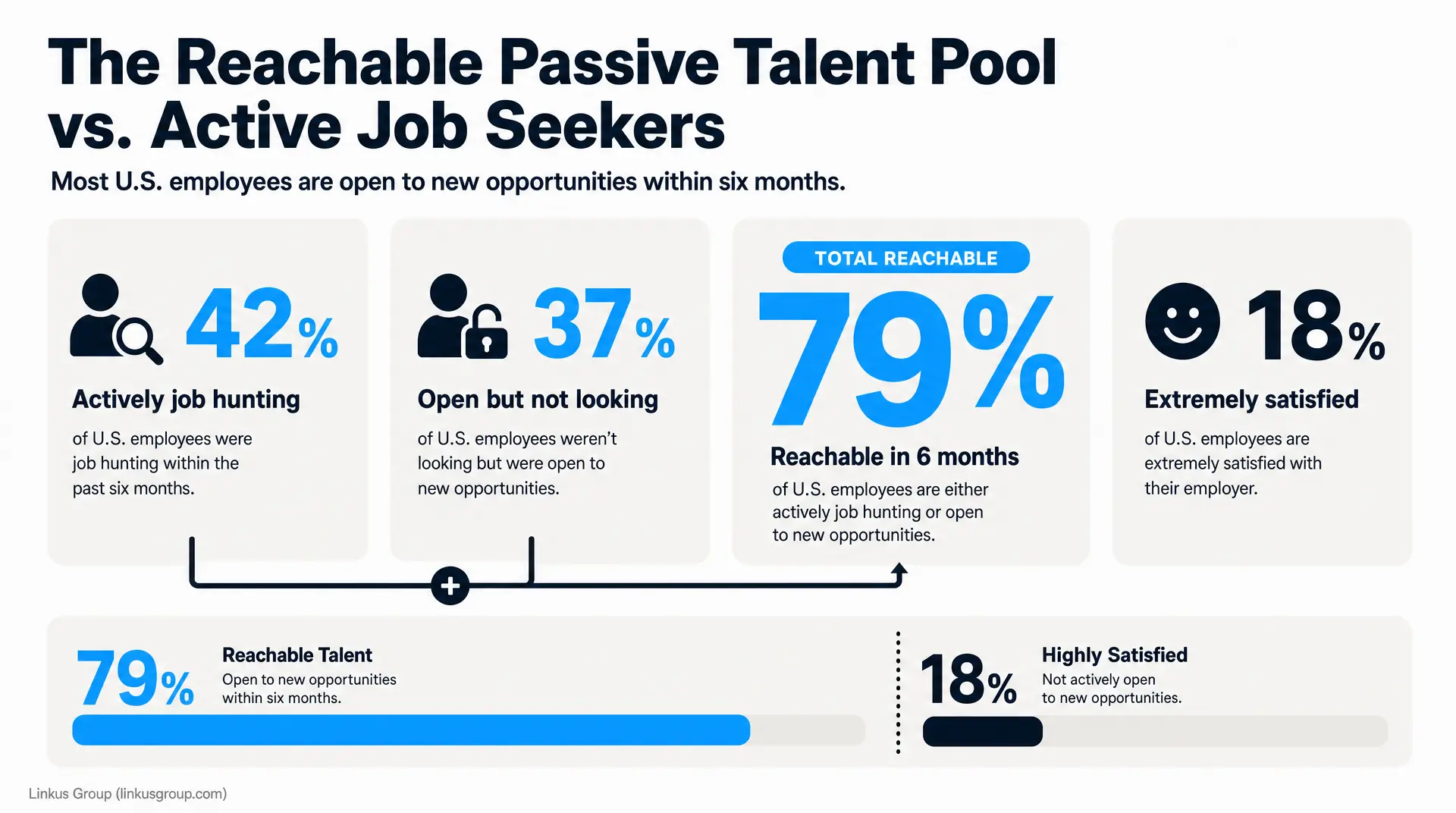
For years the industry line was that 90% of professionals are open to a better opportunity. Fair warning: that number traces back to a LinkedIn survey from 2016, so don't quote the exact figure like gospel. But the truth underneath it has only gotten stronger. Greenhouse's 2024 data found that 42% of U.S. employees were job hunting within six months, and another 37% weren't looking but were open. That's 79% who are reachable inside a six-month window.
Gallup's read for 2026 is starker still. Only 18% of U.S. employees are extremely satisfied with their employer, and 52% are either actively looking or keeping an eye out.
Most of the people you actually want are reachable right now, even though not one of them is sitting in your applicant tracking system. You just have to go get them instead of waiting for them to wander in.
People ask if having access to those candidates is our secret weapon. It isn't. Access isn't a moat, it's distribution. We can reach anyone in any market segment. The real skill is knowing how to approach them, how to read them, and how to move someone from "I'm not looking" into a real conversation about their future.
Why Are Resumes and Past Experience Poor Predictors of Future Candidate Job Performance?

Even good teams blow it the moment they finally reach strong people. They judge them on their past.
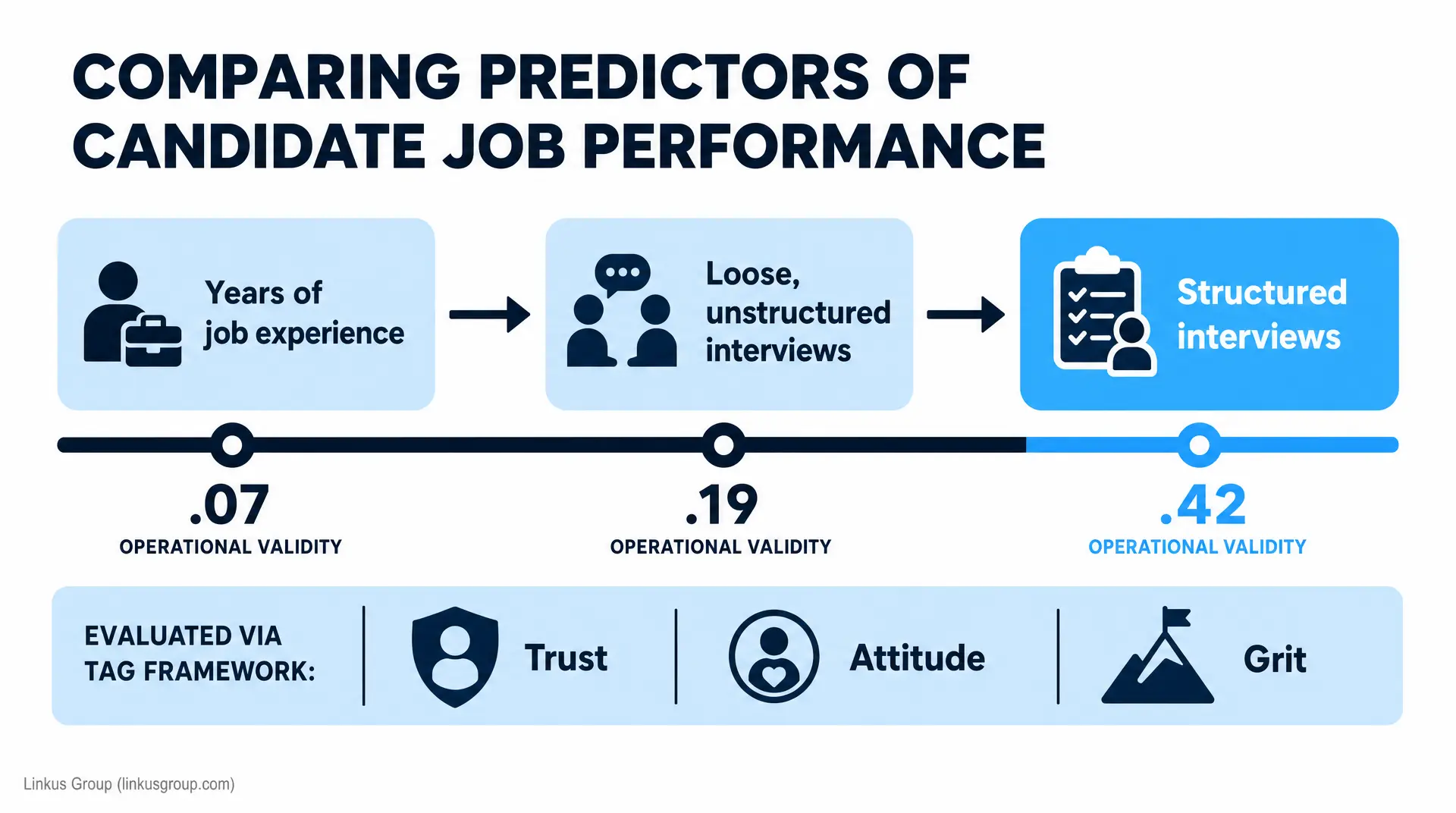
Resumes are a poor predictor of future success. I'll stake my reputation on this one: the person who's going to do the best in the job is usually the person you'd least expect. And there's now hard evidence for it. That 2022 meta-analysis in the Journal of Applied Psychology found years of job experience carried an operational validity of just .07 for job performance. Basically zero. The thing hiring managers weight most, "how many years did they do this exact thing," tells you almost nothing about how they'll actually perform.
Look at anyone who built something real. Jerry Seinfeld had a failed show. Mark Cuban got fired. Steve Jobs got pushed out of Apple. Elon Musk, pick whoever you want. Their past didn't dictate their future. Sometimes past performance lines up with what's next, but it's rare, and it always has to be contextual.
Potential is about understanding where someone's going, what their interests are, and how they line up with your role. Not where they've been. Jobs are really just business problems companies need to solve, so I run every candidate through a simple filter I call TAG: Trust, Attitude, Grit. Skills can be taught. If someone's smart, you can teach them almost anything. Attitude and drive, you cannot teach. And none of that lives on a resume. You only surface it in a real conversation.
Passive doesn't mean guaranteed, and I'll always give you the good, bad, and ugly. Years back I placed a top performer out of Microsoft into a biometrics startup. He'd been at Microsoft over a decade, wanted a change, wanted the startup life. On paper and in the room, everything aligned. It didn't work out, and he ended up going back to Microsoft, who wanted him back that badly. That's the caliber of person you get access to when you go passive. It's also proof we're dealing with humans. Hiring is never going to be 100% perfect. The whole job is reducing your risk, not erasing it.
How Do Employee Referrals Negatively Impact Workforce Diversity and Perpetuate Affinity Bias?
A lot of people leaders push back here with, "Fine, but referrals are our best source." I get it. Referred people often are well-matched, because someone's already vouching for their trust and work ethic. But referrals carry a hidden cost that should worry anyone tasked with building a diverse, high-potential bench.
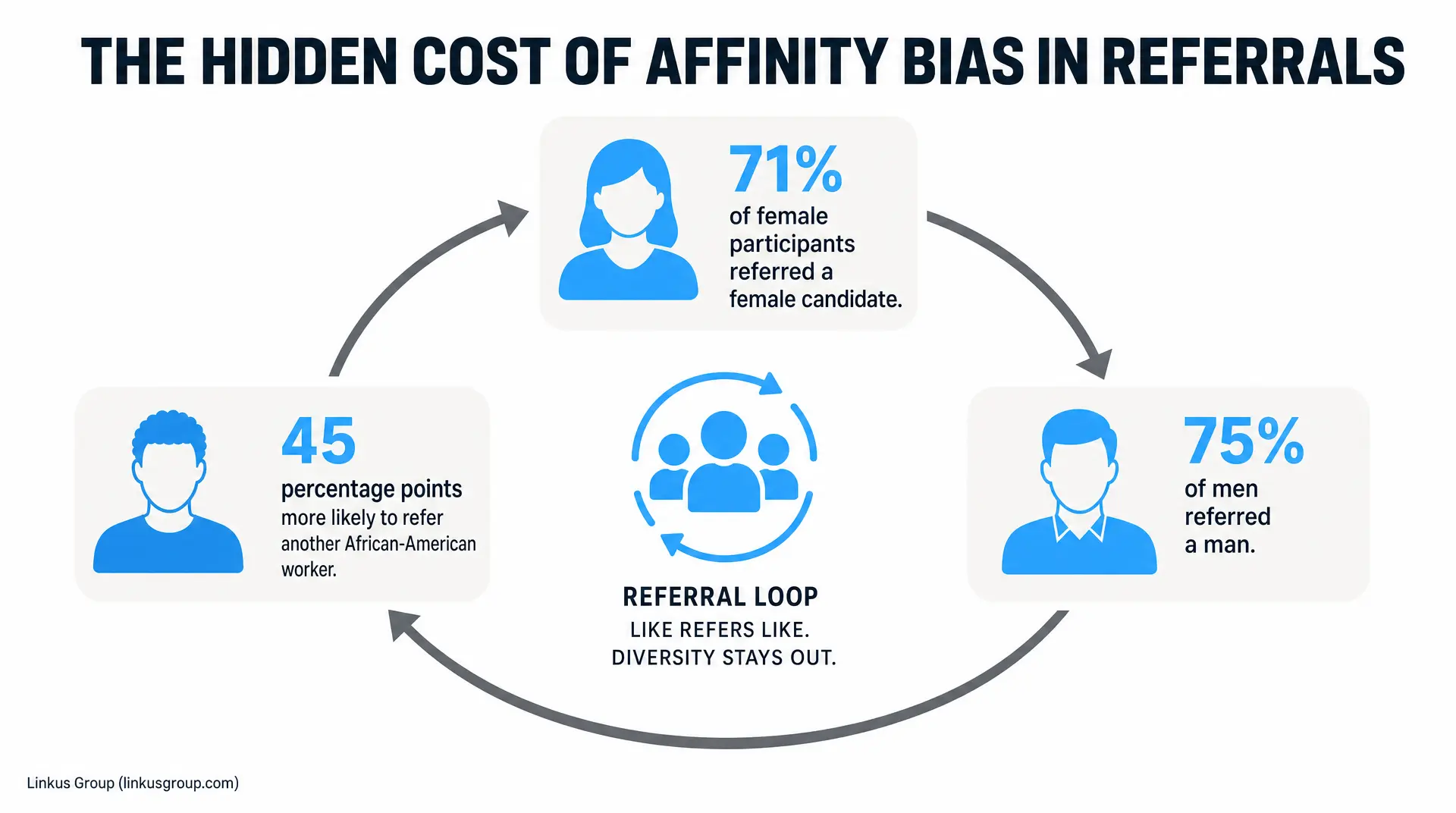
Referrals reproduce the team you already have. A 2025 field study out of Sweden found that 71% of female participants referred a female candidate and 75% of men referred a man for a real job. A Columbia Business School study found an African-American employee was 45 percentage points more likely to refer another African-American worker.
People refer people like themselves. It's not malice, it's human nature. But if your entire pipeline is post-and-pray plus referrals, you've built a machine that keeps hiring the same profile on repeat. Then everyone wonders why the team never changes and the founder's biases never get challenged.
This is exactly why the best hire is usually the one you'd least expect. Most people walk into hiring with a bias baked in. Someone from a company they trust, a school they know, a friend of a friend, a personality test they passed. They keep loading the same ingredients and getting the same result. Passive sourcing done right breaks that loop, because you're building the pool around who genuinely solves the business problem, not who's already in your orbit.
How Should Recruiters Structure Initial Outreach Messages to Engage Passive Talent Effectively?

Say you commit to chasing off-market talent. The place internal recruiters fumble it most is the very first message.
The mistake is leading with your company instead of leading with them. Most first outreach is a job description pasted into a LinkedIn DM. "We're a fast-growing company, great mission, competitive benefits." Nobody heads-down at a good job stops for that. Job descriptions suck. If they worked, I'd be out of a job. And the best people won't apply to one anyway, because they're already employed and your bullet points don't move them.
You have to market the opportunity to that one specific human. It sounds more like, "I've got something great I think you're going to want to hear about, and here's why. Are you open to giving me 30 seconds?" The hook shifts every time, but it's always about them. This role is for you. You were basically born for this. Something interesting enough that a busy, happy person actually pauses.
Getting the first conversation isn't the hard part. Keeping it going and confirming fit is. And this is exactly why AI can't replace this work. A top performer is far less likely to answer a bot than a real person who understands their world, someone who'll actually pick up on a weekend when they're weighing the biggest career decision of their year. We spend 90,000 hours of our lives at work. That conversation has to be human to human.
Why Are Structured Interviews and Effective Employee Onboarding Critical for Precision Recruitment?
I'm not telling you to switch off your job postings. I'm telling you to stop treating that pile as your strategy, because it runs on luck and it bakes in bias.
The shift is from volume to precision. When we take a mandate, we don't dump 30 resumes and let decision fatigue do the sorting. We do the deep work up front and send one highly vetted, correctly aligned candidate. And more times than we can count, the client hires the first person we send. That's what happens when you do this every single day, across hundreds of companies, instead of once a quarter for one. Proof is in the pudding, and when clients see it, they stop arguing.
There's real science under that instinct too. The same 2022 meta-analysis found structured interviews carried an operational validity of .42 versus .19 for loose, gut-feel ones. The lesson isn't "read from a rigid script." It's that assessing the same core traits consistently beats winging it. That's what TAG and PREP give us: a consistent lens delivered like a conversation, run almost like a podcast, so the real person shows up instead of the rehearsed one.
Precision at the offer stage means nothing if you fumble what comes next. I always say 90% of recruiting is onboarding, and the numbers on how badly companies handle it explain why. Gallup found only 12% of employees strongly agree their company onboards well, organizations lose a third to two-thirds of new hires within the first year, and manager involvement makes people 3.4 times as likely to call onboarding a success. Land a brilliant passive candidate, then hand them a laptop and a Slack invite on day one, and you've wasted the entire search.
One last thing for the internal recruiter fighting biased hiring managers. Trust is your leverage. Once a founder trusts that you know the market, you've earned the right to push back when their focus is wrong. That's the job. Recruiting is matchmaking, and you're there to protect both sides of the match.
The companies that win talent in 2026 won't have the biggest job-board budget or the slickest careers page. They'll be the ones who stopped waiting for the right person to show up and started going after them.
Your next great hire is out there right now, doing excellent work for somebody else. They are never going to apply to your posting. So go get them.
Frequently Asked Questions
How should a bandwidth-constrained HR team balance inbound active candidates with passive sourcing?
Stop letting the inbound queue dictate your day. LinkedIn data shows 22% of HR pros burn 3-5 hours daily just sifting applications. Outsource the heavy lifting of passive executive searches to a trusted partner, and strictly timebox your active pipeline review to protect your bandwidth.
How do I convince a founder to abandon active job boards when hiring for specialized C-Suite roles?
Show them the data. Active job boards deliver volume, not signal. Gallup found 52% of U.S. employees are open to new roles. The executives who will scale the business are crushing it elsewhere, not scrolling job boards. We must hunt them directly.
If resumes from active candidates are largely AI-generated, how do we accurately assess their actual skills?
Abandon the resume entirely and move to skill-based validation. LinkedIn reports 93% of talent professionals agree accurate skill assessment is critical. Companies prioritizing skills over pedigree are 12% more likely to make a quality hire. Use structured interviews to test Trust, Attitude, and Grit.
How do we reject mismatched active candidates at scale without damaging our fragile employer brand?
Automate respectful closures. Silence is the ultimate brand killer. iCIMS data shows 51% of people are less likely to buy from a brand after a bad hiring experience. Set up triggers to decline unqualified active applicants quickly. Treat their time with respect, even if they aren't a fit.
Are there effective ways to filter out AI-spammed active candidates before the interview stage?
Yes, by raising friction slightly on the front end. Greenhouse found 22% of candidates use AI to mass apply. Counter this by asking one hyper-specific, scenario-based question in the application. AI gives generic answers. A real expert provides nuanced insight that machines cannot fake.