

Before you start a CRO executive search, figure out whether you have a sales execution problem or a sales strategy problem. A Chief Revenue Officer is mainly a hire for scale. If you're under 50 people and still working out who buys and why, the person who moves your business forward is often a hands-on revenue leader who can sell, experiment, build the process and eventually lead a team.
Key Takeaways
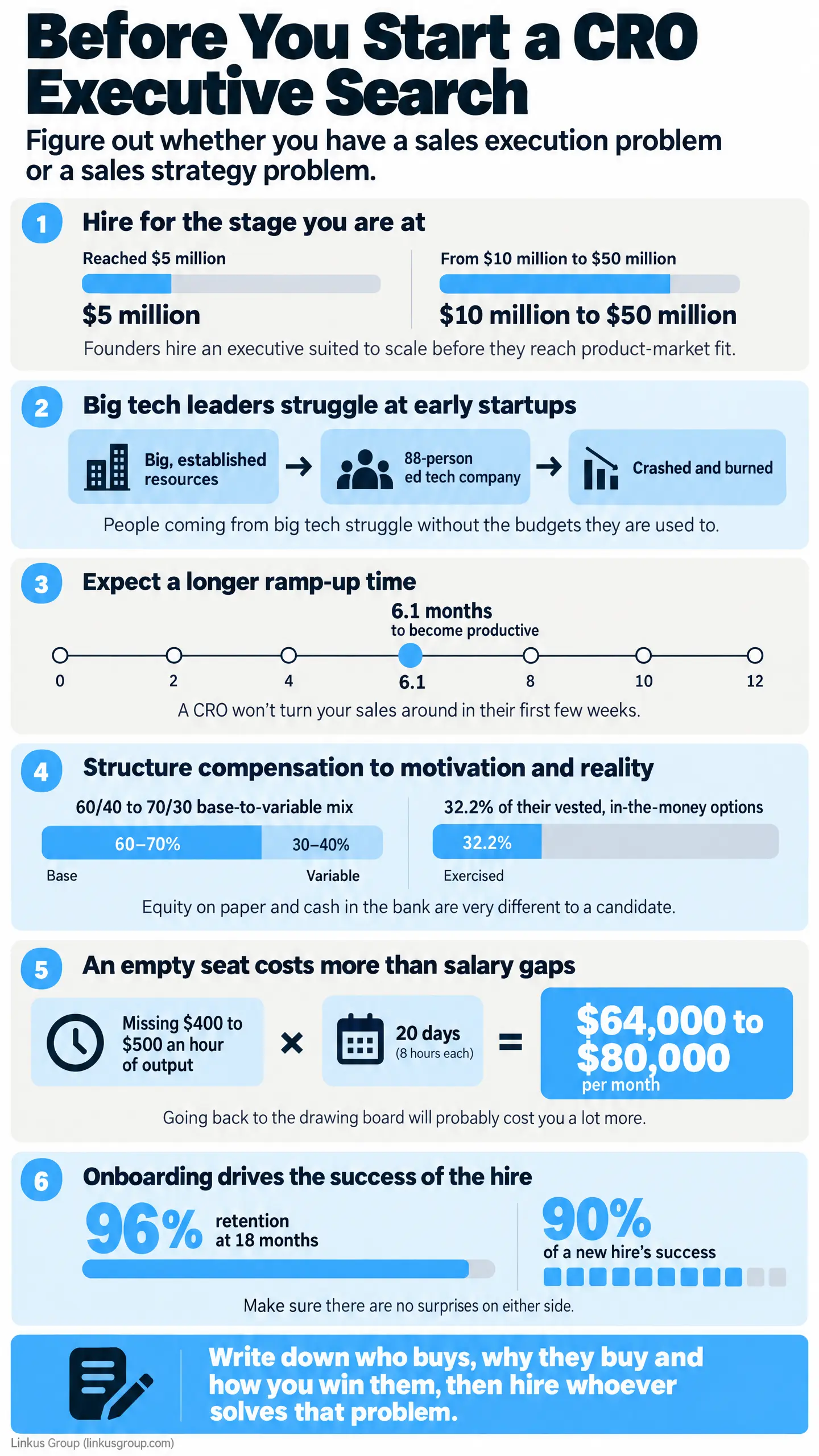
- Tech founders frequently make the mistake of hiring Chief Revenue Officers suited for $10 million to $50 million growth stages before the startup reaches $5 million in revenue.
- Missing a $200,000 revenue leader costs early-stage tech startups an estimated $64,000 to $80,000 per month in lost output.
- Tech founders substituting startup equity for a Chief Revenue Officer base salary shortfall should offer equity valued at double the missing cash amount.
- Experienced external sales executives require an average of 6.1 months to become productive according to Sales Management Association benchmarks.
- Revenue leaders transitioning from large technology companies frequently fail at early-stage startups because they rely on established brand recognition and high monthly marketing budgets.
- Linkus Group maintains a 96% candidate retention rate at 18 months by utilizing contingency-based executive searches that present vetted candidates within 48 hours.
How Do Sales Execution and Sales Strategy Problems Affect Chief Revenue Officer Executive Searches?

If you've proven product-market fit, know your ideal customer, have a repeatable sales process and know what's driving revenue, then hiring a CRO to scale is probably the right move. You've got something that works, and you need someone who's seen the movie before and can take it to the next stage. Get that leader in before you add a pile of reps. I've used a food tech company to warn founders about this: hire a big batch of salespeople without the right leadership in place, and each new hire ends up losing the company money.
The harder questions are who buys from you, why they buy, how you win them consistently and what your sales motion should look like. If you can't answer those yet, you've got a strategy problem, and a CRO isn't necessarily going to solve it. You don't have to figure it out alone. Sometimes the right executive, a consultant or an outsourced firm is exactly who you need to build the strategy. The mistake is hiring someone who's great at scaling an established sales organization when you need someone who can build one from scratch.
Each revenue hire fits a different startup stage, from a founding salesperson who works out who buys and why to a CRO who scales a proven, repeatable sales process.
|
Revenue hire |
Company stage it fits (ARR, headcount) |
Sales problem it solves |
Typical pay (USD, 2025-2026) |
|---|---|---|---|
|
Founding salesperson (founding account executive) |
Under $5M ARR, under 50 employees, after founder closes 10-20 customers |
Strategy problem – who buys, why, and how to win them |
$100,000 base / $200,000 OTE, median for all US AEs (mid-2026) |
|
Head of Sales |
Usually around $1M-$2M ARR, once two reps hit quota |
Building the sales process and leading the first reps |
$159,000 base / $250,000 OTE, US median (2025) |
|
VP of Sales |
Over $5M ARR for 54% of surveyed US startups (first CRO or VP hire, 2024) |
Leading a growing rep team on a proven process |
$200,000 base / $350,000 OTE, US median (2025) |
|
Chief Revenue Officer (CRO) |
After product-market fit, scaling about $10M-$50M ARR |
Execution problem – scaling a proven, repeatable sales process |
$180,000-$275,000 base / $350,000-$600,000 OTE, US Series A-B under $10M ARR (2025) |
|
Fractional or outsourced sales leader |
When who buys and why is still unclear |
Building the sales strategy and process |
$11,732 average per month, US and Canada (2025) |
Why Must Tech Founders Establish Repeatable Sales Processes Before Hiring a Chief Revenue Officer?
I've seen this play out with founders who built a successful business largely through their own relationships, network and ability to sell. They can't do everything themselves anymore, so they decide it's time for a CRO. Then we dig into the role and realize how much of the sales success still lives in the founder's hands. There's no clearly defined process, no predictable pipeline, and sometimes not even a consistent understanding of why customers buy.
The founder is hoping for someone who'll come in, scale the business and hit the ground running. Before anyone can scale sales, somebody has to make sales repeatable without the founder, since an employee is never going to sell the same way a founder will. Those are very different skill sets, and I've seen the wrong-stage version of this hire fail a bunch of times.
Founders also frequently hire an executive suited to take a company from $10 million to $50 million before they've reached product-market fit or $5 million. Hire for the stage you're at, since that's the company the person walks into. At this stage it's rare for a founder to be better off doing anything other than selling, so your founding salesperson should multiply your time in sales.
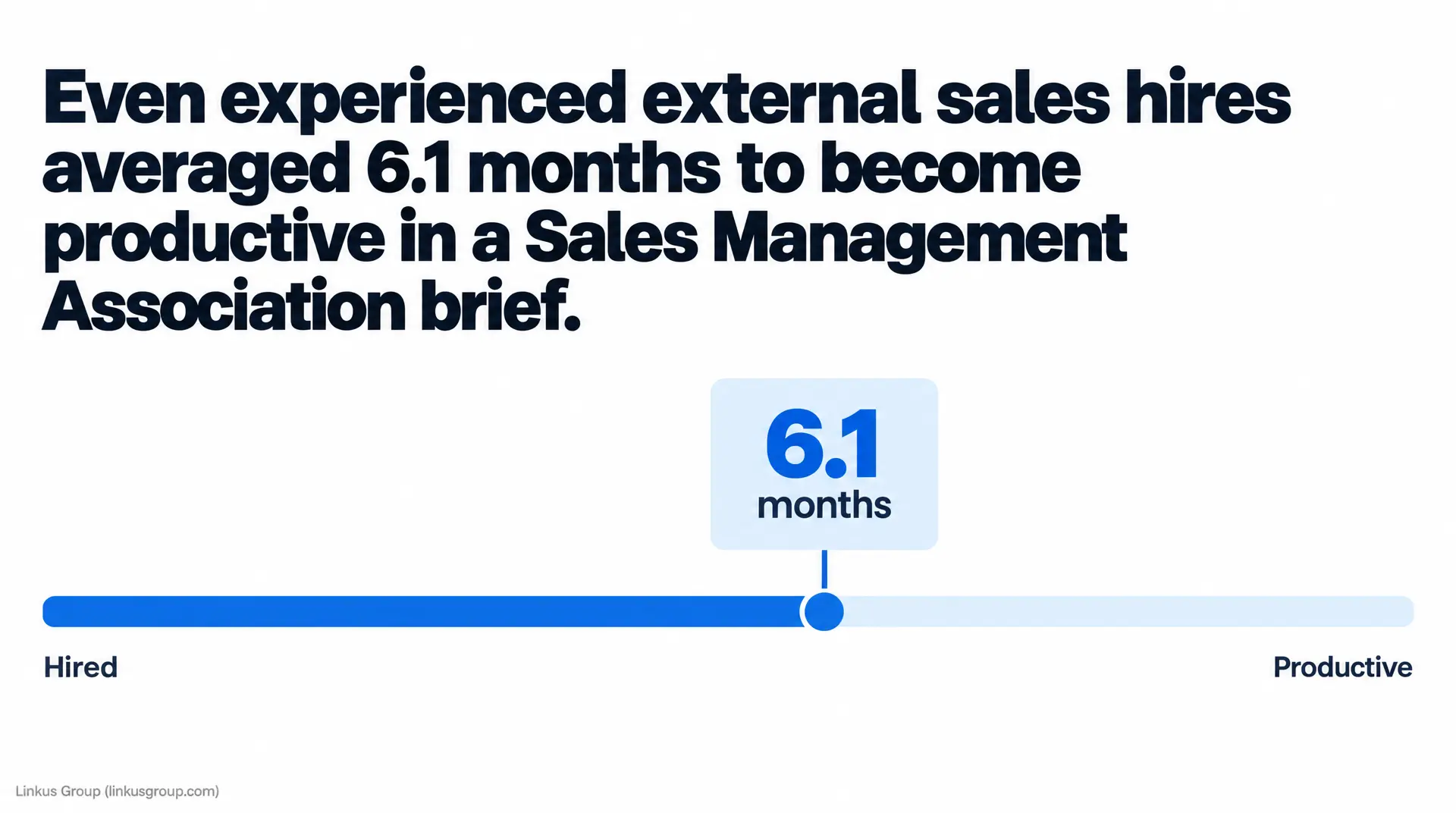
Give the right person time, too. Great hires sometimes take a little longer to get going before they become your top performer. Even experienced external sales hires averaged 6.1 months to become productive in a Sales Management Association brief. That's an older benchmark, and firms measure it differently, but it tells you a CRO won't turn your sales around in their first few weeks.
How Should Tech Founders Prioritize Job Requirements During a Chief Revenue Officer Executive Search?

A lot of the time, people want to pile everything into one hire, and that's your unicorn. An entrepreneur can do a lot of those things. Great employees can do a lot of great things too, but they're usually pretty pointy at one. A hockey team has somebody who's best in goal, somebody at forward, somebody on defense and somebody in the coach's seat. The goalie can still skate with the puck, right, but their ultimate number is save percentage.
Job descriptions suck, and if they worked I'd be out of a job, so when I sit down with a founder I ask other questions. Why did you start the business? What challenges have changed since last year? Where are you trying to get to? What isn't moving the business forward right now? Then we test those assumptions, because you can solve a problem and still miss the one holding the business back. When the wish list doesn't match what the market gives you for the money, you've got three levers: compensation, location and requirements. If you won't move one of them, you're not going to get far.
With candidates, I want to know where they play best. If you could choose one thing, what would be your superpower? What would you be known for? What can you do with your eyes closed, for less money than most people? What sets you apart?
I advised a tech founder to hire their founding salesperson for the ability to talk to customers, which solved their biggest constraint, rather than for industry experience. Their own preferred candidate turned down the offer, so they hired the one I'd recommended, and that person thrived.
How Should Tech Founders Evaluate Chief Revenue Officer Candidates for Sales Process Building Capabilities?

Revenue candidates sell for a living, so the interview has to get past the pitch. I run it like a podcast, conversational and unscripted, and I come back to the same things in different ways to see if the answers line up. How were you involved in the sale? When did you fail at one? Did you sell it on your own or did somebody help, and can I talk to them?
If they say they built a sales process, have them show it to you. If it's under NDA, have them walk you through every step: what they built, why, how, who was involved and who can verify it. Then ask how they'd build it at your company and what they'd need to ask you to succeed.
To test grit, the G in TAG alongside trust and attitude, I ask about a time they had to work harder than someone else on the team. I also ask about a time they found a way to work less. That second answer tells you a lot about whether you can trust them and whether they'll sneak around hard work. Since they'll lead a team, I also want someone who cares more about the team than about themselves, which is what separates a leader from an individual contributor.
Before you decide, run mock calls or bring them into a client meeting, and ask them to close you on hiring them. You're never going to remove the risk entirely. At some point you have to make the jump, because leaving the role open can cost you a lot more.
Why Do Revenue Leaders from Large Tech Companies Struggle at Early-Stage Startups?

You need salespeople who can sell an unknown logo. People coming from big tech companies often struggle at early-stage startups because they're used to a brand everyone recognizes, leads someone else generated and budgets you don't have. Hiring the right talent for your stage matters more than hiring top talent, so I warn founders against hiring a big name just because an investor wants one.
At an 88-person ed tech company, a newly hired executive crashed and burned because the founder didn't account for how much that person relied on big, established resources, like a high monthly marketing budget. I also recruited a top performer from Microsoft for a biometrics startup. They'd been there about 12 years, wanted a change and thought a startup was the right fit, and everything seemed to line up, but it didn't work out for the biometrics company. They left on good terms, decided they were a better fit for a bigger organization, and Microsoft hired them back.
You can lower that risk by being upfront. Tell a big-company candidate the job comes with a lot of autonomy and ambiguity, without the budget, teammates or mentorship they're used to. They'll be an entrepreneur inside an entrepreneurial business, where mistakes are a hundred times bigger and you can't hide behind them. Then look for self-awareness, realism over blind optimism, and someone who wants to understand more than they need to be right.
How Should Tech Startups Structure Chief Revenue Officer Compensation, Commission, and Equity Grants?
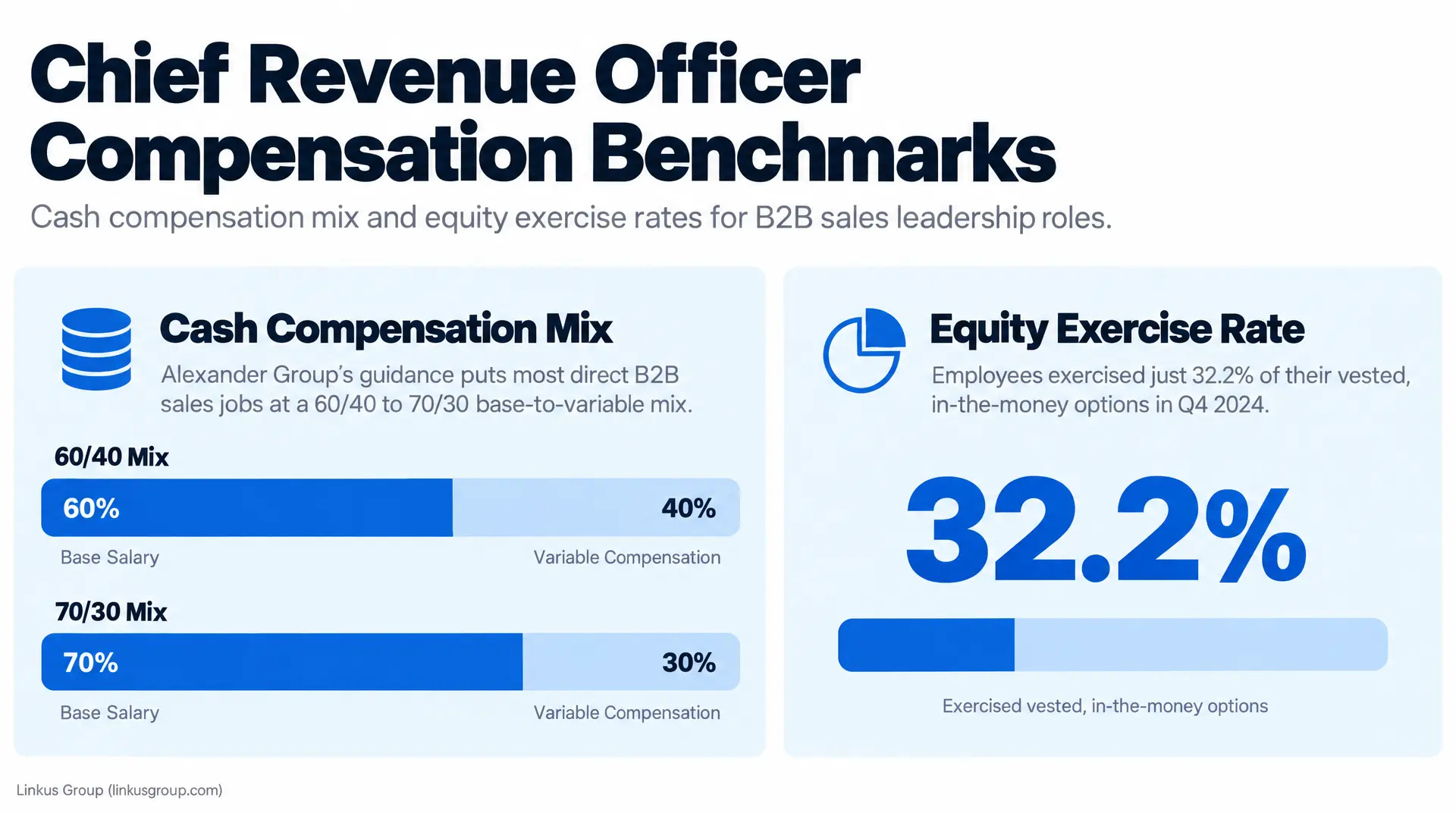
Commission is a meter stick for motivation. I like it aggressive and uncapped, because that helps you keep good people and attract better ones. Alexander Group's guidance puts most direct B2B sales jobs at a 60/40 to 70/30 base-to-variable mix, tied to how much sway the seller has over the buying decision. A hands-on builder who's still closing deals can carry more variable than a CRO who's mostly leading people, since managing a team pulls a leader off direct revenue.
If the person you want is a $200,000 hire and you can only afford $100,000, they're giving up $100,000 in hard-earned cash, right? My rule of thumb is equity worth about double that, roughly $200,000, depending on how long it takes to vest. Equity on paper and money in the bank are different things to a candidate. In Carta's data, employees exercised just 32.2% of their vested, in-the-money options in Q4 2024, so use the double to size the grant and be straight about what it might turn into. Growth is the number one driver for sales candidates, so be just as clear about bonuses and where the role can go.
You're also better off paying more for one really good person than hiring several average ones to hit a headcount number. I advised a 30-person, founder-led legal tech firm to hire single, high-performing salespeople and product managers rather than triple their headcount. That let them move methodically, stay highly profitable and absorb top talent from competitors that went bankrupt.
How Can Tech Founders Accelerate Chief Revenue Officer Searches to Minimize Revenue Vacancy Costs?
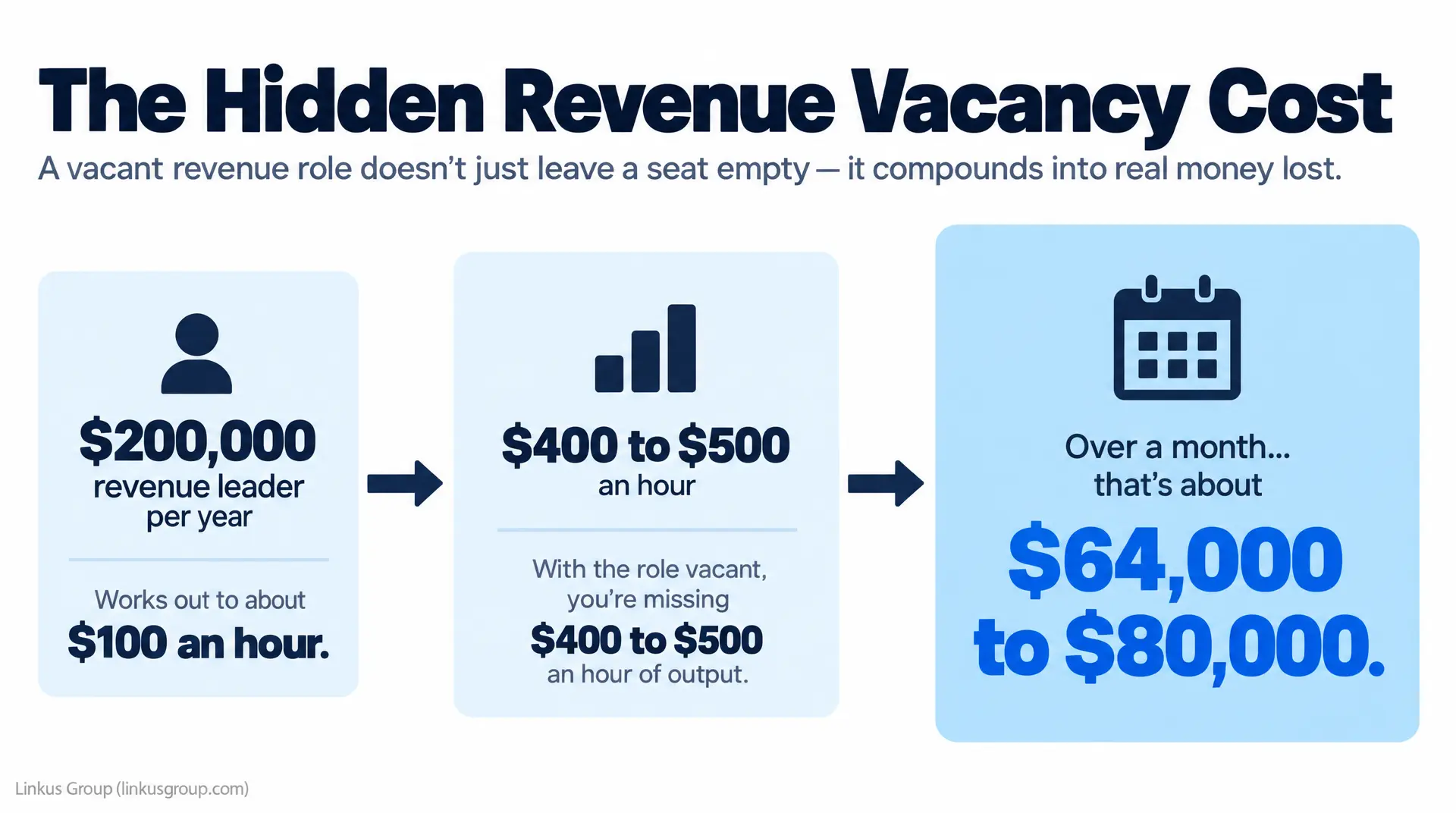
Hire slow, fire fast is the biggest lie ever told in hiring, and an empty revenue seat shows why. A $200,000 revenue leader works out to about $100 an hour over a working year of roughly 2,000 hours. Multiply that by four or five, roughly what a great hire should return on their salary, and you're missing $400 to $500 an hour of output. Over a month of 20 eight-hour days, that's about $64,000 to $80,000. Those are estimates, and they don't count the team covering the gap, where overworked people frequently end up leaving. Next to that, a $5,000 salary gap with the right candidate is small, and going back to the drawing board will probably cost you a lot more.
What kills quality in a fast search is a lack of clarity. Pre-plan every step, know exactly what good looks like, and agree up front on who makes the final call and who owns the outcome. Hiring processes frequently fall apart at the very end when someone who doesn't own the result vetoes the right person. One company stalled on a highly prepared Head of Sales candidate because they said they were too busy, which signaled the role wasn't a priority.
Plenty of recruiting is set up to get paid for process and time, which is how founders end up locked into upfront fees on a search that drags. At Linkus Group, we aim to put one highly vetted candidate in front of a founder within 48 hours. We won't always fill a role in 48 hours, since some are harder than others, but usually the person a client hires is the first one we sent. We're on contingency, so if that candidate isn't good, you don't hire them and we don't get paid.
Before you commit to a CRO, spend time together as if you already work together, with a conversation on the weekend or a meal. It's a bit like living together before you get married. And when you see the right person, be ready to decide on the spot, so a competing offer doesn't get the chance to land.
What Onboarding Strategies Maximize Chief Revenue Officer Retention and Performance in Tech Startups?

I'd put at least 90% of a new hire's success down to how you onboard and treat them after the offer is signed. That 90% is my own estimate, and research on new hires backs the direction if not the number. A meta-analysis covering 70 newcomer samples found that role clarity, confidence in the job and feeling accepted by the team helped explain how onboarding relates to performance, intentions to stay and turnover. For a revenue leader whose job is making sales work without you, that means explaining the good, the bad and the ugly before they start, so the role is exactly what they were told. Then guide them actively once they're in.
If you're layering them over a loyal early team member, make sure the team understands the mentorship the new leader brings and why it fits your stage. If it doesn't work out, own it, since blaming the candidate is usually an excuse. Our placements hold 96% retention at 18 months, and a big part of that is the time we spend with clients making sure there are no surprises on either side.
In your seat, I'd write down who buys, why they buy and how I win them, and I'd be honest with myself about how much of that answer is me. Then I'd hire whoever solves that problem, whatever the title, and be ready to say yes the moment they're in front of me. If you want a second set of eyes on the role before you kick off a search, I'm happy to jump on a quick call and talk it through.
Frequently Asked Questions
Should a seed-stage startup hire a CRO or a Head of Sales?
Titles matter less than the business problem. Carta's data shows the median seed-stage team size is just four people. At that size, you don't need a CRO to manage executives. You need a hands-on builder. Call them Head of Sales, but hire for grit, not a fancy title.
How do I handle CRO candidates demanding unlimited PTO and massive perks?
Walk away. Zero-to-one startups require survival skills, not a country club. If a candidate prioritizes unlimited PTO over the equity upside and the raw challenge of building a revenue engine from scratch, they lack the fundamental grit you need. Hire an entrepreneur, not a tourist.
Are mock pitch exercises actually accurate when assessing a revenue leader?
Yes, but they aren't foolproof. Meta-analyses show work-sample tests have roughly a 0.33 correlation with actual job performance. A mock pitch won't guarantee ultimate success, but it quickly exposes whether a candidate relies on big-brand resources or if they can actually sell your unknown logo.
How can Canadian founders stop US startups from poaching top revenue talent?
You can't outspend US cash, so out-compete on vision and equity. Since Carta reports employees exercised only 32.2% of vested options recently, equity often feels like fake money to candidates. You must clearly map out their realistic financial exit.
Should my new revenue leader focus on customer discovery or immediate sales?
Both, but expect delays. Research shows involving customers early increases your likelihood of closing, but it extends the time to sale. Your first revenue leader must balance exploratory customer discovery to nail down your product-market fit while hunting for short-term deals to keep the lights on.