

The cleanest resume in your stack is a record of the organization that made the operator look good. The team, the budget, the layers of support behind a name like Boeing stay behind the moment that person walks onto your 60-person floor.
OPM's own research puts raw years of experience at .18 for predicting performance, the weakest signal in the file, and you weight it heaviest. Hiring the past feels safer than judging the person sitting across from you.
The operator who actually holds your line at 11pm is the one you'd have screened out for missing a box.
Key Takeaways
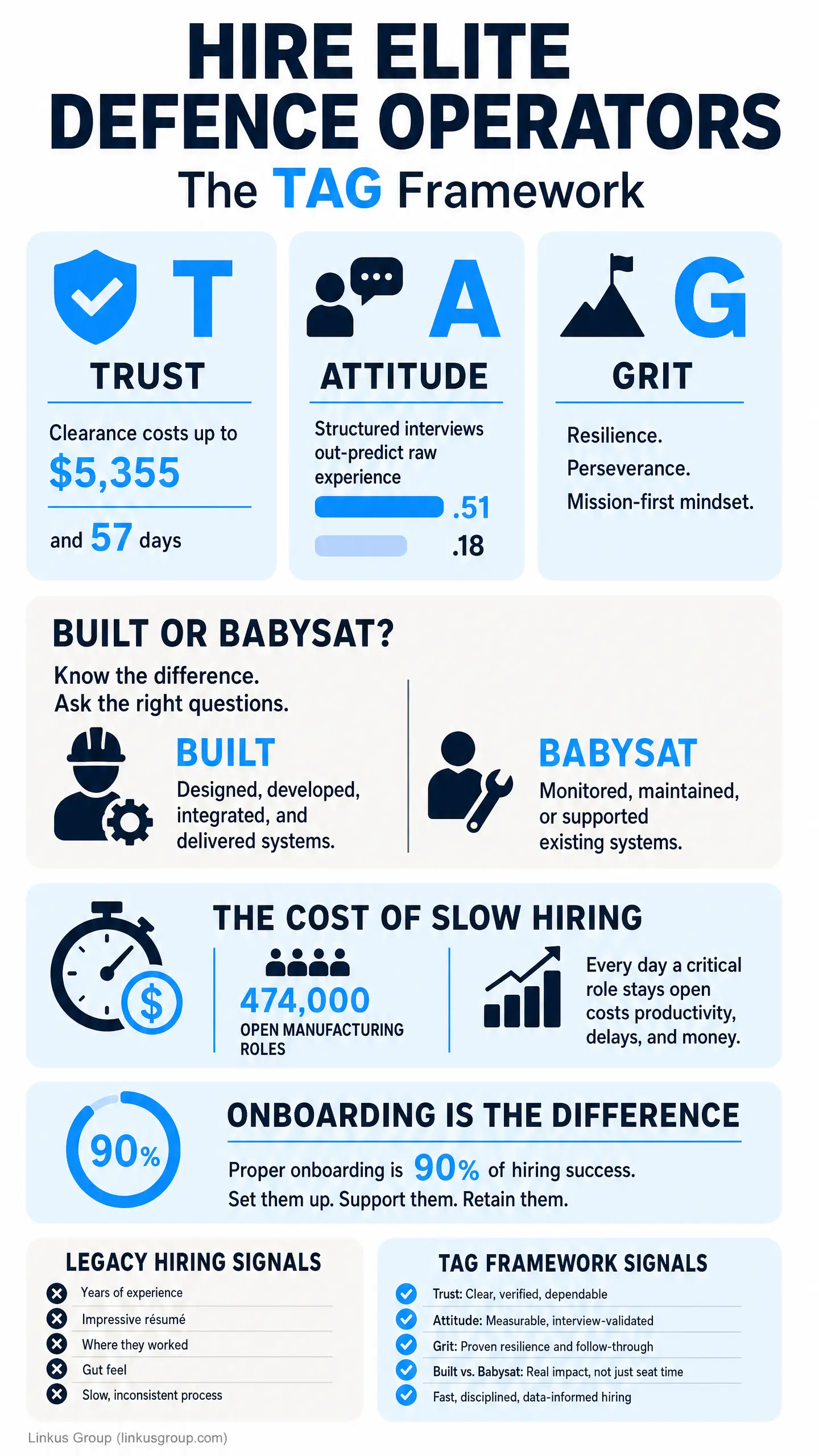
- DCSA background investigations average 44 days for Secret clearances and cost $5,355 for a Tier 5 investigation, creating significant financial and timeline risks for defense hiring mistakes.
- Office of Personnel Management research indicates that structured interviews predict job performance at .51, while raw years of experience offers a much weaker predictive signal of .18.
- Referred workers are 10% to 30% less likely to quit, providing critical stability for clearance-heavy defense manufacturing roles.
- Top performers leaving large contractors like Boeing often struggle at 60-person defense suppliers because they suddenly lack established budgets, dedicated teams, and structural support.
- Asking candidates how they would train a new employee to run a proprietary system from scratch reliably differentiates original system architects from inherited system operators.
- Hardware startup founders should offer senior operators equity valued at roughly double the amount of their foregone cash salary to ensure a fair compensation trade-off.
Why Is Trust and Security Clearance Verification Critical When Hiring Defence Operators?
In most industries trust is a soft word. In yours it has a dollar figure and a clock attached.
Think about what your operators actually touch. The DoD calls most of the sensitive data on a manufacturing floor Controlled Unclassified Information. Design information, performance specs, shop-floor execution data, supply-chain operational information. The kind of thing adversaries go hunting for. And they don't only go after the big primes. DoD has been clear they target subcontractors down in the lower tiers, where the whole base runs across more than 220,000 companies. With CMMC requirements now phasing into contracts, the person you hire isn't just doing a job. They're a node in your security posture.
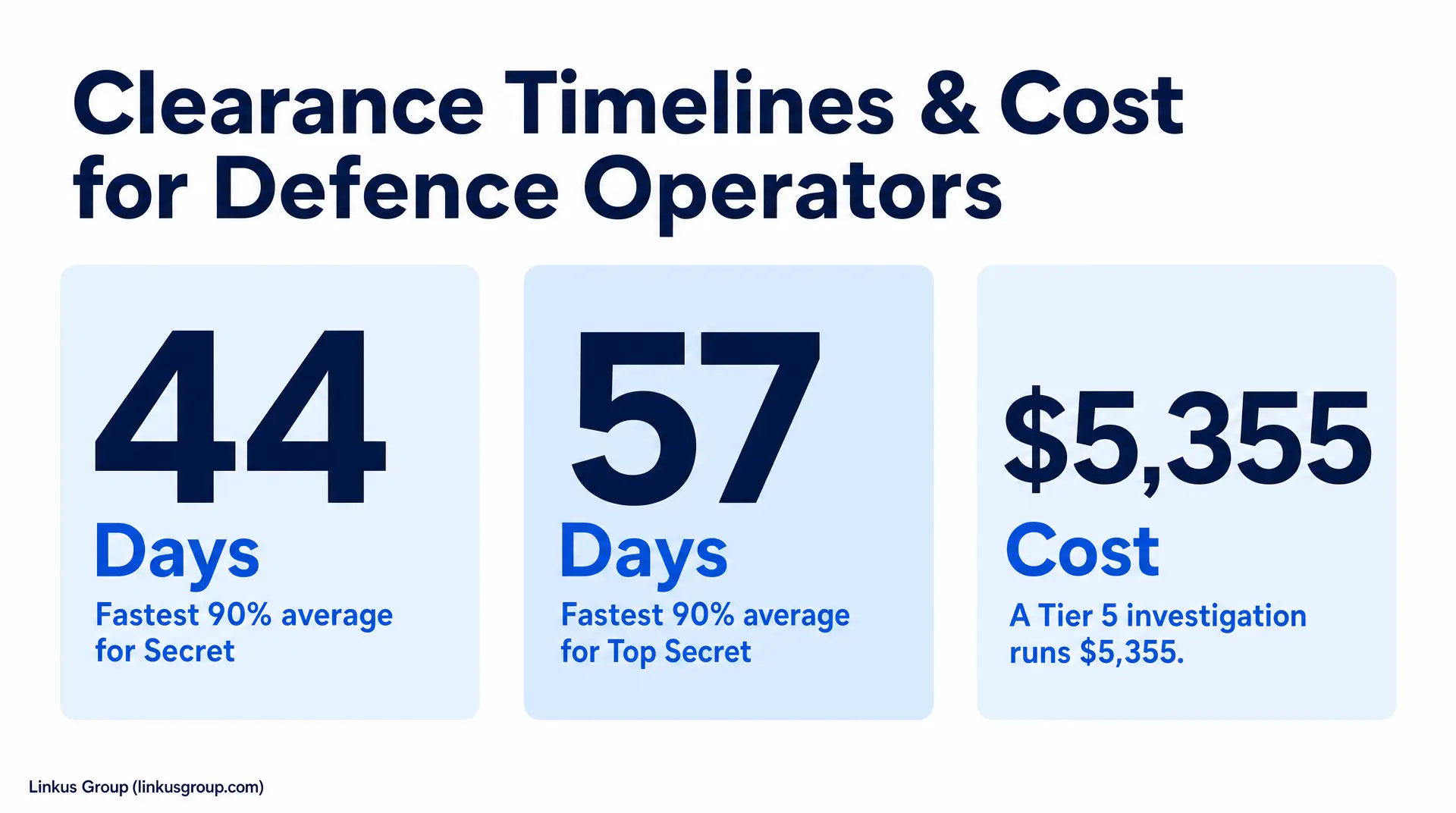
That's before clearances even enter the picture. By early 2026, DCSA's fastest 90% of background investigations still averaged 44 days for Secret and 57 for Top Secret. A Tier 5 investigation runs $5,355. So when you hire wrong in this space, you didn't just pay severance. You burned weeks of clearance runway and real money verifying someone who's now gone.
So how do I test for trust? I'm blunt about it. I'll tell a candidate straight up, we work with customers who have sensitive information, we deal with compliance, how do I know I can trust you with that? Then I ask for specific examples. If the answer comes back too clean, too rehearsed, I get suspicious. So I ask the same thing a different way two rounds later and see if the story holds up.
And I lean hard on references, because the data agrees with my gut. The strongest operators I've ever placed almost never came in with the cleanest resume. They came in because someone who'd already watched them hold the line vouched for them. A large referral study found referred workers were 10% to 30% less likely to quit, and OPM's own research puts reference checking around .26 on predictive validity. In a clearance-heavy role, a trusted referral isn't a nice-to-have. It's protected runway.
Why Is Candidate Attitude More Important Than Resume Experience When Hiring Defence Operators?

Here's a conviction I'll stake my name on. Skills can be taught. Attitude and drive cannot. If somebody is genuinely smart and hungry, you can teach them almost anything.
That cuts against how most hardware and defence leaders hire. You want someone who has shipped your exact product, in your exact category, with your exact vendors. I get it. Low ramp, knows the landscape, speaks the language. It's not a bad instinct. But it traps you, because you end up screening for the past instead of the future. OPM research makes the point cleanly: a structured interview predicts performance at around .51, a work-sample test even higher, while raw years of experience sits down at .18. You're over-weighting the one signal that means the least.
It also helps to know how small the obvious pond really is. The U.S. aerospace and defense prime base shrank from 51 contractors in 1993 to just 5 by 2000. The supply of people who've genuinely operated at scale in your world is far thinner than the resumes make it look. Fish only there and you'll wait forever.
Let me give you a real one. I once placed a genuine top performer out of Microsoft into a biometrics company. Twelve years at the company, brilliant, trustworthy, wanted a change, every box checked. It didn't work out. They missed the resources and structure of a big organization, and they went back. Microsoft actually rehired them. That's how good they were.
The lesson stuck. A great person inside a giant company does not automatically become a great operator inside your scrappy shop. When you pull someone out of a Boeing or a Lockheed into a 60-person supplier, talent usually isn't the problem. The gap is. They had a dedicated team, a budget, layers of support. You're handing them ambiguity and a fraction of the resources. Their attitude has to fit your floor, not the one they're leaving. So I dig in directly. Why are you leaving? What did the big-company structure give you that you're about to lose? How do you operate when there's nobody to hand the hard part to?
How Do You Evaluate Grit During Defence Manufacturing Operator Job Interviews?

Grit is the one that matters most in a capital-intensive, unforgiving environment. It's the extra gear. The willingness to own a problem at 11pm when the line is down and there's no team of forty to hide behind.
Now I want to be honest, because honesty is the whole business. Grit isn't a switch you flip with one clever question. A big meta-analysis pulled together 584 effect sizes and found grit only moderately tied to performance and very strongly tied to plain old conscientiousness. Which is exactly why I don't trust personality tests or a single silver-bullet question. If one question proved great hiring, everybody would ask it and you wouldn't be reading this.
So I treat the interview like a podcast. A conversation, not a checklist. And I circle the same outcome from a few angles. Tell me about a time you had to work harder than anyone else on your team. Why did you get into this work in the first place? Then the one that earns its keep: tell me about a time you found a way to work less.
That last question is gold. In a relaxed, candid conversation, things slip out. If a candidate lights up about how they snuck around a hard task or quietly offloaded the ugly part of the job, you just learned something no assessment would ever surface. On a floor where grit is the difference between hitting the delivery and eating a late penalty, that's the exact person you keep away from your operation. Nobody's ever been let go for working too hard.
What Is the "Built It or Babysat It" Test for Evaluating Defence Operators?
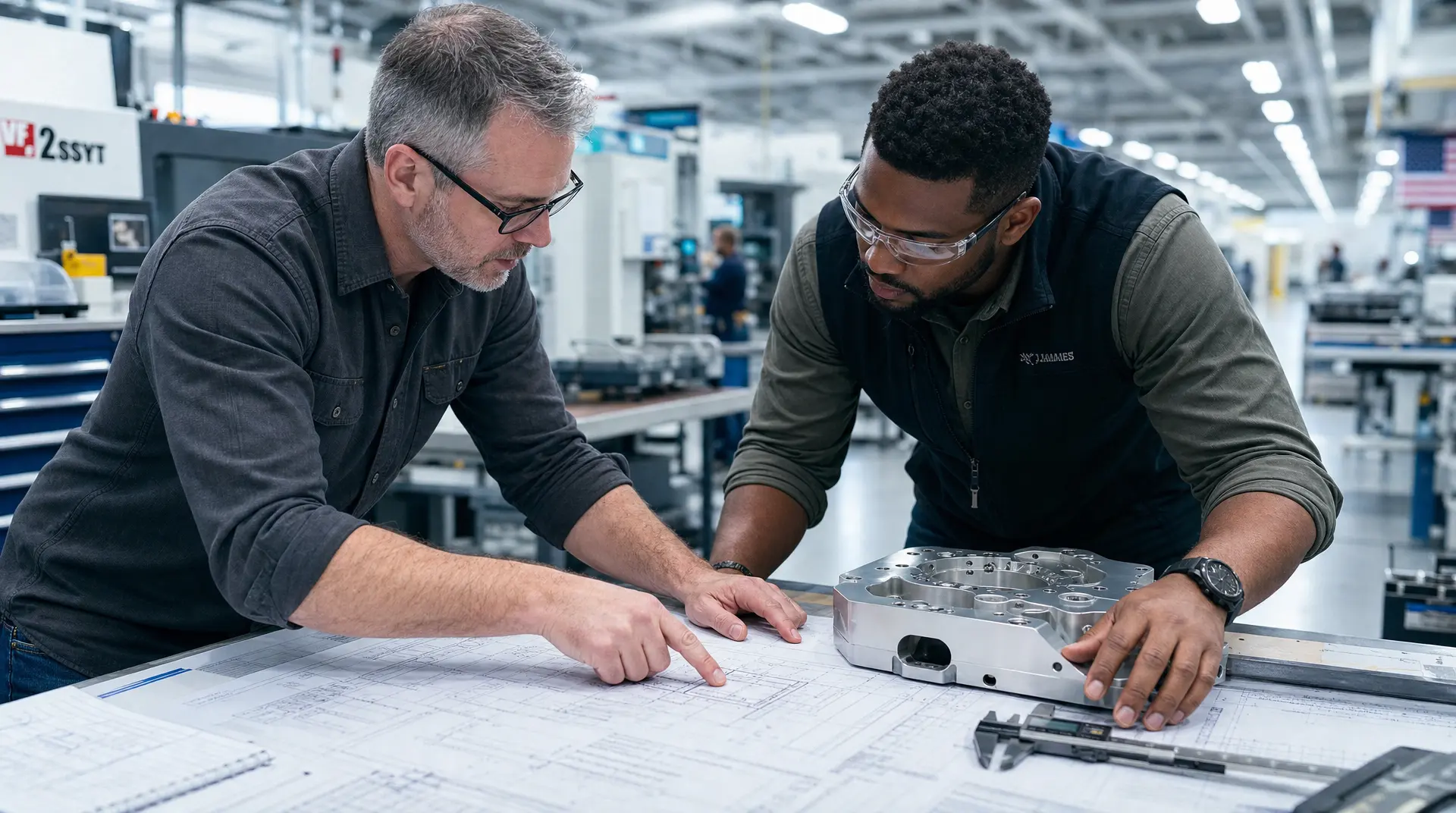
This is the one your world needs most, and almost nobody runs it properly. You have to know whether a candidate actually built an operational system, or just ran one some smarter person built five years before they showed up. Those are two completely different humans. One can do it again at your shop. One can't.
It's simpler than people make it. If the system isn't under NDA, have them show it to you. If it's proprietary, have them walk you through every single stage. What they built, why they built it that way, and exactly who was involved. Then I work backwards from training, because that's where the truth lives. How would you train a new person to run this from scratch? Someone who architected the thing answers in living detail. Someone who inherited a dashboard gets vague in a hurry.
Then I go to the references that actually count. Not the friend who vouches for their personality. The person who built it alongside them. Who on your team can verify this is what you put together, and why? After that, I hand them a live scenario tied to your business. If you had to build our inbound inspection process or our supplier scorecard from zero, how would you start? Ask me the questions you'd need to do it right. The quality of their questions tells me more than the polish of any answer.
How Does a Slow Hiring Process Negatively Impact Manufacturing and Defence Profit Margins?
Hire slow, fire fast is the biggest lie ever told in hiring. You never have to fire if you hire really well.
The instinct in a capital-intensive business is to go slow and be careful. But time does not improve the quality of your hire. Give a hiring team a longer runway and they don't reduce risk. They just add rounds and invite more people to veto the right candidate at the finish line. Speed doesn't kill quality. Not having clarity does.
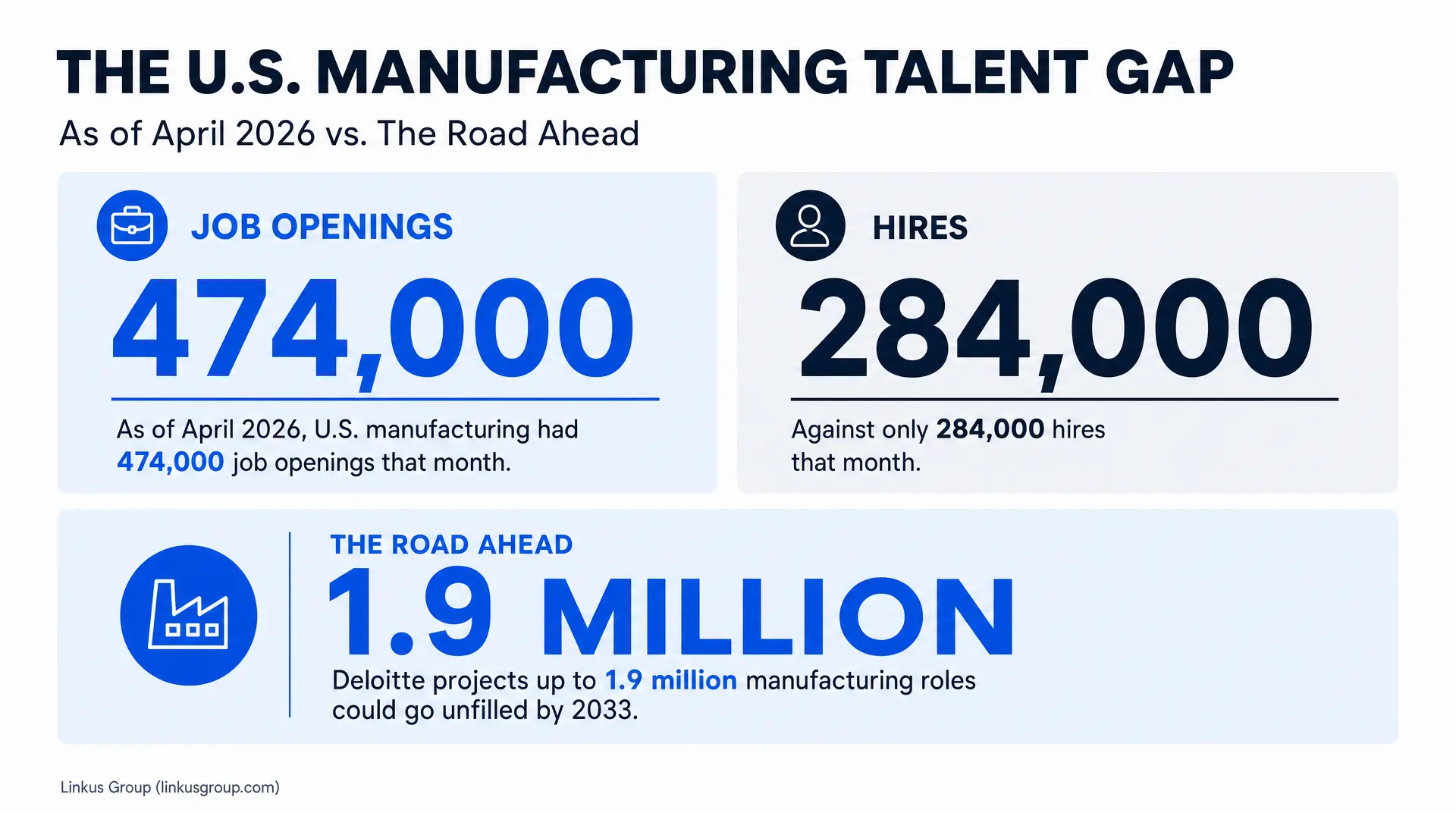
And the market won't sit and wait for you. As of April 2026, U.S. manufacturing had 474,000 job openings against only 284,000 hires that month, with durable-goods makers carrying the bulk of it. Deloitte projects up to 1.9 million manufacturing roles could go unfilled by 2033. When you finally meet the right operator, hesitating is how you lose them to the shop down the road. You have to be ready to move the moment you see it, the way you'd jump on a free agent before the other team signs them.
Run the actual math, because your CFO instincts are right to want it. Take the hourly rate of the target salary, triple it, then multiply by the hours you'll burn on the search and the six to nine months it takes a new operator to fully ramp. That's the real cost of the empty chair. Now stack the clearance clock on top, another 44 to 57 days before they can even start contributing. You lose more money and more team energy dragging out a search than you ever would by making a confident, well-diagnosed hire. The empty seat is the expensive one.
How Should Hardware and Defence Companies Structure Operator Compensation and Equity?

Compensation is where I watch hardware founders accidentally repel the exact operators they need.
A commission or bonus is really just a meter stick for motivation. The mistake is borrowing a structure from software, where deals close fast and the cycle is quarterly. Your product is physical, capital-heavy, and slow to turn. So the pay has to match that reality. If a candidate does direct, output-tied work, you can weight toward variable pay. If they're running a team or owning compliance, the quiet work that doesn't post a daily number, weight toward a higher base. Then tie the variable piece to your real cash flow and your real product cycle, not an arbitrary quarter that has nothing to do with when your line actually ships.
If you're cash-tight and want a senior operator to take equity instead of salary, be honest about the trade. They're giving up real cash that won't vest for years. My rule of thumb is that foregone cash should be worth roughly double in equity. People do what they want to do in the end. But if the trade is fair and you make it clear, the right one stays.
How Can Defence Companies Reduce Hiring Risk and Improve Operator Retention Rates?

After more than 15 years and a 96% retention rate at 18 months, here's the truth nobody selling you a hiring "solution" will say out loud. You can't guarantee a perfect hire. You're dealing with humans. Anyone promising you a flawless operator is selling you something.
What you can do is reduce the risk, and that is the entire game. TAG gives you the traits that survive pressure. The built-or-babysat test confirms the work was real. Speed gets you the person before your competitor does. Honest pay keeps them in the chair.
And remember where the real win gets decided. Onboarding is 90% of hiring success. A 2025 meta-analysis of newcomer research found that how well a new hire is socially accepted in their first months tracks with both their performance and whether they stay. You can run a flawless search and still lose a great operator in the first 90 days if you drop them on the floor and walk away.
One last conviction, and it's the one I'd bet my reputation on. The operator who performs best is usually the one you'd least expect. Most leaders hire with a bias. Same background, same prime, same checklist, and they keep getting the same result. The candidate who doesn't tick every box, but carries the trust, the attitude, and the grit, will out-work the perfect resume every time. Your job isn't to find the flawless one. It's to find the aligned one, move fast, and set them up to win once they're through the door.
Frequently Asked Questions
How does a bad operational hire impact manufacturing machine maintenance?
A weak operator breaks your line. NIST notes unplanned downtime costs U.S. manufacturing $18.1 billion annually. Reactive maintenance destroys margins. You need rigorous leaders who build systems to anticipate failure, rather than scrambling when the floor stops. Protect your capital by hiring proactive operators.
What is the true revenue cost of poor shop-floor execution in defence manufacturing?
Poor execution destroys customer trust. NIST estimates delayed deliveries and maintenance defects cost U.S. manufacturing $100.2 billion in lost sales. In defence, one defect kills a prime contract. You must hire operators who ruthlessly protect output quality and treat every manufacturing step as mission-critical.
Why are simulation skills becoming critical for defence hardware operators?
Hardware mistakes are too costly for the live floor. Demand for simulation skills jumped 75% recently. Elite operators now validate complex supply chains virtually before deploying real capital. This foresight drastically reduces your financial risk and prevents catastrophic manufacturing bottlenecks.
How does CMMC compliance change the hiring profile for lower-tier defence subcontractors?
It turns floor managers into security nodes. Strict CMMC requirements phase in on November 10, 2025. You cannot hire operators who treat data security as merely an IT issue. They must actively defend your vulnerable shop-floor execution data from adversaries targeting lower-tier suppliers.
How can hardware founders compete for talent when open roles vastly outnumber active candidates?
You stop waiting for perfect resumes. BLS data shows open manufacturing roles outnumber hires 1.7 to 1. The talent pool is mathematically drained. To win, you must hire for grit over exact industry experience. Move fast, make competitive offers, and onboard aggressively.