

The deliberate, careful process you trust to protect you from a bad hire is the exact thing costing you the good one.
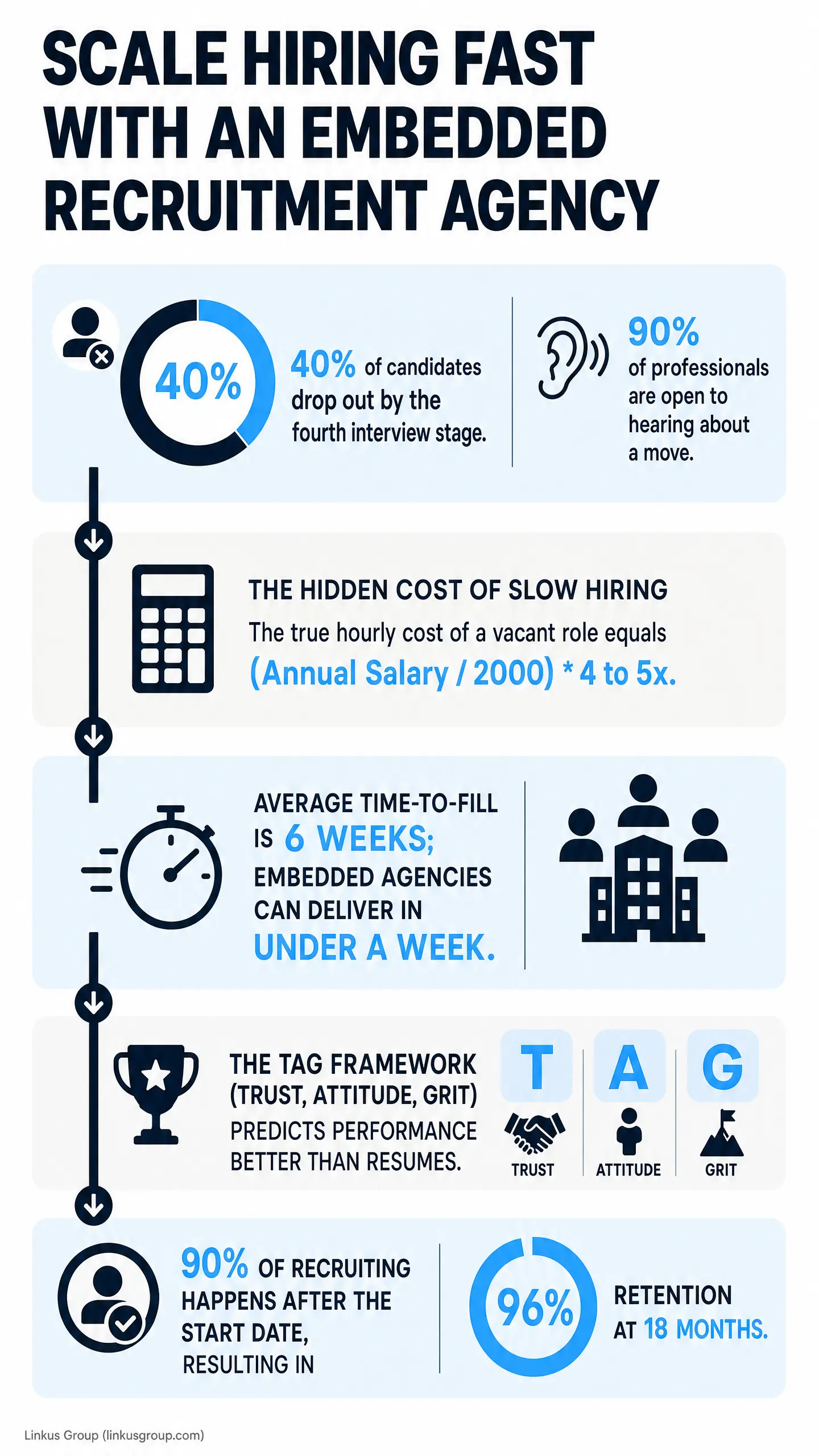
Every interview round you add for certainty deletes your strongest candidate from the pool. Greenhouse's 2024 research shows 40% of them tap out by the fourth stage, and the first to walk are the ones already holding offers elsewhere.
One company I watched won a major bank contract, then lost the entire project because their interview process couldn't match the deadline. All that diligence protected nobody. It handed the deal away.
Key Takeaways
- Greenhouse's 2024 research reveals that 40% of candidates abandon the hiring process by the fourth interview stage, causing companies to lose top talent to competing offers.
- To calculate the financial cost of a vacant role, divide the annual salary by 2,000 to determine the hourly rate, then multiply by three to four to measure lost output.
- Unfilled roles severely degrade existing teams, with Robert Half research directly linking unstaffed positions to burnout at 42% of organizations and increased turnover at 36%.
- The TAG recruitment framework evaluates candidates on Trust, Attitude, and Grit through unscripted, podcast-style interviews that test behavioral consistency better than traditional industry experience screening.
- Linkus Group achieves a 96% placement retention rate at 18 months by explicitly preventing the job scope bait-and-switch experienced by 53% of U.S. candidates.
- Linkus Group improves external recruitment by embedding directly into client Slack channels, operating strictly on contingency, and enforcing a written policy against working with direct competitors.
Why Do Startups Purposefully Under-Resource Their Internal Recruiting and Hiring Departments?

Recruiting is the only department in the company that you try to throw less resources at to get it right. Sales gets a tech stack and SDRs. Engineering gets infrastructure. You get a LinkedIn seat and a posting budget. People just kind of throw common sense out the window when it comes to recruiting.
And posting a job and trying to do hiring internally is just the bare minimum. It's like a salesperson making 10 phone calls a day and calling it pipeline.
Now look at the searches actually sitting on your desk. The CRO. The senior product manager. Those people don't apply to postings. They're employed, they're busy, and they've trained themselves to ignore recruiter messages. I've said for years that 90% of people are open to a better opportunity when it's presented the right way at the right time. LinkedIn surveyed more than 33,000 professionals and landed on the same number: 90% were open to hearing about a move.
Somebody has to make that presentation, though. Somebody has to call, market the role, and answer "why would I leave?" until it lands. That's a full-time outbound job stacked on top of the full-time job you already have. Closing that bandwidth gap is exactly what a real partner does while you keep building the engine.
How Can Startups Calculate the Cost of Vacant Roles to Justify Recruitment Agency Budgets?
Before process, let's handle the meeting where your founder questions the agency fee. "We need help" loses that meeting. Math wins it.
Take the role's annual salary and divide by 2,000. That's the hourly rate. Multiply by four or five, because every employee you hire should return three to four times their salary anyways. Now you have the hourly cost of the empty seat in lost output. Present it as a daily number and watch the room change.
I worked with an Amazon e-commerce brand where one unfilled manager seat left inventory decisions exposed – hundreds of thousands in weekly revenue riding on a chair nobody sat in. I also watched a company win a major bank contract, then lose the whole project to a competitor because their interview process couldn't match the project timeline. They needed three hires. They moved too slow. All that careful diligence protected nobody. It handed the deal away.
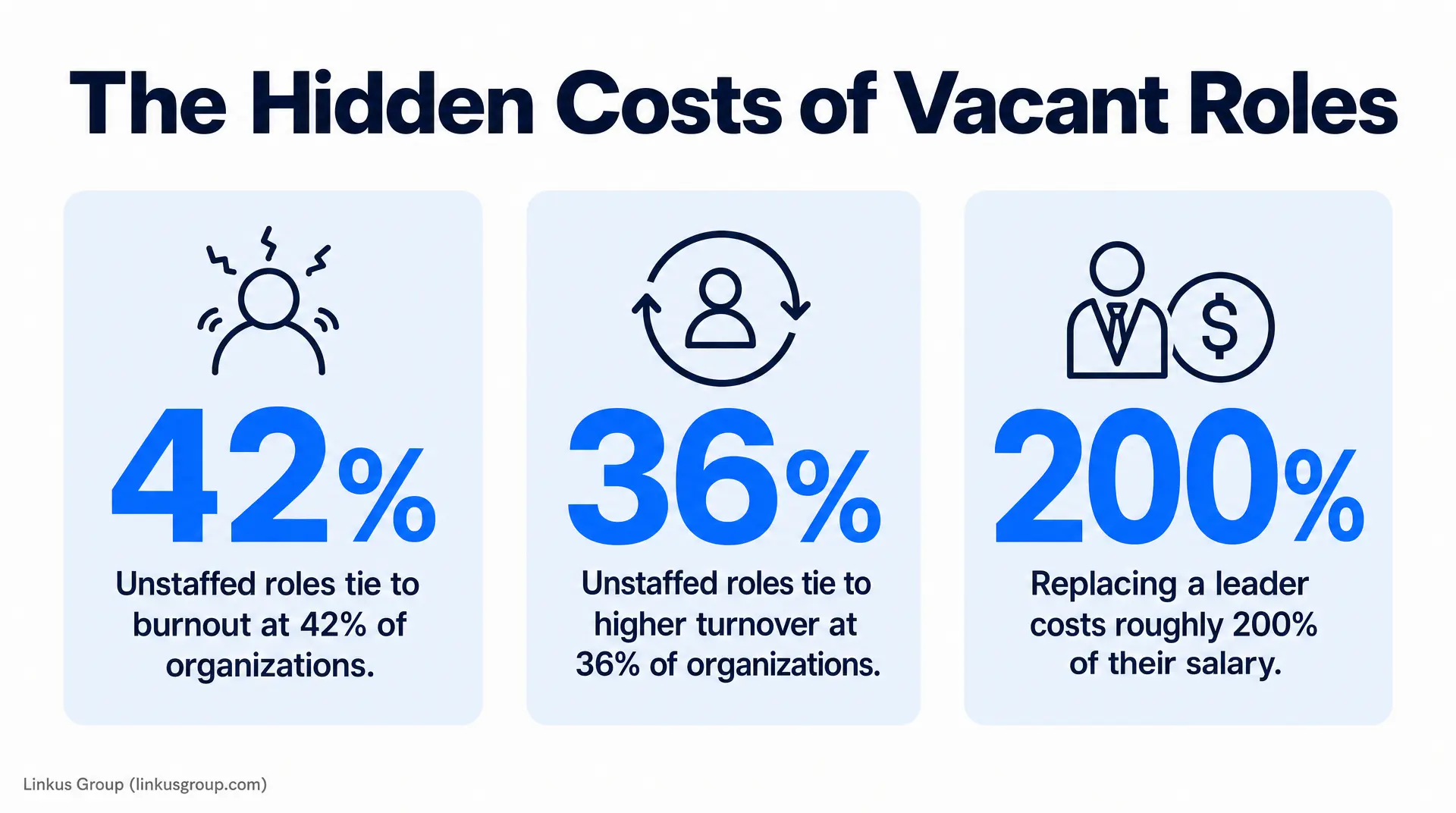
Vacancies also eat your existing team. Robert Half's hiring research ties unstaffed roles to burnout at 42% of organizations and higher turnover at 36%. The empty seat exhausts the people covering it, one of them leaves, and suddenly you're running two searches with a more cynical team watching. And Gallup puts the cost of replacing a leader at roughly 200% of their salary.
Stack all of that against a recruitment fee and the fee starts looking like a sales tool purchase. Money in, multiples out. You lose more money spending more time than hiring the wrong person. I'll stake my career on that sentence.
Why Does Lack of Role Clarity Hurt Hiring Quality More Than Fast Recruitment Speeds?
"Hire slow, fire fast" is the biggest lie ever told in hiring. You never have to fire if you hire really well. And time itself does nothing for quality. Give a hiring team six weeks and they'll fill six weeks – extra rounds, extra stakeholders, extra opinions, zero added certainty. SHRM benchmarks average time-to-fill at roughly six weeks. We deliver a vetted, top-choice candidate within 48 hours and typically complete placements in under a week.
People ask how we do that without cutting corners. Clarity, locked in before anyone gets sourced. Jobs are really just business problems that companies need to solve, so I run a deep discovery on the actual problem first. That usually means stripping a three-roles-in-one job description down to the single outcome this hire must own. Job descriptions suck – if they worked, I'd be out of a job.
Discovery also means naming the final decision-maker before the first interview happens. I've watched perfect candidates get vetoed at the finish line by a stakeholder who joined the loop in round 4 doesn't own the outcome of the role. The failure shows up at the end. It was caused at the beginning.
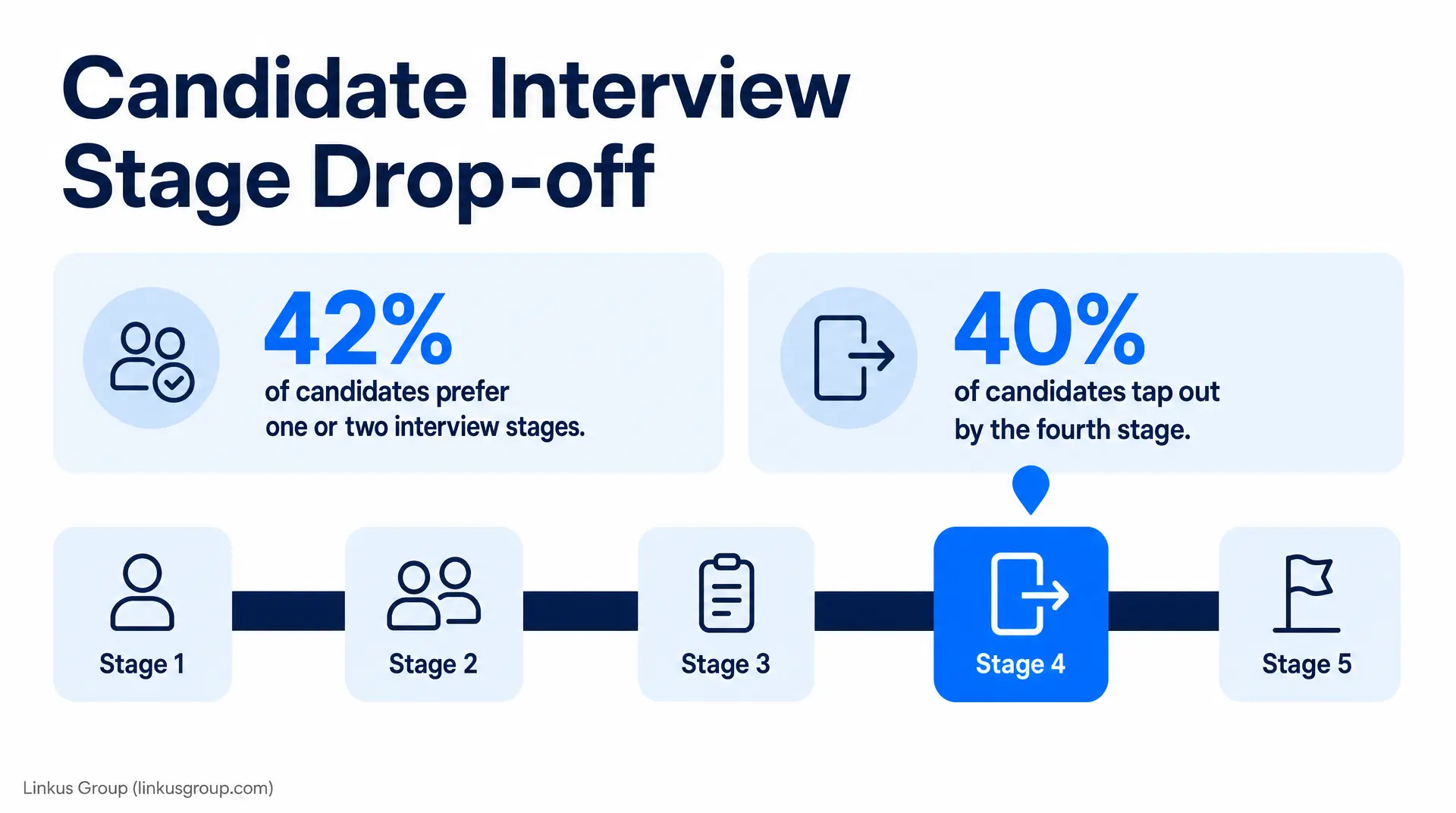
Candidates are begging you for the same discipline. Greenhouse's 2024 candidate research found 42% of U.S. candidates want one or two interview stages, and another 40% tap out at four. Every extra round quietly filters out the people holding competing offers, which is exactly the group you're trying to win. Top candidates are free agents. The team that hesitates watches them sign somewhere else.
Then, instead of flooding your inbox, I send one candidate. If you're Don Draper pitching a client, you don't show up with 10 ideas so everyone gets confused. You show up with the one idea you'd stake your name on. After enough at-bats, the pattern holds: usually, companies hire the first person we send them. Run that against your current interview-to-hire ratio.
What Are the Benefits of Using an Embedded Startup Recruitment Agency in Slack?

Let's be honest about why talent leaders distrust agencies. The big transactional shops get paid to do process. Layers, status updates, stacks of redacted resumes – activity that looks like work. When a role gets genuinely hard, they drift toward easier mandates and quietly ghost you. Meanwhile, every lazy outreach message they send goes out under your name, because to a candidate, that recruiter is your company. Greenhouse found 52% of U.S. candidates have been ghosted after an interview. Each one of them retells that story, and the villain is always the employer, never the agency.
I built Linkus Group to run the opposite way. We embed directly in your Slack or Teams channels, so communication happens where your team already works – your internal recruiting function, just sitting in another building. My team makes zero outbound sales calls. They're 100% dedicated to the accounts we already serve. And clients deal with me directly, weekends included, because candidates make career decisions on Sunday nights, and an offer that sits untouched over a weekend is an offer a competitor can beat on Monday.
Two policies do more work than any promise. We refuse to work with your direct competitors, full stop, which kills the conflict of interest that quietly poisons most agency relationships – and lets us headhunt from those competitors for you with zero divided loyalty. And we work on contingency. We get paid when you hire, not before. If we can't deliver quality at speed, we don't eat.
One more thing most talent leaders never get from an agency: intelligence about your own brand. We hear what candidates actually say about your company out in the market – the compensation chatter, the reputation whispers that never reach your internal surveys – and we feed it back to you before it costs you a finalist.
None of this replaces you or your internal recruiters, by the way. The strongest outcomes I've seen combine internal cultural knowledge with external market intelligence. You know the inside of the building. I know what's moving outside it.
How Does the TAG Framework Evaluate Candidate Trust, Attitude, and Grit Better Than Resumes?
You know this fight. A hiring manager who only trusts safe referrals and checkbox resumes. Brand-name employer, identical title, "must have sold into our industry before."
After two decades, my most unshakeable conviction is that the person that's going to do the best in the job is usually the person you'd least expect. The data backs me up. Research pooling decades of hiring studies found years of experience barely predicts job performance, while structured, probing interviews predict nearly three times better. A resume tells you where somebody sat. What they'll actually build in your environment lives somewhere else.
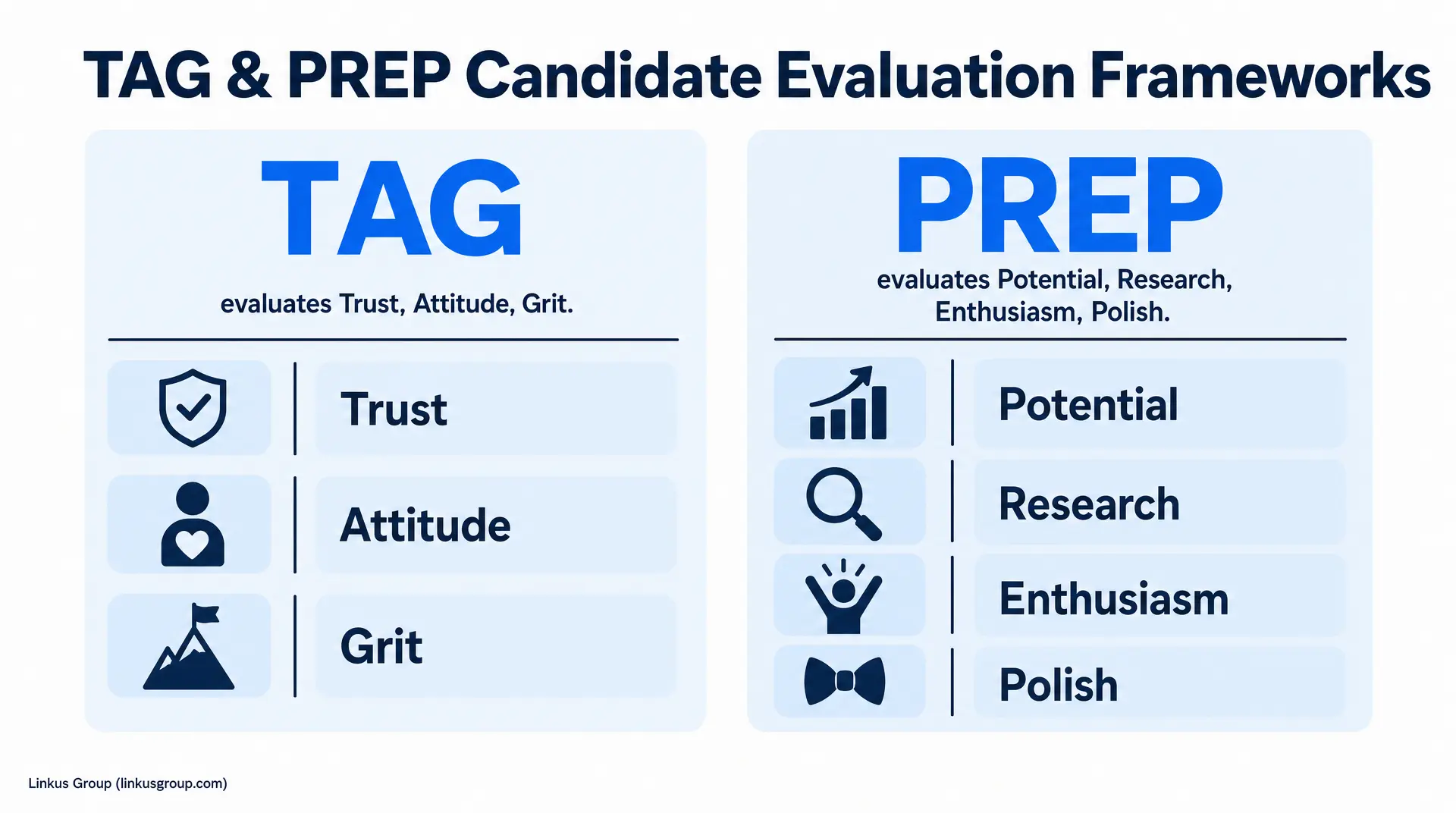
So we screen on two frameworks built across thousands of placements. TAG stands for Trust, Attitude, Grit: can I trust this person with sensitive information, do they make a room better under pressure, and do they bring that extra layer of work ethic when things get ambiguous? Nobody's ever been let go from a job for working too hard. PREP covers Potential, Research, Enthusiasm, Polish: where is their trajectory heading, did they do the homework on you, do they want this role specifically, and will they represent your brand well in front of customers?
The method matters as much as the acronyms. We run interviews like a podcast – unscripted, conversational deep dives instead of checklist scripts. I'll ask about trust directly: we handle sensitive salary data, how do I know we can trust you in those situations, give me real examples. Twenty minutes later I'll circle back to the same territory, framed differently, and check whether the answers line up. A rehearsed candidate keeps a polished story straight once. Almost nobody keeps it straight three times.
This buys you leverage internally, too. When a hiring manager anchors on industry experience, I walk them through their own journey – you didn't know this industry when you started either, you learned it because you cared. Skills can be taught. Attitude and drive can't. And sometimes the honesty points back at the client. One company came to us with rough Glassdoor reviews, below-market pay, and burned bridges across their talent pool. I told them straight: there are three levers – location, compensation, requirements – and if you won't move one of them, we're not the right partner for you. You deserve an agency that says that out loud, because it's the same voice that backs you up in front of your founder.
Why Does 90% of Successful Startup Recruiting Occur After the Candidate's Start Date?
Most agencies treat the signed offer as the finish line. I treat it as the 10% mark, because 90% of recruiting is the onboarding process.
Look at why placements actually crack. Greenhouse found 53% of U.S. candidates hit a bait and switch on job scope – the role they started differed from the role they were sold. Everyone hates surprises. A surprise in week two becomes a resignation by month four, and then you're defending your process in front of the board. So during every search, we talk about the good, the bad, and the ugly with candidates. It costs a few maybes up front. It saves the placements that matter.
Our placements hold a 96% retention rate at 18 months, and that number comes from alignment before the offer plus staying engaged through the ramp. When it lands right, it compounds for years. One candidate we placed went from a $70,000 salary to $500,000 and an exit with the company. The founder then started a new business and hired that same person back as co-founder. That's the trajectory you're actually recruiting for.
It's also why I push clients off "time to fill" as a metric. The true measure is time to quality of hire. A seat filled fast with someone gone in six months just restarts the clock, with interest. Only 20% of organizations track quality of hire at all. Start measuring it and you're instantly operating ahead of 80% of the market.
How Should Startups Conduct an Honest Recruitment Post-Mortem When a Candidate Placement Fails?

You know the dread meeting. A placement didn't stick, the agency gets defensive, the hiring manager points fingers, and you referee.
I once recruited a genuine top performer out of Microsoft for a biometrics startup. Twelve years at Microsoft, hungry for change, aligned on everything we could test. It still didn't work out. They realized they were built for a big organization, and Microsoft hired them back. That's how good they were.
My post-mortem rule: assume a portion of all three factors – the candidate, the company, and things nobody controls. Then diagnose without ego. Could this have been avoided in the interview process, and where exactly? Is there a turnover pattern on that specific team? Did the day-to-day match what was sold? Sometimes a human being simply changed their mind, because humans do that. The person you were 10 years ago is rarely the person you are 10 years from now.
Hiring is never going to be 100% perfect, but it's all about reducing your risk in hiring. An agency that gets defensive in that meeting was transactional from day one. You just found out late.
Why Is Repeat Business the Most Important Key Performance Indicator for Startup Recruitment Agencies?

At Linkus, our one true KPI is repeat business. I want to be your hiring partner for 15 years – through the leadership build-out, through the exit – and that only happens if every placement makes you look sharp in front of your founder and your board.
The prize is bigger than any one search. Companies rated highly capable at recruiting show 3.5 times the revenue growth of weak ones. Hiring is the biggest unlock in a company's business, and you're the one building the machine that does it.
So hold any partner to a hard standard. They should live in your Slack, put the no-competitors policy in writing, send one right candidate instead of 30 maybes, stay engaged deep into onboarding, and sit through the honest post-mortem when something breaks. If they flinch at any of that, they're selling you activity while you're trying to buy outcomes.
You've watched companies overcomplicate this your whole career. Strip it back. Get clear on the business problem, move fast on the right person, and treat the start date as the halfway mark. Hiring should actually be very easy. It shouldn't be overcomplicated.
Frequently Asked Questions
How do we justify the high upfront cost of executive searches to our board?
By showing them the math of a bad hire. SHRM data shows executive hiring costs nearly 7x more than nonexecutive roles. Gallup puts a leader's replacement cost at 200% of their salary. You aren't paying a fee just to fill a seat. You're buying insurance against a million-dollar mistake.
When should my internal talent team hand off a specialized search to an agency?
Hand it off the second it starts cannibalizing your pipeline for other roles. Unstaffed seats cause employee burnout for 42% of organizations. Your internal team needs to focus on culture and onboarding. Let a boutique partner hunt the off-market whales so your core engine doesn't stall.
How do we stop hiring managers from adding unnecessary interview rounds for 'culture fit'?
Remind them that top-tier talent won't wait around for consensus. Greenhouse research proves that 40% of candidates max out at four interviews. Every extra round deletes your strongest, most heavily recruited candidates from the pool. Lock in the decision-maker early and strictly cap your process.
How do we protect our startup's employer brand when rejecting highly qualified finalists?
Give them the actual truth, immediately. Over half of U.S. candidates report being ghosted after an interview. A transactional agency hides from bad news. A real partner picks up the phone. Treat rejections with deep respect, and those finalists will still advocate for your brand.
How can we push founders past 'checkbox' resume bias to find high-potential talent?
Confront them with the data. A massive meta-analysis shows 'years of experience' predicts job performance at a dismal 0.18 correlation. Resumes just tell you where somebody sat. Force your managers to use structured interviews that test for grit and adaptability. Skills can be taught. Drive cannot.