

Recruiting is the only department in your company where leadership responds to a problem by taking resources away.
The stalled search gets no sourcer, only a personality test, another panel, one more alignment call – theater that exists so someone has an object to point at when the hire goes sideways.
The executive on the other end reads those six weeks exactly right: a company that cannot make a decision, and does not think they are worth one. That read alone sends a third of candidates out the door.
Key Takeaways
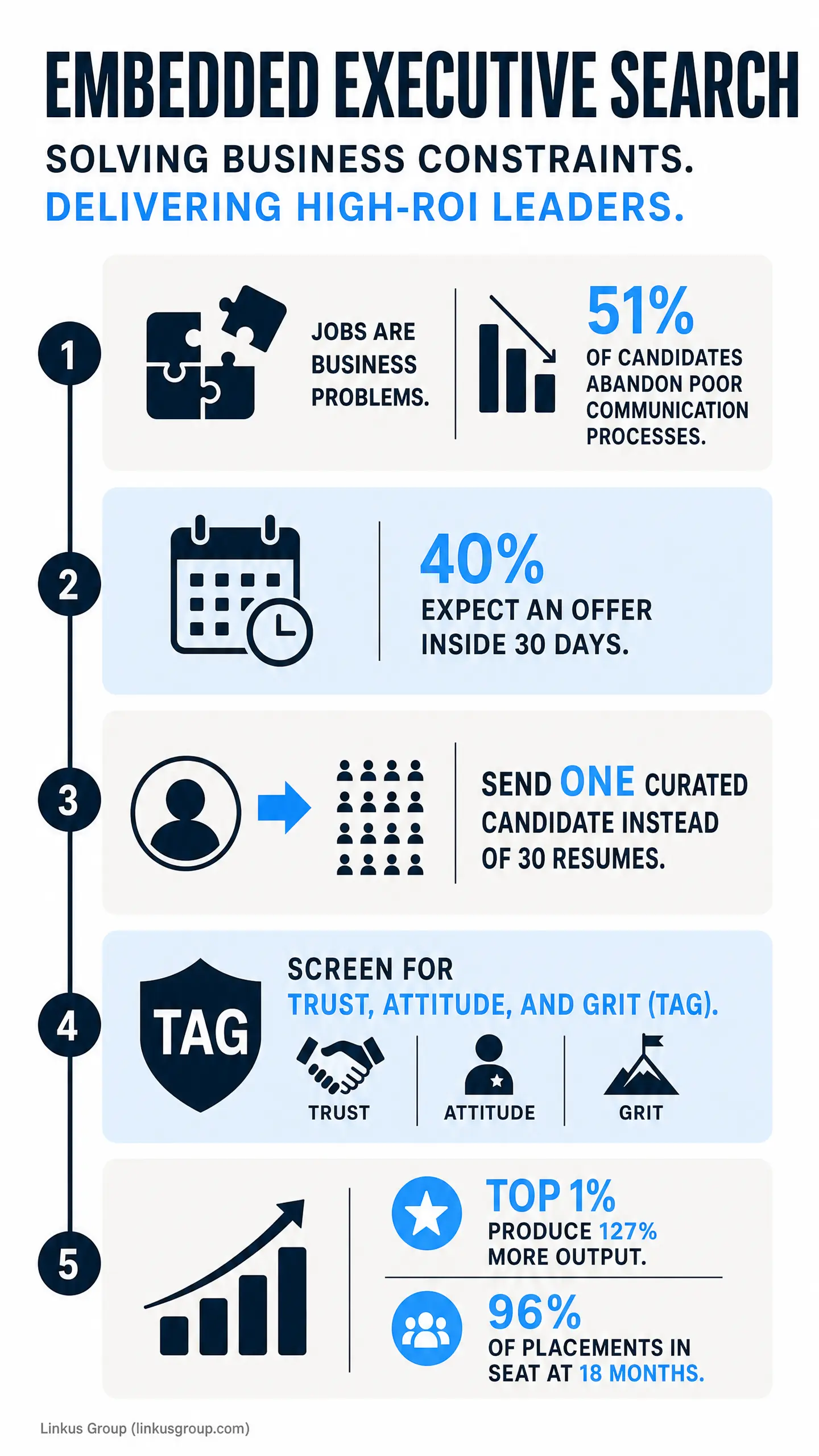
- Greenhouse data reveals that 40% of workers expect a job offer within 30 days, while the average executive hiring process spans 46 days, creating a gap where searches fail.
- Presenting founders with a single curated executive candidate rather than a high volume of resumes forces definitive decision-making and protects the company interview-to-hire ratio.
- Tracking time to quality of hire instead of standard time-to-fill metrics helps executive search partners maintain a 96% placement retention rate at the 18-month mark.
- Unfilled executive roles force 36% of remaining employees to carry heavier workloads, driving their burnout rate to 61% compared to the 18% baseline found in SHRM research.
- Research indicates that in highly complex executive roles, the top 1% of performers produce 127% more output than an average employee.
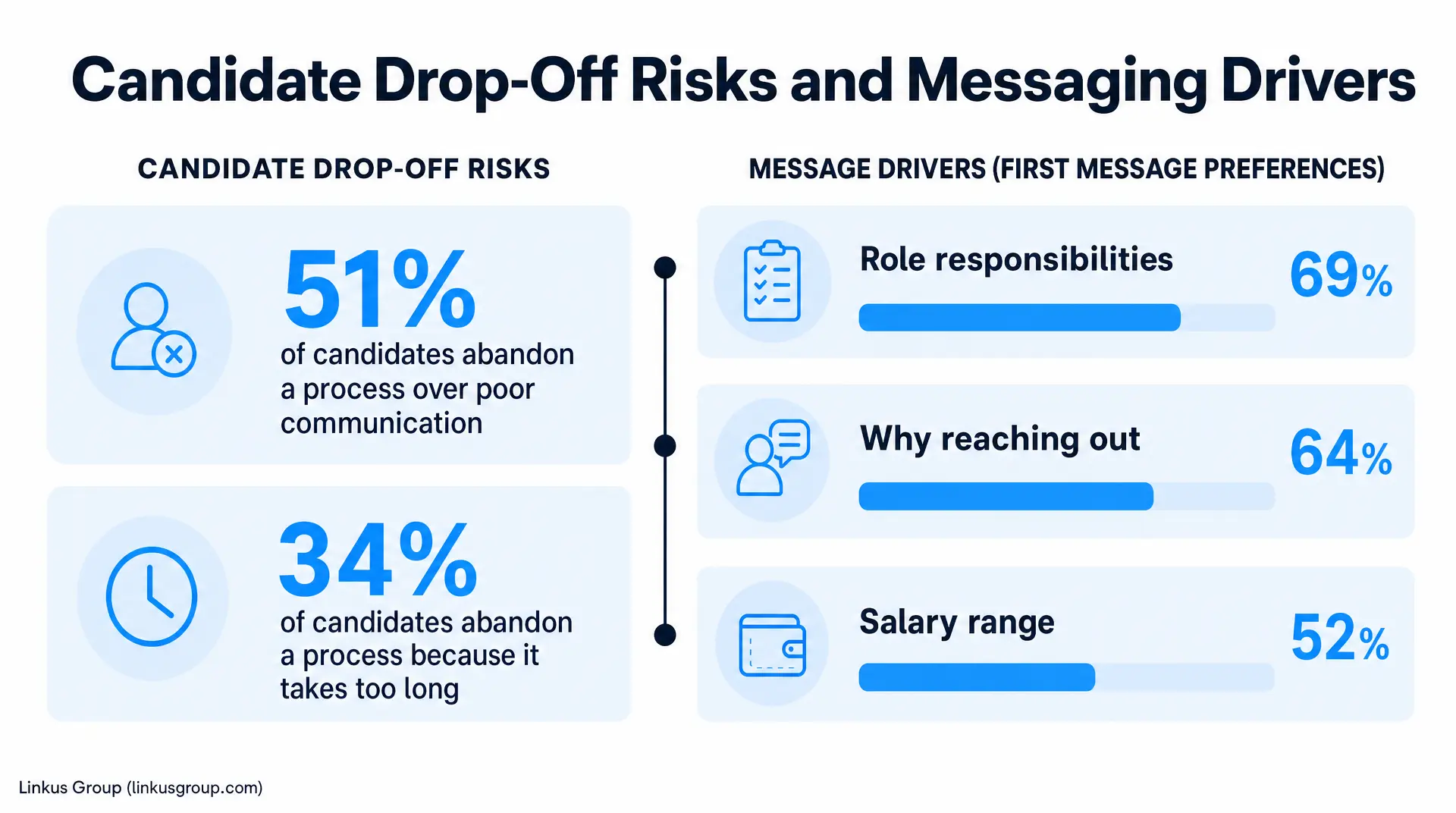
- LinkedIn data shows that passive candidates prioritize recruiter messages detailing role responsibilities at 69%, specific outreach reasoning at 64%, and concrete salary ranges at 52%.
How Does Focusing on Business Constraints Rather Than Job Titles Improve Executive Searches?

Jobs are really just business problems that companies need to solve. A CRO search is never about "a CRO." Revenue has flattened, the founder is still personally closing every deal, and the board wants a repeatable engine before the next raise. That constraint is the actual job. Everything else on the req is decoration.
Job descriptions suck. If they worked, I'd be out of a job. What usually lands on my desk is three roles stapled together and priced below market. So the first thing I do on any executive mandate is sit with the talent leader and the founder and strip the req down to the single biggest constraint in the business. You're hiring to solve one specific problem, and the search gets dramatically faster the moment everyone agrees on what that problem is.
The same precision applies when we go outbound. LinkedIn asked professionals what matters most in a first recruiter message: role responsibilities came in at 69%, why you're reaching out at 64%, and a real salary range at 52%. Executives don't respond to "fast-paced environment" fluff. They respond to a sharp problem, an honest number, and a specific reason it's them.
What Is an Embedded Recruitment Partner and How Do They Accelerate Executive Searches?

"Embedded" gets thrown around a lot, so let me make it concrete. The way I describe Linkus: we're your internal HR team, but instead of our office being down the hall, we're just in another building. We work inside our clients' Slack and Teams. When I'm working with an HR manager, I have direct access to them, like we're sitting next to each other. If the role shifted after Monday's leadership meeting, I know Monday afternoon. A vendor finds out two weeks later, after they've sent candidates for a job that no longer exists.
Knowledge is power in a search. If you're going to space, you want quick access to information. If you're solving a crime, same thing. Things worth doing are a race against the clock, and executive hiring absolutely qualifies.
You've probably lived the other model. A big agency takes the JD, disappears, and lobs resumes over the fence. Their recruiters can't answer a candidate's hard questions about your culture because they've never been inside it. And every sloppy interaction they have in the market happens under your employer brand, not theirs. You pay for their shortcuts twice.
Embedding runs both directions, though. You hold the cultural knowledge. I bring the market intelligence: comp data, competitor movement, and what candidates say about your company when you're not in the room. I consider that last piece part of the job. A real partner is your ear to the market, and some of the most useful things I tell clients are things no candidate would ever say to their face.
One more structural piece. We refuse to work with our clients' direct competitors. Yes, that leaves revenue on the table, and I'm fine with it. It means I'm never shopping your shortlist across the street, and it means your competitors' teams become my hunting ground instead of my client base. My team doesn't even make outbound sales calls. They're 100% on delivery. At the end of the day, that's what wearing your brand on our sleeve actually requires.
Why Do Slow Hiring Processes Create High Revenue Risks in Startup Executive Searches?
Hire slow, fire fast is the biggest lie ever told in hiring. You never have to fire if you hire really well, and going slow doesn't help you hire well. It mostly helps your competitors.
Think about dating. You have a great first date, then wait three days to text back. Or you announce you want to keep playing the field and you'll circle back in a month. How does that land? An executive reads a five-round, six-week process exactly the same way: you can't make a decision, and you don't think they're great. Criteria's candidate experience research found 51% of candidates have abandoned a process over poor communication and 34% because it simply took too long. Greenhouse's data shows 40% of workers expect an offer inside 30 days while the average process runs 46 days. Executive searches sit in that gap and die there.
I watched a company win a major bank contract and then lose the entire project to a competitor because they couldn't hire the three people the project required fast enough. Their interview process was never aligned to the project timeline. The revenue was already won, and their hiring process gave it back.
Just the other day we ran a search where our candidate held multiple offers, with other companies chasing the same person. If that client had run their usual committee pace, the candidate was gone. We coached them to move decisively and they won. For anybody who wants to win, winning means being first to practice and first to score.
Look at how backwards the standard instinct is. Recruiting is the only department in the company where leadership tries to throw fewer resources at the problem to get it right. Then teams compensate with rigor theater: personality tests, an extra panel, one more alignment call. I see personality tests in hiring as a stalling tactic, something to point at if the hire goes sideways. Going slow is just really an excuse for "I don't want to make a mistake," and meanwhile the process itself does the damage. It strains whoever's covering the empty seat, and it makes you look disorganized to the exact people you're trying to impress.
Speed doesn't kill quality. Not having clarity does. When the upfront work is real, we deliver a highly vetted candidate within 48 hours of taking a mandate and complete most placements in under a week.
Why Should Executive Search Agencies Deliver One Curated Candidate Instead of Resume Volumes?

You should never need 30 resumes to make a decision. If an agency sends you 30, they skipped discovery and they're billing you in busywork. The thinking got outsourced back to you, which is the one thing you were paying to avoid.
We send one. Think about Don Draper pitching a campaign. Do you walk in with 10 ideas and confuse the room, or one great idea you'd stake your name on? One aligned candidate forces a real decision conversation with the founder instead of a resume beauty contest. It protects your interview-to-hire ratio, saves your hiring managers days of screening, and protects the candidates too. Every executive dragged through a bloated process talks about it afterward, and your employer brand pays that bill long after the agency has moved on. And honestly, the approach proves itself: usually, companies hire the first person we send them.
There's a measurement problem hiding underneath all this. Everyone tracks time-to-fill, which tells you nothing by itself, while only 20% of organizations measure quality of hire at all. The metric I run my entire business on is time to quality of hire. One number, both dimensions, no hiding.
How Can Startups Identify High-Performing Unconventional Executive Candidates Using TAG Screening?

After two decades, my most unshakeable conviction is this: the person that's going to do the best in the job is usually the person you'd least expect. Which puts me in the same fight you're in every week, against safe referrals, checkbox resumes, and the big logo that soothes a nervous board.
I once pushed a technology client to meet a CTO candidate they'd already written off. Wrong industry, no obvious resume alignment, it just didn't click for them on paper. They met him because I insisted. That candidate helped them raise their Series A and Series B, and eventually the founder and this "wrong resume" became friends and started new businesses together.
Another client was choosing between two candidates for a founding sales role. I recommended the one who could genuinely talk to customers over the one with industry experience. They went the other way. Their preferred candidate declined the offer, they hired my recommendation by default, and that person thrived. I'd rather be heard the first time, but I'll take the outcome.
Skills can be taught. Attitude and drive can't. So we screen against TAG, which stands for Trust, Attitude, and Grit, and we interview like a podcast: unscripted, conversational, circling the same territory from different angles until the rehearsed answers run out. If one clever question could expose grit, everyone would ask it and hiring would be solved. It's the way you ask, and whether the answers line up across a long, candid conversation.
The passive market rewards this human work, by the way. I've said for years that 90% of people are open to a better opportunity presented in the right way at the right time, and LinkedIn's survey of 33,000+ professionals landed almost exactly there: 90% were open to hearing about new opportunities. At the senior level, an NBER study of search-firm records found 52% of contacted executives were willing to become candidates. The inertia you can't break with a templated InMail breaks quickly with a direct, well-positioned, human approach.
Why Should Executive Search Firms Remain Involved During the Candidate Onboarding Process?
90% of recruiting is the onboarding process. Most agencies treat the signed offer as the finish line and vanish with the invoice. Even the AESC's client bill of rights, the search industry's own standards document, says firms should stay involved through onboarding and integration. Most don't, and it shows: Gallup found only 12% of employees strongly agree their organization does a great job onboarding. All that vetting effort, wasted in the first 90 days.
Placements will still occasionally break, and anyone promising perfection is lying to you. I placed a genuine top performer out of Microsoft, 12 years there, into a biometrics startup. Everything aligned. He wanted a change, wanted startup life, left on great terms. It still didn't work. He realized he was built for a big organization and went back, and Microsoft rehired him. That's how good he was.
What matters for you is what happens next, because you've lived the defensive agency post-mortem. My approach assumes the miss could sit with the candidate, the company, or us, and I ask clients straight up: could we have caught this in the interviews? What did you see that we didn't? Is this a turnover pattern, or did a human being simply change their mind? People evolve, and the person someone is today is rarely who they'll be in 10 years. Hiring is never going to be 100% perfect, but it's all about reducing your risk. That honest loop is a big reason 96% of our placements are still in the seat at 18 months.
How Do Startups Calculate the ROI of Executive Search Fees and Vacant Roles?
At some point you'll defend a search fee to a founder or CFO, so here's the arithmetic I hand my clients. Take the role's annual salary and divide by 2,000. That's the hourly cost of the empty seat. Now multiply by four or five, because a great hire should return three to five times their salary. Run that across a quarter of searching and the fee stops looking like a cost.
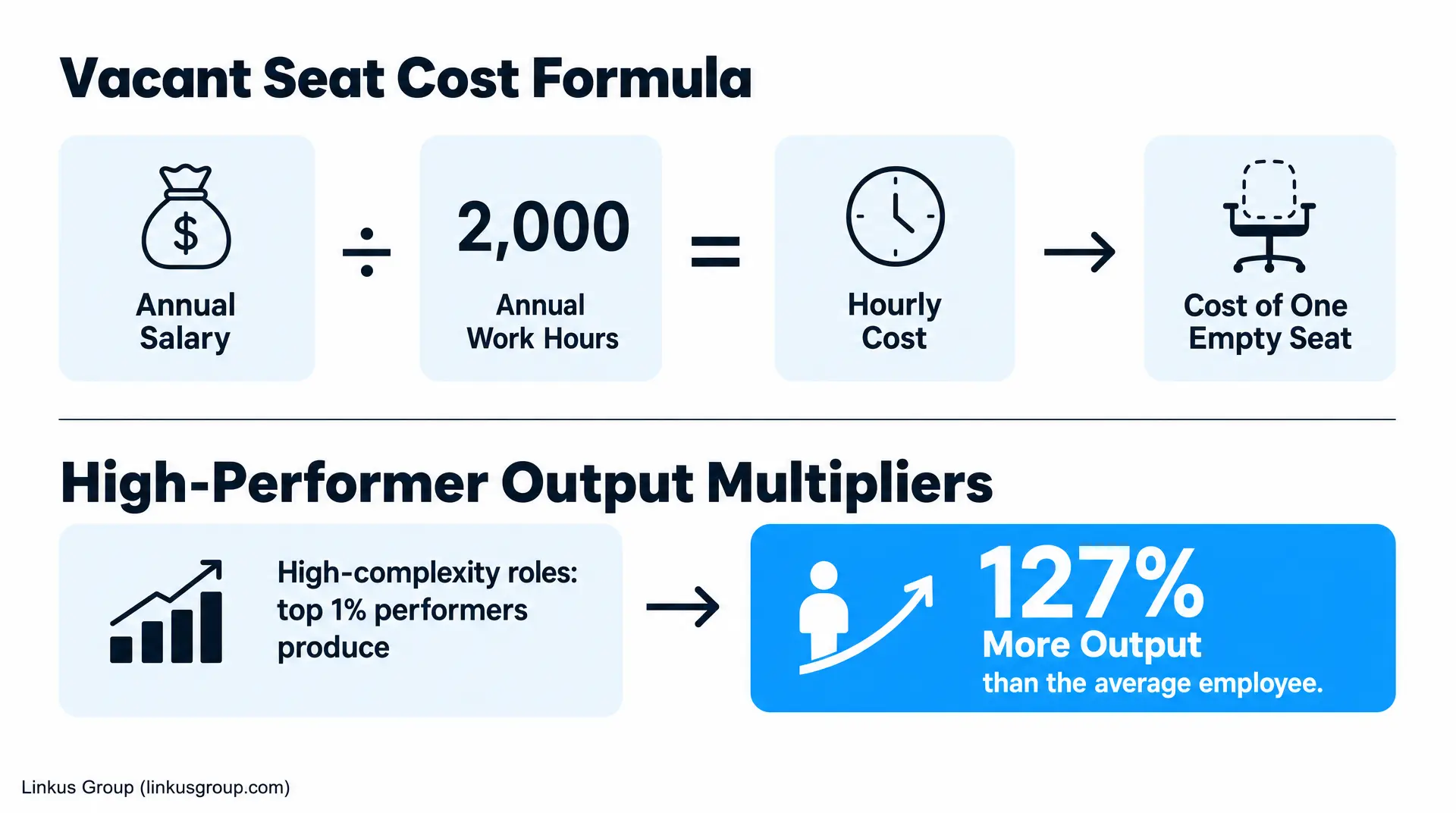
Executive seats amplify everything. Research on job complexity found that in high-complexity roles, the top 1% of performers produce 127% more output than the average employee. The gap between a decent executive and an elite one is the widest spread in your company.
And an empty seat is never actually empty. Your best people are absorbing it. SHRM's workplace research found 36% of workers carry heavier loads because of unfilled roles, and those workers report burnout at 61%, against 18% for everyone else. That burned-out group is exactly who starts taking recruiter calls. You lose more money spending more time than hiring the wrong person.
Why Is Repeat Business the Ultimate KPI for Contingency Executive Search Partners?

Your job is the engine: brand, process, onboarding, experience. My job is the spike the engine wasn't built for. The CRO search, the wildcard CTO, the off-market operator who ignores every message except the right one.
Linkus runs on contingency, so we only get paid when you hire. My one true KPI is repeat business. Not placements, not submittals, just whether you come back. That number only moves if the hire works, you looked great to your founder and board, and the candidate is thriving a year in.
One last thing. I answer on weekends, and I mean that literally. If I were making the biggest hire of my company's life, I'd want to reach my partner when the decision actually happens, the same way I'd want to reach my doctor. Hiring is the biggest unlock in a company's business. Work with someone who sits close enough to treat it that way.
Frequently Asked Questions
How do we convince a biased founder to meet an unconventional executive candidate?
Stop pitching the resume and start pitching the business constraint. Founders cling to safe, big-logo checkboxes when they lose sight of the actual problem. Force them to define the exact revenue or operational hurdle, then objectively show how this specific candidate's grit perfectly solves it.
What makes startup executive searches materially more expensive than standard requisitions?
The stakes and the scarcity. SHRM data shows executive cost-per-hire hit $10,625. You aren't just buying time. You're buying market intelligence and access to the 70% of passive talent who will completely ignore a standard job board posting.
How do you get off-market executives to actually respond to startup outreach?
Ditch the fluff. LinkedIn data proves executives want precision: responsibilities (69%), why you chose them (64%), and real salaries (52%). Passive candidates respond to a sharp problem and a specific reason they are the right fit.
Should founders rely on unstructured conversational interviews to assess executive culture fit?
Gut feel is a liability. Research shows structured interviews hit .51 validity, crushing unstructured chats (.38). We interview like a podcast to uncover grit, but map every answer to a strict scorecard.
How do we prevent candidate ghosting when our executive interview panels stall?
You stop stalling. SHRM notes 41% of employers face increased candidate ghosting. Executives interpret a six-week process as incompetence. If you cannot align your panel quickly, over-communicate relentlessly. Silence kills deals in this market.