

Most recruiting agencies are paid to run a process, paid to take their time, paid to add layers until motion passes for progress.
Speed is the one thing their model cannot afford to give you, which is why the retainer goes quiet the week your role gets hard.
I own one of these firms, and the clients I turn away are the ones I could have billed the longest.
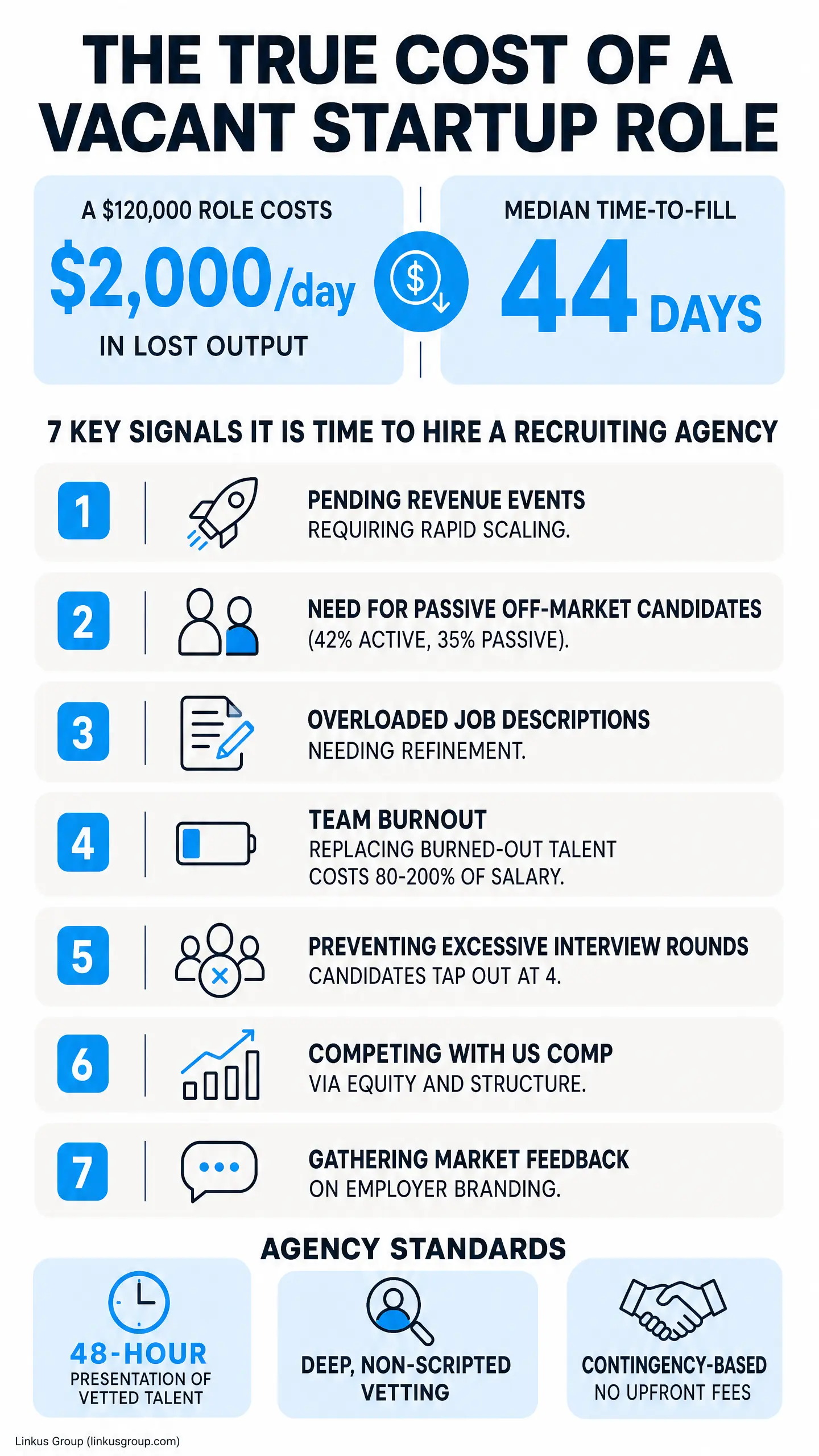
Key Takeaways
- A vacant $120,000 startup role costs approximately $2,000 per day in lost output, assuming every employee must generate three to four times their base salary in business value.
- Prolonged startup vacancies trigger team burnout and subsequent resignations, which carry replacement costs of 80% of base salary for technical professionals and 200% for managers according to Gallup estimates.
- Because Greenhouse data indicates 40% of candidates tap out of hiring processes extending beyond four stages, startups must condense interview rounds to secure top talent ahead of competitors.
- To overcome a 46% compensation premium for U.S. technology workers, Canadian startups can successfully compete by offering equity valued at roughly double the candidate's sacrificed base salary over the vesting period.
- Startups struggling to attract talent should distill job descriptions into a single 12-month business outcome, as Greenhouse research reveals 26% of candidates cite excessive role responsibilities as a top frustration.
- Linkus Group achieves a 96% 18-month candidate retention rate by replacing standard resume screenings with unscripted interview formats that specifically evaluate trust, attitude, and grit.
How Do You Calculate the Financial Cost of a Vacant Startup Role?
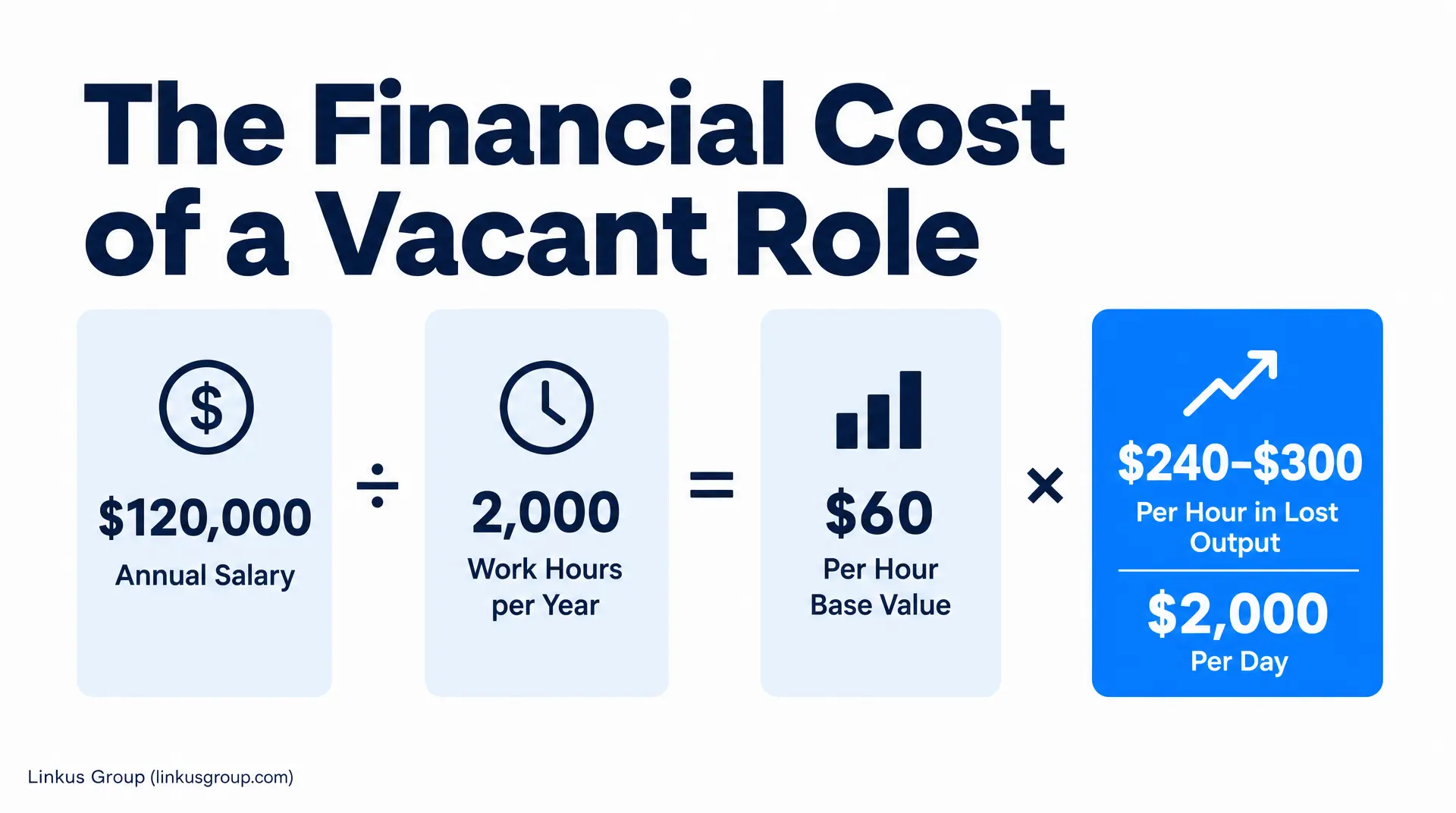
Take the annual salary of the open role and divide it by 2,000. That's the hourly rate. Now multiply by four or five, because every employee you hire should be generating three to four times their salary in value, minimum. A $120,000 role works out to $60 an hour, which means the empty seat is costing you $240 to $300 an hour in output that never happens. Call it $2,000 a day.
I worked with an Amazon e-commerce brand where the missing seat was an e-commerce manager. Without someone in that chair, they were exposed to inventory mistakes and hundreds of thousands of dollars in lost weekly revenue. Once you see the seat priced that way, a recruiting fee starts looking like a sales tool you're buying, with a return attached.
Now hold that against the market's pace. SHRM's benchmarking puts median time-to-fill for a nonexecutive role at about 44 calendar days. At "average" speed, you're bleeding for a month and a half. You lose more money spending more time than hiring the wrong person. I know that sounds backwards. Run the math on your open role and then tell me I'm wrong.
What Are the Key Signals That a Startup Should Hire a Recruiting Agency?
Seven signals. Be honest with yourself as you go through them.
Why Should Startups Hire a Recruiting Agency When a Revenue Event Is Pending?

I watched a company win a major bank contract and then lose the entire project to a competitor, because they couldn't align their interview process with the project timeline. They needed three people hired fast. Their process moved in weeks. The contract didn't wait.
It's like a free agent hitting the market. The team that moves decisively signs him. The team that "circles back Monday" watches him score against them next season. Speed is the one advantage that scaling companies have, and most founders throw it away the moment hiring starts.
If a contract, a launch, or a funding milestone has a date on it and your internal process is measured in weeks, check the box.
How Do Recruiting Agencies Help Startups Source Passive Off-Market Candidates?

Job descriptions suck. If they worked, I'd be out of a job. Posting a role and waiting is like putting one flyer up in a couple of places and hoping the right person happens to walk past your shop. The people you actually want are employed, heads down, and nowhere near a job board.
I've said for years that 90% of people are open to a better opportunity when it's presented the right way at the right time. Greenhouse's candidate data backs the instinct: 42% of U.S. candidates were actively looking, and another 35% weren't searching but were open. Somebody still has to make the approach. My hook takes 30 seconds: I've got something I think you're going to want to hear about, and this is why. Getting that first conversation is the easy part. Walking a top performer through a life-changing career decision is human work, and top performers don't do it with a bot.
If your target profile is passive and off-market, posting internally is the bare minimum. Box checked.
How Can a Recruiting Agency Help Startups Refine Overloaded Job Descriptions?

You want someone who can code, sell, manage, and write copy, all for a below-market salary. I call it hunting for the purple squirrel, and I've watched it bottleneck founders for entire quarters. Candidates see it coming too: 26% of U.S. job seekers name job descriptions with too many responsibilities as a top frustration. Your strongest prospects read that posting and quietly pass.
Jobs are really just business problems that companies need to solve. One hire, one problem. When I dismantle a three-page description with a founder, we work down to a single question: what outcome moves the business in the next 12 months? Everything that doesn't serve that outcome comes off the page.
If you can't answer that question in one sentence, no recruiter on earth can find the person, and a partner who has run this exercise a thousand times gets you there in one call instead of one quarter.
Why Does Team Burnout Indicate a Startup Needs a Recruiting Agency?
Every week the seat stays open, your strongest people cover for it. They stay late, they context-switch, they do two jobs. Then, quietly, they start taking recruiter calls themselves, and one vacancy turns into three. I've seen team exhaustion from a slow search do more damage than any bad hire ever did.
The replacement math is brutal. Gallup estimates that 42% of voluntary turnover is preventable, and pegs replacement costs at roughly 80% of salary for technical professionals and 200% for managers. Put real numbers on it: your $150K engineering lead walks because she spent a quarter doing two jobs, and now you're out $120K in replacement cost on top of the seat you still haven't filled.
If your best people are visibly stretched over a gap, check the box before they check out.
How Do Recruiting Agencies Prevent Excessive Startup Interview Rounds?
Hire slow, fire fast is the biggest lie ever told in hiring. You never have to fire if you hire really well, and going slower doesn't make you hire well. Give a team a longer deadline and they don't reduce risk. They expand the process. More panels, more take-homes, more great candidates lost to whoever moved first. Speed doesn't kill quality. Not having clarity does.
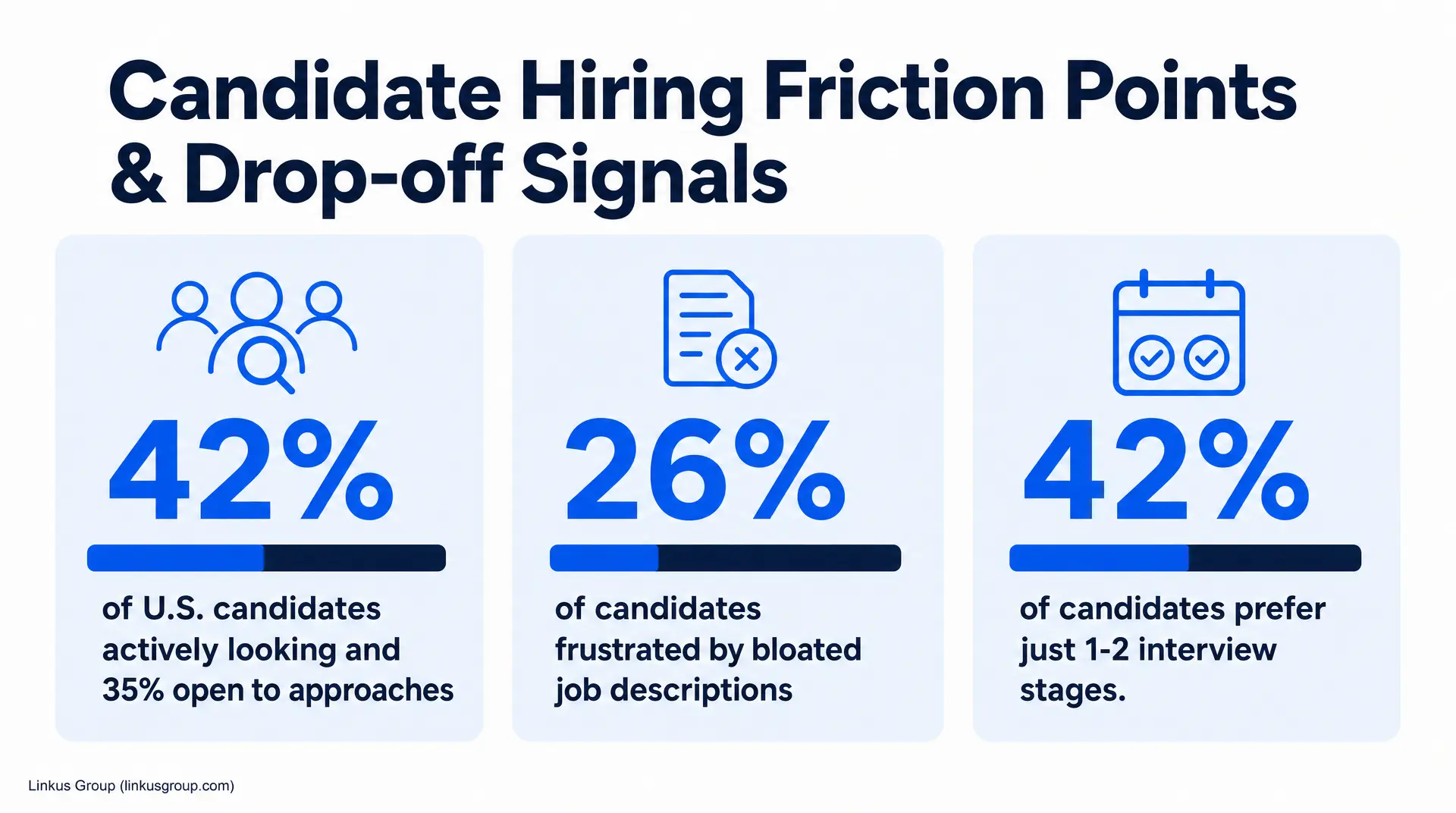
Candidates have hard limits here. Greenhouse found 42% of candidates want just one or two interview stages, and another 40% tap out at four. Your six-round gauntlet means your finalist is entertaining other offers by round three.
It's like dating. You find the right long-term fit by going deep with two people, not shallow with five. If your process ballooned because one bad hire burned you, that's fear wearing a diligence costume. Check the box.
How Can Canadian Startups Use Recruiting Agencies to Compete With US Compensation Offers?
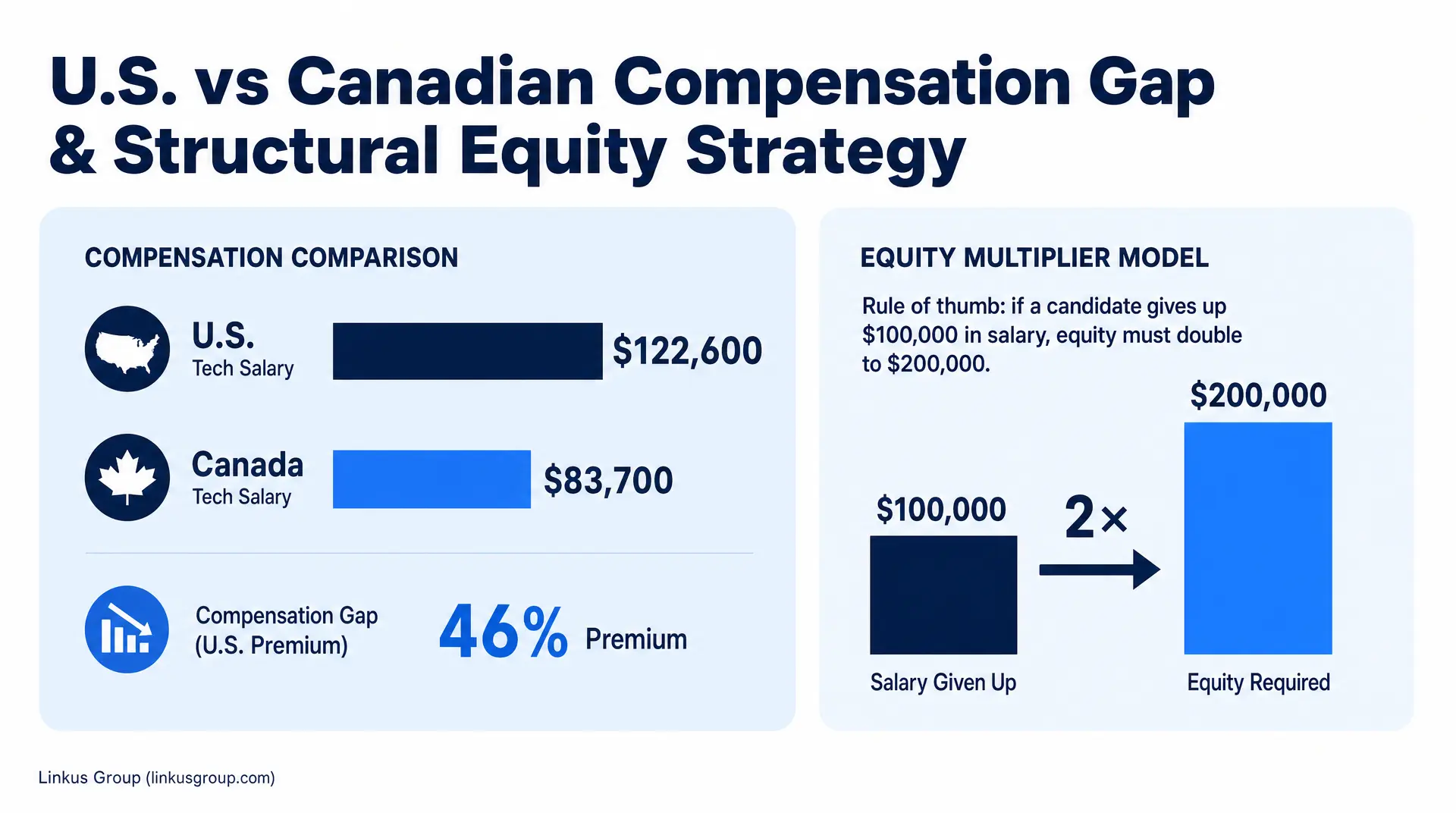
Canadian founders feel this one hardest. A study from The Dais put the typical U.S. tech salary at $122,600 against $83,700 in Canada, a 46% premium. You will not win a cash-for-cash war, so stop fighting one.
You can win on structure. My rule of thumb on equity: if a candidate gives up $100,000 in hard-earned salary to join you, the equity has to be worth roughly double, about $200,000 over the vesting period. Nobody trades real risk at even money.
On keeping the team you have, remember that people don't leave companies, they leave leadership. Gallup's attraction data shows 60% of employees weighing a move rate work-life balance and wellbeing as very important, ahead of the 53% who say the same about a bigger paycheque. Ownership of the work, flexibility, real growth trajectory. Those are levers a 30-person company can pull that a giant structurally can't. If you don't know how to package that against a bigger number, get someone who structures these deals every week.
Why Do Startups Need Recruiting Agencies to Gather Market Feedback on Employer Branding?

There's a moment I have with founders that never gets comfortable. I pull up the market map and walk through it: here are the people you already spoke to, here's what each of them wanted, here's why they passed. Usually the founder had no idea. The feedback never travels back inside your own walls.
Sometimes one "must-have" requirement is quietly repelling every strong candidate in your market. Sometimes it's your comp band. Sometimes it's what a former employee is saying about you. A real recruiting partner acts as an ear to the market, relaying what's actually said about your employer brand out there, because you can't fix a reputation you can't hear.
When Should a Startup Avoid Hiring a Recruiting Agency?
I turn away business, and I'll tell you exactly when I'd turn away yours. There are three levers in any search: location, compensation, and requirements. If you won't move any of them, nobody can help you. We had a client with a genuinely rough reputation – bad Glassdoor reviews, known for running people hard, bridges burned across their industry – who still wanted to underpay for hyper-specific experience. We told them straight: move one of the three levers or we're the wrong fit, and come back if something changes. Any agency that takes that mandate without saying so is billing you to fail.
Skip the agency if you need volume to feel safe, too. If you want 30 candidates before deciding, we're a bad fit and I'd say that to your face. Needing that much paper usually means nobody ever defined what the role has to produce, and no shortlist fixes a discovery problem.
And if your network genuinely covers the hire, take the free win. LinkedIn's research has long ranked employee referrals as the top channel for quality hires, ahead of job boards. Referrals won't scale you past a point – my whole business exists for what happens after they run out – but never pay a fee for what your network hands you.
One more. 90% of recruiting is the onboarding process. If nobody owns your new hire's first 90 days, the placement fails no matter who sourced it. Same warning if you can't name your final decision-maker today: I've watched perfect candidates get vetoed at the finish line by internal stakeholders who won't own the outcome of the role. Fix the alignment first. Then search.
What Performance Standards Should Startups Demand From a Recruiting Agency?

If three or more boxes pointed you toward a partner, raise your standard for what one looks like.
Demand speed with conviction behind it. At Linkus Group, we aim to put a highly vetted candidate in front of you within 48 hours, and usually companies hire the first person we send. If you're Don Draper pitching to win the account, you don't walk in with 10 ideas that confuse the room. You walk in with the one you'd stake your name on.
Demand vetting that goes past the resume. We screen for trust, attitude, and grit, because skills can be taught and drive can't. Our interviews run like a podcast, unscripted, circling the same question from different angles to see whether the answers line up. A rehearsed candidate survives a checklist. Almost nobody survives a real conversation. And nobody's ever been let go from a job for working too hard.
Demand skin in the game. We work on contingency, so we eat only when you hire. We refuse to work with our clients' direct competitors, which means we can recruit from them, sit inside your Slack like your internal HR team in another building, and answer on a Saturday, because that's when candidates actually wrestle with career decisions.
And demand honesty about the failures. I placed a genuine top performer from Microsoft at a biometrics startup once. Motivation, interest, fit on paper – everything aligned. They went back to Microsoft, who rehired them on the spot. That's how good they were, and it still didn't work. Hiring is never going to be 100% perfect, but it's all about reducing your risk. Anyone selling you a guarantee is selling you a story. Which is also why the only numbers I care about are time to quality of hire and repeat business, while SHRM found only 20% of organizations measure hiring quality at all. The rest are grading themselves on resume volume. Ask any agency what they get measured on before you sign anything.
Why Should Startups Develop a Proactive Recruiting Strategy Before Resignations Occur?

Hiring is the biggest unlock in a company's business, and the most underrated way to accelerate one. Done right, it compounds: 96% of the people we place are still in the seat 18 months later, because we treat every search like a long marriage instead of a transaction. And in my experience, the founders who insist on both speed and quality don't just win candidates. They tend to be the ones who exit faster.
Run this checklist while it's still a spreadsheet exercise. On the day your engineer resigns, it becomes an emergency, and emergencies are where founders overpay for mediocre. Remember the math from the top. That empty seat is already on the clock at $250 an hour, whether or not you've decided what to do about it.
Frequently Asked Questions
At what headcount should a startup build an internal recruiting team instead of using an agency?
Hold off until you hit 40 to 50 employees and need high-volume hiring. Until then, an internal recruiter is a fixed cost draining runway. You need surgical strikes for key operators. An embedded agency acts as your internal HR down the hall without the payroll liability.
How do we handle candidates demanding unlimited PTO and massive corporate perks?
You don't. Pivot to what your startup actually offers: true ownership. Gallup data shows 60% of employees prioritize balance and wellbeing over massive benefits. Sell flexibility and lack of bureaucracy. If they demand enterprise perks, they lack startup grit.
Why is a retained search model dangerous for early-stage startup hiring?
Because retainers kill urgency. You pay upfront, and the massive transactional agency gets comfortable. When the role gets hard, you get ghosted or spammed with redacted resumes to prove they did work. Early-stage hiring demands speed and contingency. If they won't eat only when you hire, walk away.
Why do top candidates suddenly drop out right before we make an offer?
You moved too slow. Greenhouse reports 77% of candidates expect responses within two weeks, and 29% reject offers for a faster competitor. Speed is your ultimate leverage. If your process spans weeks, top performers assume your operations are equally sluggish.
How do we vet for startup grit without bloating our interview process?
Stop relying on rehearsed behavioral checklists. Conduct one unscripted, deep-dive conversation. We screen specifically for Trust, Attitude, and Grit. Circle the same problem from different angles. You are testing if they will sneak around hard work. Real conversations expose a lack of hustle instantly.