

The most biased tool in your company is the resume, and it does its damage before anyone speaks.
Identical applications with White-sounding names pull 50% more callbacks, and the degree line quietly rejects the people already doing the work. Every screen for the right school, the right tenure, the right logo reproduces the team you already have.
You insist you can't find women who can sell, still the supply was never the problem – the work ran 47.9% women last year. You built that filter yourself, then called the result a shortage.
Key Takeaways
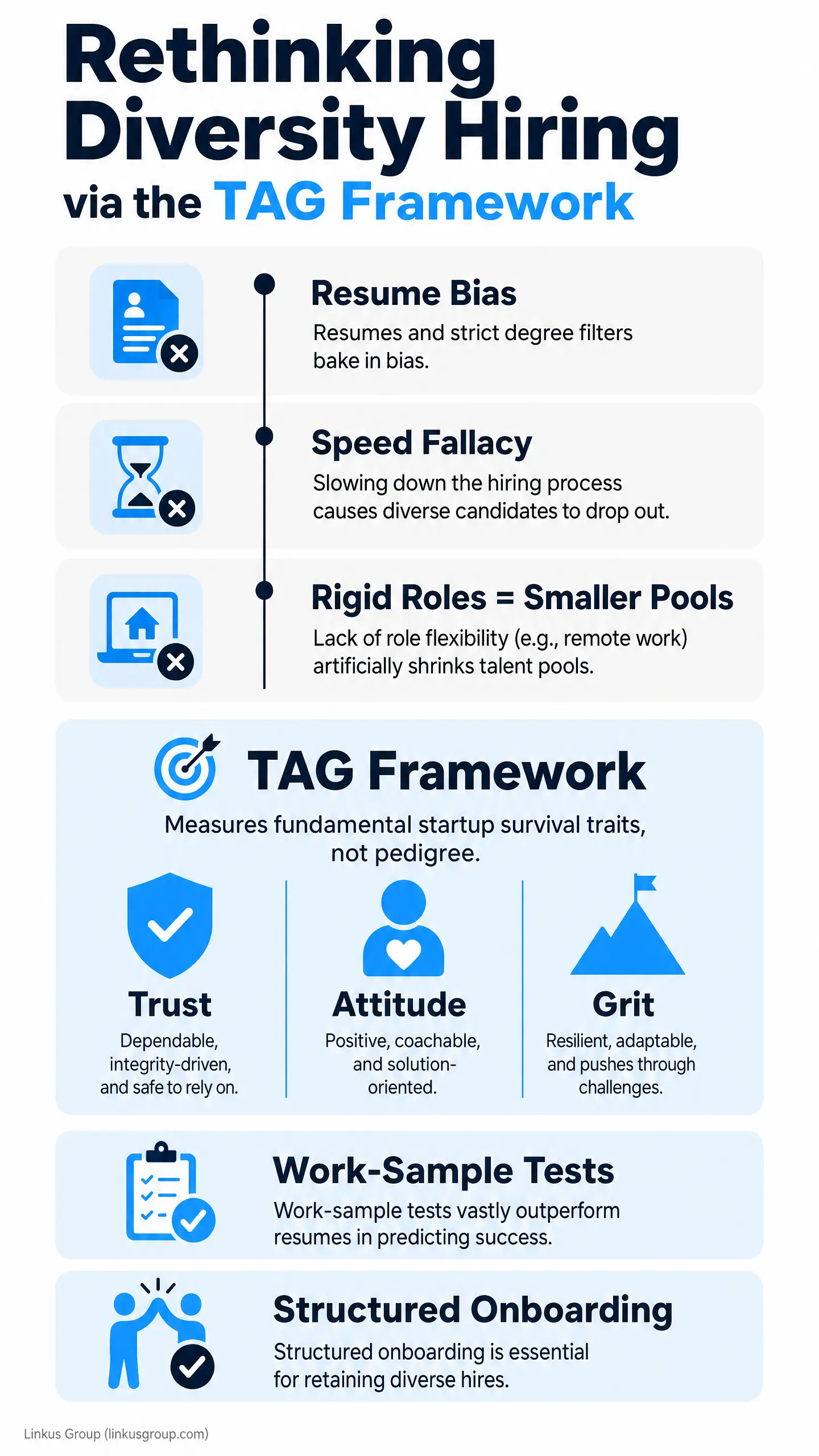
- A Harvard Business School study found that 67% of production supervisor job postings require a college degree, despite only 16% of active production supervisors actually possessing one.
- Bureau of Labor Statistics data shows 54% of part-time working women cite family obligations, making inflexible in-office mandates a primary barrier to hiring from the 47.9% female sales workforce.
- Criteria's 2024 candidate survey reveals that over one-third of candidates abandon hiring processes for taking too long, demonstrating that artificially prolonging interviews actively harms startup diversity strategies.
- The TAG hiring framework evaluates Trust, Attitude, and Grit by replacing traditional resume filters with behavioral assessments of how candidates solve problems using limited startup resources.
- Schmidt and Hunter's meta-analysis demonstrates that work-sample tests predict job performance at a 0.54 rate, significantly outperforming structured interviews at 0.51 and reference checks at 0.26.
- Although a multi-firm study shows referred workers are 25% more profitable, employees predominantly refer candidates matching their own demographic profile, which bakes bias into startup hiring pipelines.
- Gallup data indicates only one in 10 employees strongly agree their company handles onboarding well, though these adequately onboarded hires are 2.3 times more likely to report accurate job expectations.
Why Does Slowing Down the Hiring Process Harm Startup Diversity Strategies?

Most founders assume diversity hiring means adding steps. Another panel. A scorecard. A personality test. A fourth round so everyone "feels comfortable." I think that's a fallacy, and a damaging one.
Speed has nothing to do with diversity. Treating people equally means moving at the same pace for everyone. Say you've got a diverse group of finalists and you start dragging your feet. Three rounds become five. Two weeks becomes six. How do you think that candidate reads your hesitation? They're wondering if you're moving slow because they're part of a diverse group. You just created the exact perception you were trying to avoid.
Then they leave. Criteria's 2024 candidate survey found more than one-third of candidates had abandoned a hiring process for taking too long, and 31% had walked away because the role had no remote or flexible option.
The personality test is the worst offender. In my experience it's a stalling tactic. Nobody wants the blame if the hire goes wrong, so they buy a report to hide behind. Top candidates see it for what it is, and it slows things down for exactly the people you say you want more of. Going slow is really just an excuse for "I don't want to make a mistake."
Doing it right means the work happens before the first conversation. Upfront alignment on the business problem this hire solves. Transparency about the good, bad, and ugly of the role. Clarity on who makes the final call, so someone who doesn't own the outcome can't veto a great candidate at the finish line. Nail that and a diverse hire takes no longer than any other hire.
Why Do Startups Struggle to Hire Women in Sales Roles?
Back to that founder. The company has no remote option and no give on when the work gets done. They want a certain group in the door while running a setup that pushes them out.
The talent exists. In 2024, U.S. sales occupations were 47.9% women. When a startup tells me it can't find women who can sell, I know we're looking at role design, compensation, or sourcing. The supply is fine.
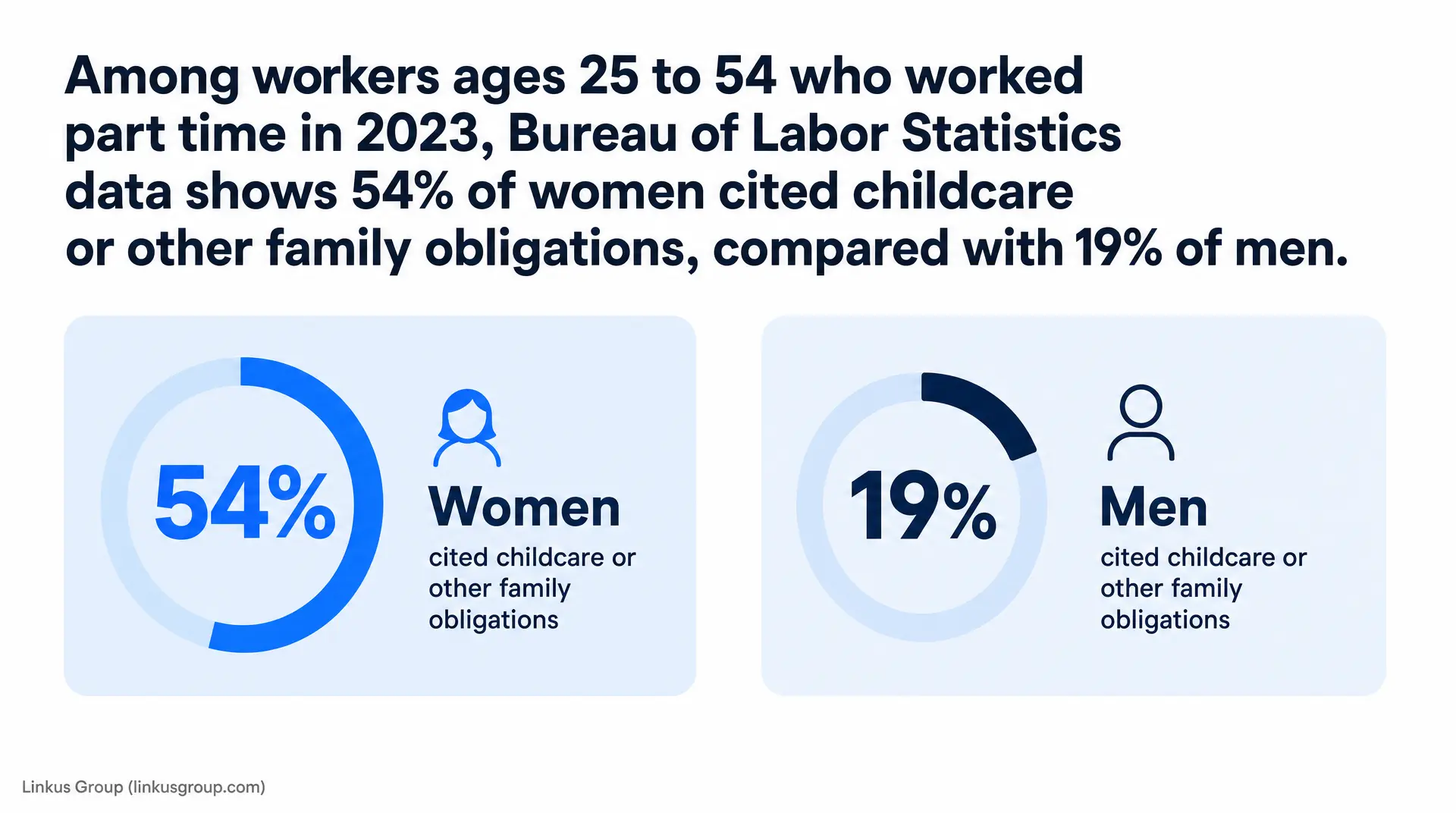
Flexibility is usually the crack. Among workers ages 25 to 54 who worked part time in 2023, Bureau of Labor Statistics data shows 54% of women cited childcare or other family obligations, compared with 19% of men. Demand nine-to-six in the office with zero give and you've built a filter. It just isn't filtering for who can sell.
There are three levers in any search: location, compensation, and requirements. We had a client with a rough reputation and bad Glassdoor reviews. They wanted very specific experience, wanted to underpay, and were known for working people hard. We told them straight. You won't get far unless you move one of those three levers. They wouldn't, so we weren't the right fit. Diversity works the same way. Refuse to move a lever and no recruiter on the planet can widen your funnel.
What Does the TAG Hiring Framework Measure in Startup Recruitment?
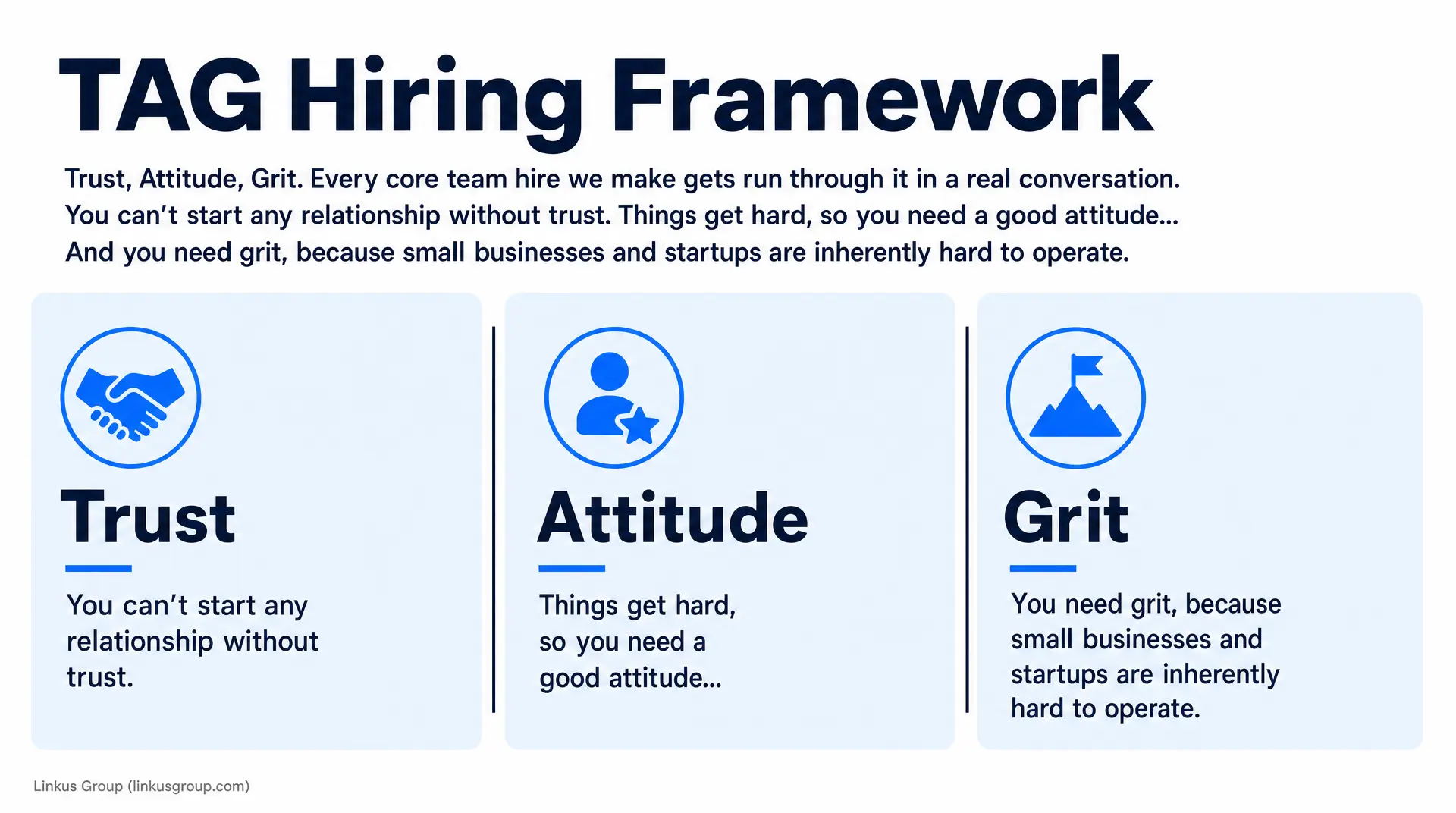
Trust, Attitude, Grit. Every core team hire we make gets run through it in a real conversation. You can't start any relationship without trust. Things get hard, so you need a good attitude, and people who bring a good attitude around others. And you need grit, because small businesses and startups are inherently hard to operate. If it was easy, everyone would do it.
I want to be precise about grit, because people ask about it in a way that assumes the answer. Grit measures whether someone can work through problems with less budget, fewer teammates, no mentorship, and mistakes that cost a hundred times more than at a big company. That's the entire job of that letter. Building a diverse team matters for plenty of other reasons. Grit just isn't the tool for it.
So why does TAG matter for diversity at all? Look at what it leaves out. School isn't on it. Tenure isn't on it. The logo on the last resume isn't on it. Those are the filters that produce the same team on repeat. I've watched founders decide they only hire from sports teams, or only from hospitality, or only from one referral circle. They keep putting in the same ingredients, keep getting the same result, and never learn what success looks like outside that box.
The same bias runs inside the interview. A friend referred this person, so they must be good. The resume was incredible, so this must be the one. We come in with no emotion attached to any candidate, so we can actually listen.
How Does the TAG Framework Evaluate Candidate Trust Across Different Industries?

Founders ask how they can trust someone with a critical part of the business when that person has never worked in their world. I test it head-on. "We deal with customers who have sensitive information. We deal with salaries. We deal with how people operate. How do we know we can trust you in those situations?" Then I ask for examples.
If the answer sounds like exactly what I wanted to hear, I assume it might be rehearsed. So I ask again later, a different way, and see if the two line up. I watch how they show up across the process. Did they follow up? Did they remember names? Did they disappear for three days? Then I call people they've actually worked with. None of that requires industry context.
I once pushed a client to interview a CTO whose resume had no obvious match to their industry. Plenty of teams would have passed on paper. They took the meeting. That CTO helped them raise a Series A and a Series B, then co-founded new ventures with the same team. Skills can be taught. Attitude and drive can't. If somebody's smart, you can teach them almost anything.
How Does the TAG Framework Measure Candidate Grit in Startup Hiring?

Some argue grit favors candidates who could afford to take risks or grind through unpaid time. I don't buy it. You need filters. You can't hire anyone for any job, and pretending otherwise spins you in circles. And there are a ton of people working extremely hard with pennies to their name and no access to the right people. Grit shows up in them as clearly as in anyone. No excuses. Figure out the right way to go about it.
I test it with questions that circle hard work from different angles. "Tell me about a time you had to work harder than somebody else on your team." "Why did you get into this?" "Was there a time you found a way to work less?" That last one is my favorite. When the conversation is candid and podcast-style, people relax and tell you things. If they snuck around the hard part, it comes out. Nobody's ever been let go from a job for working too hard.
Why Are Resumes Considered the Most Biased Tool in Startup Hiring?

I watched a hiring team stop at the surface on a candidate. Short stint at the last job. Hadn't gone to the school they expected. Never worked in this exact environment. Automatic pass, straight off the page. Once they actually met the person, the items they'd flagged as weaknesses turned out to be the candidate's greatest strengths. The only thing that changed was the founder's lens. That's self-awareness, and it's what lets a founder see the forest between the trees.
The resume is the most biased tool you own. In a field experiment with fictitious resumes, applicants with White-sounding names received 50% more callbacks than otherwise similar applicants with African American-sounding names. The exclusion happened before anyone spoke. Degree screens do it quietly. A Harvard Business School study found 67% of production supervisor postings required a college degree while only 16% of working production supervisors had one. That's a filter set against the people already doing the job.
Referrals are my favorite source, with one catch. Referred candidates are typically my highest performers, and they rarely arrive with a perfect resume. Someone vouches for their trust, attitude, and grit. But a multi-firm study found referred workers were roughly 25% more profitable and also found employees tend to refer people who match them in age, ethnicity, gender, and marital status. Your network clones itself.
That's why you go off-market. Posting a job and waiting is post and pray. It reaches only active seekers, which shrinks your pool and bakes in bias. LinkedIn's Global Talent Trends research found 90% of professionals were open to hearing about new opportunities. Almost none of them are applying to your posting. Go get them, including the people your network would never surface.
How Do Work-Sample Tests Improve Diversity Hiring Outcomes in Startups?
The most diversity-friendly move you can make in an interview is to ask for the work. If I'm hiring for polish in an ops role, I'll say, "Show me the email you'd send a vendor to order a thousand pairs of jeans." If someone claims they built a system, I have them walk me through every step, why they built it that way, and who was involved. For sales, run a mock call or bring them into a client meeting before you decide.
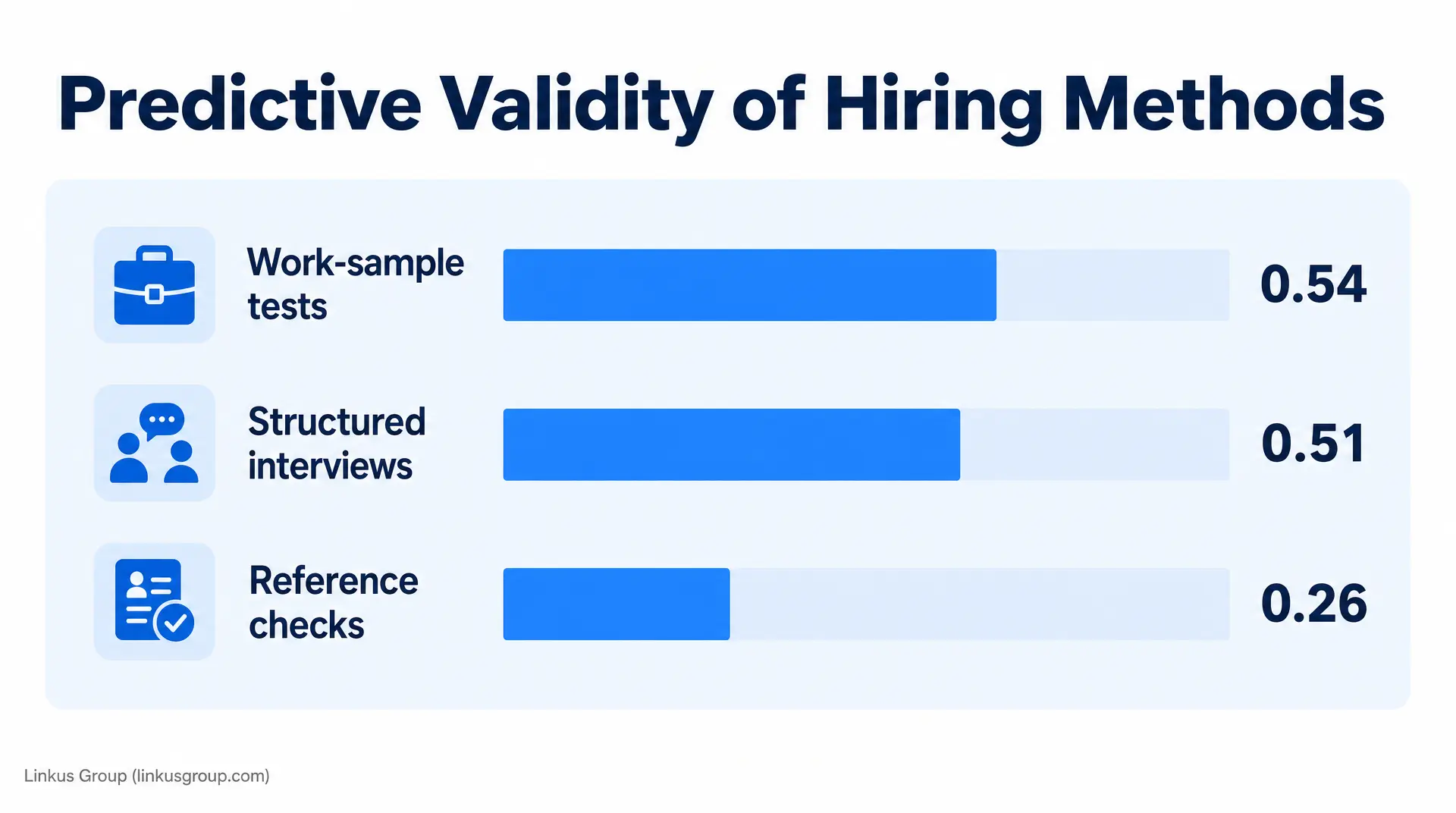
The data backs this up. Schmidt and Hunter's meta-analysis found work-sample tests predict performance at 0.54, structured interviews at 0.51, and reference checks at 0.26. The methods that actually predict the job don't care where someone went to school. And "structured" in that research means probing the same things with everyone, which is what TAG does in conversation form. I probe the same three traits every time, without reading them off a sheet.
Why Is Proper Onboarding Critical for Retaining Diverse Startup Hires?

90% of recruiting is the onboarding process. Hire someone from outside your usual mold, hand them a laptop, and disappear, and you'll lose them within the year. The candidate needs to be set up for success just as much as the company does, and a lot of companies don't prioritize that. Gallup found only about 1 in 10 employees strongly agree their company does a good job onboarding, and those who do are 2.3 times more likely to say the job matched or beat what they were promised. That last number is the whole game. Everyone hates surprises. Candidates leave when the job isn't what was explained to them.
And hire an HR leader before you hire a recruiter. Someone has to build the onboarding, the coordination, and the candidate experience, or you keep filling seats and emptying them.
How Does Diversity Strategy Support the Best Person, Shortest Time, Lowest Cost Hiring Goal?
None of this changes my definition of great hiring. Get the best person for the job in the shortest amount of time for the lowest cost. Diversity done right just makes sure you're looking at everyone who could be that person, instead of the slice your resume screen keeps handing you. Hiring is never going to be 100% perfect. It's about reducing your risk. And the person who's going to do the best in the job is usually the person you'd least expect. I'd stake my reputation on it.
Frequently Asked Questions
Does dropping degree requirements to increase diversity mean I have to lower my hiring standards?
Absolutely not. Dropping degree filters actually raises your talent floor. Currently, only 37.4% of U.S. adults hold a bachelor's degree. Mandating a four-year school blinds you to millions of qualified operators who built their grit through alternative routes. Skills execute. Paper doesn't.
How can I rewrite my job descriptions to attract diverse talent without sounding like a corporate HR brochure?
Stop writing three-page wishlists. Isolate the single business problem you need solved. Research on 4,000 job ads shows masculine-coded jargon actively repels women from applying, despite having the right skills. Keep JDs raw, realistic, and brutally transparent about the hard work ahead.
How do cash-strapped early-stage startups compete for diverse senior talent against massive US salaries?
Compete on equity and structural flexibility, never base salary. You cannot outspend heavily funded competitors. However, 54% of women working part-time cite family obligations. Offer meaningful vested ownership, mandate extreme flexibility on when the work happens, and watch high-performers flock to you.
Should I rely on my founder 'gut feel' to ensure diverse hires fit our startup culture?
Never trust your gut. Your gut just wants to hire your clone. Meta-analysis proves structured interviews predict performance at 0.51, vastly outperforming unstructured chats (0.38). Ask every candidate the exact same core questions about trust, attitude, and grit. Predictability beats intuition every time.
How do we hire diverse candidates without caving to toxic modern HR demands like unlimited PTO?
You filter for grit, not entitlement. Building a diverse team doesn't mean compromising fragile early-stage economics. If a candidate demands massive perks you can't afford, they fail the attitude test. Present the ugly reality of startup life upfront. True high-performers will lean in.