

Grading a startup's hiring against the market's average time to hire means grading it against the pace it's supposed to beat. The time to hire benchmark also starts its clock on the wrong day, puts no price on the seat while it sits empty, and scores a hire you have to make twice as two quick wins. So if you've got a role open right now, that number can tell you you're on track while the business has been paying for the empty seat since the problem showed up, and while a faster company is already talking to the person you want.
Key Takeaways
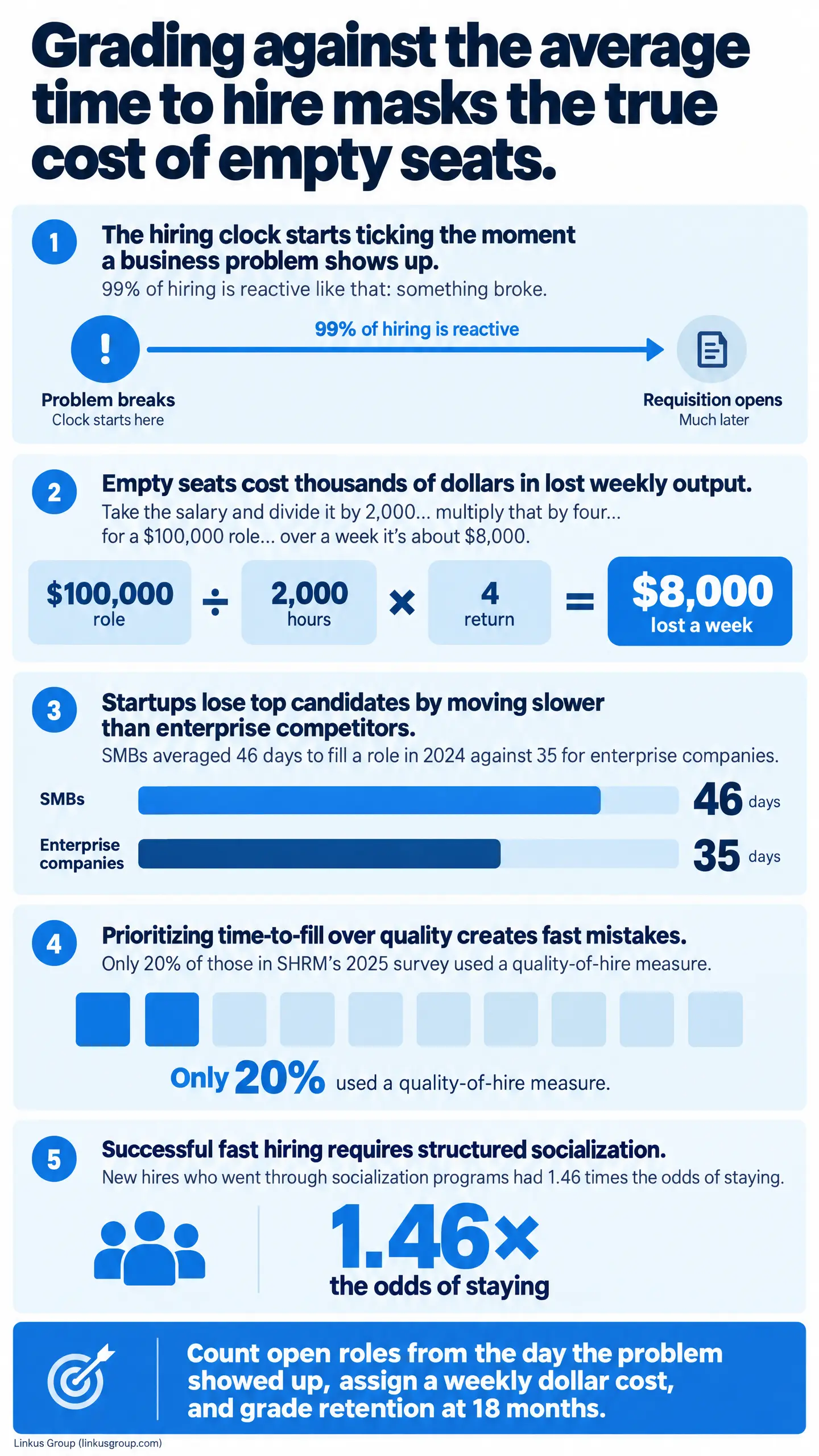
- Startups can calculate the weekly financial cost of a vacant role by dividing the annual salary by 2,000 to find the hourly rate, then applying a four-to-five-times expected return multiplier.
- According to Employ's 2024 report, small businesses averaged 46 days to fill open roles, lagging behind the 35-day enterprise average despite speed being a primary startup advantage.
- Traditional time-to-fill metrics obscure the financial cost of replacing poor hires, especially since only 20% of organizations in SHRM's 2025 recruiting survey actively utilize a quality-of-hire measurement.
- Linkus Group achieves a 96% candidate retention rate at 18 months by presenting vetted talent within 48 hours and requiring founders to isolate a single core business constraint.
- Implementing formal socialization programs gives new hires 1.46 times higher odds of long-term retention compared to employees who skip structured integration, based on 83 field experiments.
When Should Startups Start the Time-to-Hire Clock for Vacant Roles?

Whether your team calls it time to hire or time to fill, the count starts when the role opens or when a candidate applies. SHRM's benchmark, for one, counts time-to-fill in calendar days from the day a requisition opens to the day the candidate accepts the offer. By the time a startup gets around to opening the role, its clock has been running for a while.
For hiring, the clock starts ticking the moment there's a problem in the business. The company is spending more than it's making, customers are churning, the NPS score is down, product isn't shipping fast enough or you can't raise money. From that day on, the business is paying for a person it doesn't have yet.
Most companies call me when they needed somebody as of yesterday, and in my experience 99% of hiring is reactive like that: something broke, the team is stressed, and now there's a job to fill. So my first conversation on a search is about the business, before anyone looks at a job description. I ask founders why they started it, what's changed since last year and where they're trying to get to, and then we get to the problem. What broke? What's required to fix it? Who's the right person to fix it, and does it even need a full-time hire, or would a fractional or hourly person do the job? I'd get the search moving the day the problem shows up, before it turns into a full crisis and without waiting to be certain.
How Do Startups Calculate the Weekly Financial Cost of an Empty Seat?
You'd never run a marketing campaign without knowing what it costs each week, right? An open seat deserves the same attention, and the math I teach clients is simple. Take the salary and divide it by 2,000, which is roughly the hours in a working year, to get an hourly rate. Then multiply that by four or five, which is the return I plan on from a strong hire.
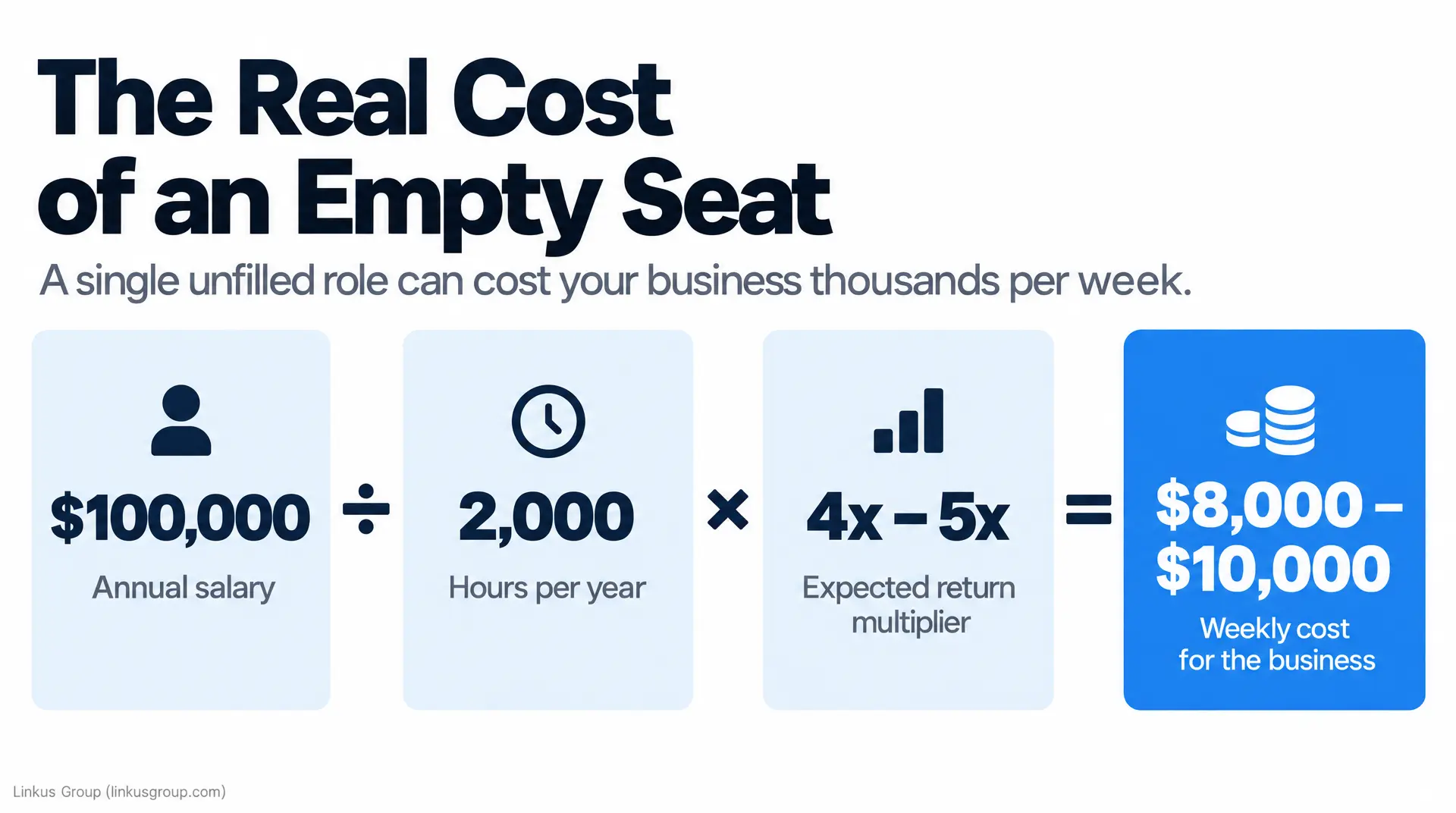
For a $100,000 role, that's $50 an hour, and four times that is $200 an hour of output you're not getting. Over an eight-hour day that's $1,600, and over a week it's about $8,000, or closer to $10,000 at five times. The multiple is a planning assumption you can adjust for the role, and it gives you a weekly number to put next to every other cost in the business.
Now put that next to a founder hesitating over a candidate who wants $5,000 more than budget. That's $5,000 a year, less than one week of the seat sitting empty, and going back to the drawing board costs a lot more than that, with no promise the cheaper person gets you the outcomes you need.
Some seats cost far more than the formula says. For an Amazon e-commerce brand I worked with, not having a manager in the seat risked inventory mistakes and hundreds of thousands of dollars in lost revenue every week. Another company won a major bank contract and then lost the project to a competitor, because its interview process wasn't lined up with the project's timeline and it couldn't hire the three people it needed fast enough.
You lose more money spending more time than you would hiring the wrong person, and that's before you count the people covering for the empty seat. When hiring doesn't get prioritized, the team gets exhausted and overworked people start leaving, so one open role can turn into several.
Why Must Startups Beat Average Market Benchmarks for Time-to-Hire?
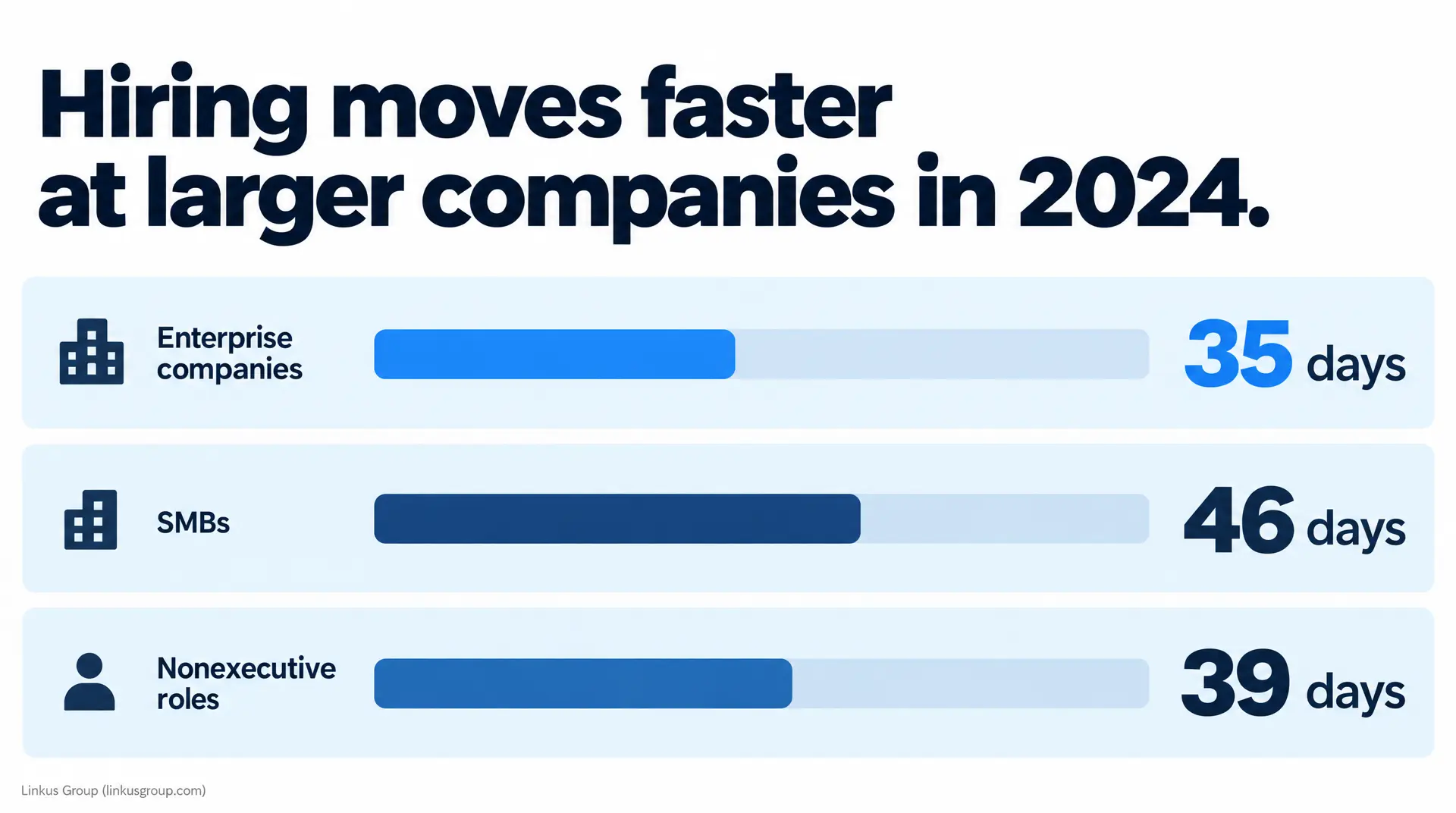
Under 250 employees, speed is the biggest single asset a company has, which makes the market's pace the wrong bar. There's no 2027 benchmark out as I write this, so going into the year you'll be held to numbers like SHRM's latest, which is actually a median: 39 calendar days for nonexecutive roles. In Employ's report on its own customers, SMBs averaged 46 days to fill a role in 2024 against 35 for enterprise companies, so the companies whose edge is supposed to be speed were the slower ones.
At $8,000 a week of lost output for a $100,000 role, waiting out a published time to hire benchmark costs $40,000 or more, and Employ's 2025 SMB average pushes it past $95,000.
|
Time to hire benchmark |
Time to hire (days) |
When the clock starts and stops |
Empty-seat cost, $100,000 role (US$, at 4x return, $8,000 a week) |
|---|---|---|---|
|
SHRM time-to-fill benchmark, nonexecutive roles (median) |
39 calendar days |
Requisition opened to offer accepted |
about $44,600 |
|
SHRM time-to-fill benchmark, executive roles (median, 2025) |
Requisition opened to offer accepted |
about $51,400 |
|
|
Employ time-to-fill, SMBs (average, 2024) |
Requisition posted to offer accepted |
about $52,600 |
|
|
Employ time-to-fill, enterprise companies (average, 2024) |
35 days |
Requisition posted to offer accepted |
$40,000 |
|
Employ time-to-fill, SMBs with 0-249 employees (average, 2025) |
Job posted to offer accepted |
about $95,400 |
|
|
Gem time to hire benchmark, engineering roles (median, 2025) |
Application to hire |
about $44,600 |
Take two coffee shops that open right next to each other. One knows what it's looking for in a hire, pays a competitive salary, understands the market and moves fast, and it's just going to be better, right? Hiring works the same way when you're up against the company down the street for the same engineer or the same head of sales.
My clients lose strong candidates to faster companies every day, and what the faster company does is simple. It can tell what good looks like and it gets to the offer faster. It gets the decision-makers in the room, keeps the candidate moving and doesn't interrogate them. It works in your favor when you're the fast one: I recruited an in-office, bilingual financial leader, a highly specific profile, for a client who landed their ideal candidate by moving quickly and giving immediate feedback.
If a lead worth a million dollars came in, you wouldn't let it sit for 48 hours, even a weak one, but people let strong candidates sit that long every single day. Moving slowly tells top candidates you're disorganized and that you don't prioritize them. One company stalled on a highly prepared head of sales candidate because they said they were too busy, which signaled the role wasn't a priority.
Going into 2027, I think time will be worth even more than it is now, and companies already look more alike on the surface than ever. If you're remote, so are other companies. If you offer a benefit, someone else offers it too, and if you have a mission, another company has a similar one. Every candidate is accessible, to you and to every competitor, so reaching people won't set you apart either. In my experience, founders who hire with both speed and quality beat competitors to top candidates and tend to exit faster too.
Why Does Prioritizing Time-to-Fill Over Quality-of-Hire Cause Startups to Replace Fast Hires?
A time-to-fill number only counts days, so it can't tell a good fast hire from a fast mistake. Fill a seat quickly, fill it again a few months later, and your report shows two quick hires while the business paid for the empty seat twice.
When a quick hire does fall apart, the misalignment usually shows up right away, and it's fundamental. You expected the person to show up and take action in their first week, and they didn't do what they said they'd do, or they didn't show up at all. The companies where that almost never happens know who the best person for the job is, they're decisive, they understand the business problem, they're aligned, they tell candidates the truth and they onboard properly.
Slowing down won't fix it. Give a hiring team a longer deadline and the process just grows to fill the time, without taking any risk out of the hire. Personality tests are a stalling tactic of exactly that kind, mostly a way for a hiring team to avoid blame if the hire goes wrong, and to a top candidate they make the company look like it doesn't know what it's doing.
The same fear of making a mistake sits behind "hire slow, fire fast," which I'd call the biggest lie ever told in hiring, because if you're too slow, you never find the right person at all. No hire is 100% certain at any speed, so the work is reducing your risk, and you reduce it by getting clear on the business problem and what good looks like before the first conversation. Most organizations also have no formal way to tell whether a fast fill was a good one, since only 20% of those in SHRM's 2025 survey used a quality-of-hire measure, down from 27% in 2022.
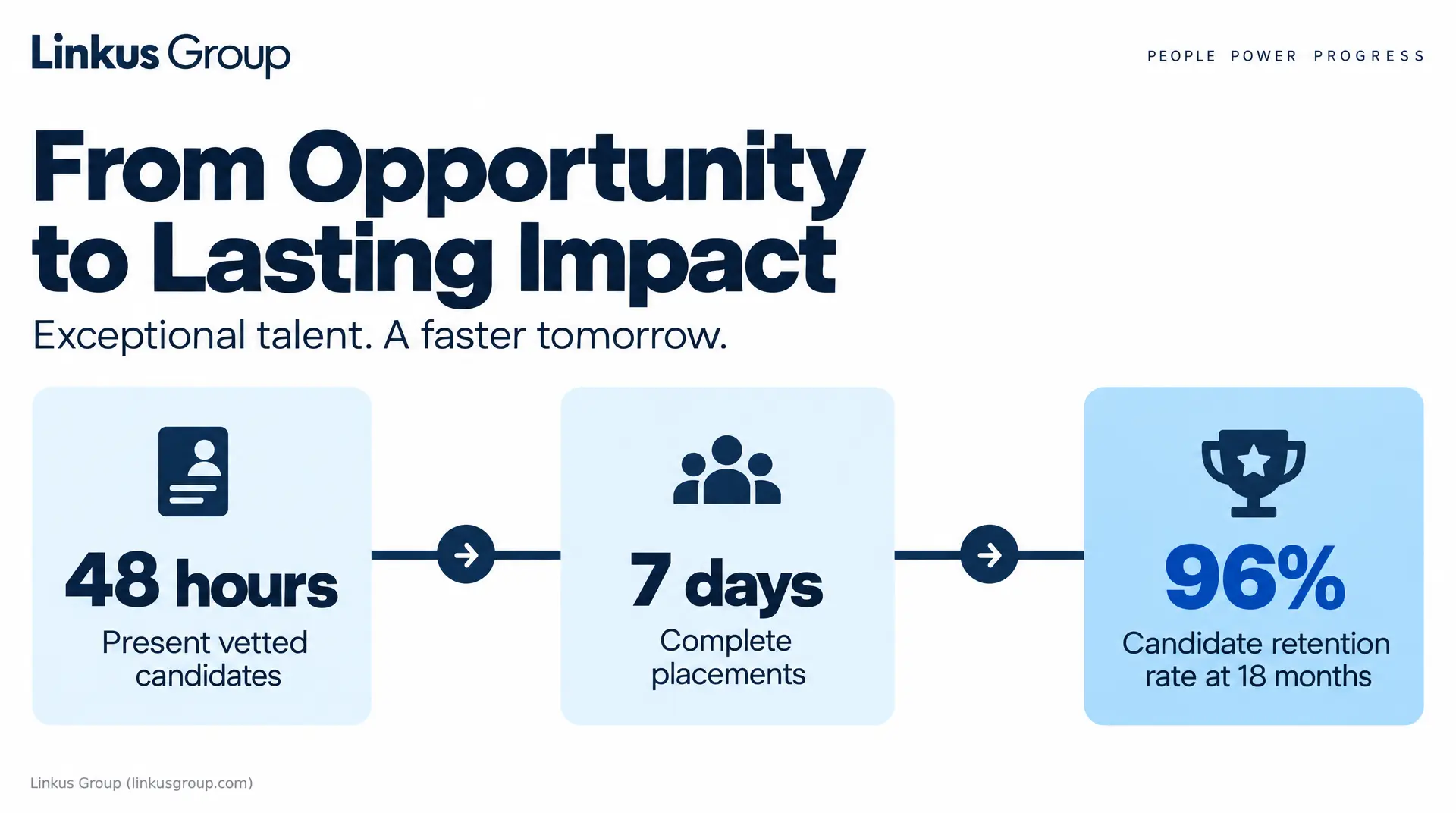
The number I hold us to at Linkus Group is time to quality of hire: how long it takes to get the right person solving the problem, counted from the day the problem shows up. We aim to put a vetted candidate in front of a client within 48 hours and to complete placements in under a week, though that won't happen on every role, because some roles and markets don't allow it. We work on contingency, so we only get paid when a client hires, and a fast candidate who isn't good enough doesn't get hired. Clients usually hire the first person we send them, and our candidate retention rate at 18 months is 96%.
How Can Startups Successfully Execute a 48-Hour Hiring Process?

Companies can hire in 48 hours or less when they've pre-planned every step, know exactly what good looks like and keep the candidate experience high, and most of that work happens before the first candidate shows up.
If the role reads like a wish list, one of three levers has to move: compensation, location or requirements. A founder I worked with wanted a three-in-one operations manager who could run a P&L and do CPA-level accounting. I showed them what talent was actually available at their budget and in their location, and they dropped the three-in-one role and narrowed in on the right option. Great people are usually pointy at one thing, so I have founders strip the list down to the single biggest constraint in the business, and once it's that clear, you shouldn't need 30 resumes or 30 interviews to make a decision.
Before the search starts, I ask the client who makes the final call, who owns the outcome of this hire and who else could still say no at the end. Processes often fall apart at the very end when someone who doesn't own the role vetoes a great candidate. If you're using a recruiter, treat them as part of the team, with every decision-maker available, immediate feedback and a heads-up the moment the role changes. We sit inside our clients' Slack or Teams so feedback and changes reach us right away.
When you see the right person, be ready to make the offer, the way a team jumps on a free agent, because deciding fast takes competing offers off the table. Do the reference checks after you've decided, since the best candidates are employed and the people who can vouch for them are busy. And use the interviews to get aligned, walking the candidate through the good, the bad and the ugly of the day-to-day so nothing surprises them when they start.
At least 90% of a hire's success comes from how you onboard and treat the person after the offer's signed. That's my number from 20 years of hiring, and research on onboarding points the same way: across 83 field experiments, new hires who went through socialization programs had 1.46 times the odds of staying compared with those who didn't. It's a big part of why our retention holds up, because we spend a lot of time with clients predicting where onboarding will get hard and coaching them through it.
If I were in your seat, I'd count every open role from the day the problem showed up, put a weekly dollar figure on it, settle who decides before the first conversation, and grade the hire on whether that person is in the seat and performing 18 months later.
If you've got a seat open right now and want a second set of eyes on what it's costing you and how fast it can realistically close, give me a call and we'll walk through the role together.
Frequently Asked Questions
Why do SMBs often have a longer average time-to-fill than enterprise companies?
You'd think startups move faster, but data disagrees. In 2024, SMBs averaged 46 days to fill a role, while enterprises took 35 days. Startups often over-engineer decisions or lack dedicated recruiting teams, letting faster, resourced competitors snatch top talent.
Does a longer time-to-hire ever yield better business outcomes for startups?
Speed is vital, but complexity demands care. Research on public firms found longer vacancy durations for higher-skill jobs correlate with higher future profitability. For specialized leadership roles, rushing a misaligned candidate ruins your runway. Move decisively, but never compromise your core business requirements just to stop the clock.
How does our internal recruiter's workload compare to larger corporate competitors?
Startups expect their lone HR generalist to perform miracles. According to SHRM, median annual requisitions per recruiter are 6 at small organizations versus 50 at large ones. Big tech recruiters are volume specialists. Your team needs focus, clear decision-makers, and realistic job criteria, not a massive stack of wishlists.
How can we assess candidates rapidly without relying on stalling tactics like personality tests?
Ditch the tests and use structured interviews. They remain the top-ranked selection procedure. Research shows structured scoring vastly improves performance assessments, with validity estimates of ρ = .30 for task performance. Know exactly what business problem you're solving, ask targeted questions, and make the call quickly.
Why is time-to-fill tracked religiously while quality-of-hire is often ignored?
Counting days is easy. Tracking outcomes is hard. Shockingly, SHRM reports just 20% of surveyed organizations used a quality-of-hire measure in 2025. Time-to-fill is a vanity metric if the person fails. You must grade the hire on whether they are actually in the seat and performing 18 months later.