
Francis Davidson announced on November 10, 2026, that OpenAI had acquired Odessia, the AI travel-planning startup he'd founded less than a year earlier, and that he was joining OpenAI to work on the future of travel. The terms weren't disclosed, Odessia's service was discontinued, and OpenAI didn't announce a travel product with the deal. TechCrunch called the Odessia acquisition an apparent acqui-hire, meaning a company bought mainly for its people.
I read it the same way, and from a recruiting point of view it's a very smart move. Davidson was right to put speed first, OpenAI was right to go after him, and I think deals like this are going to keep happening.
Why Did OpenAI Use an Acqui-Hire Strategy to Recruit Odessia's Travel AI Talent?

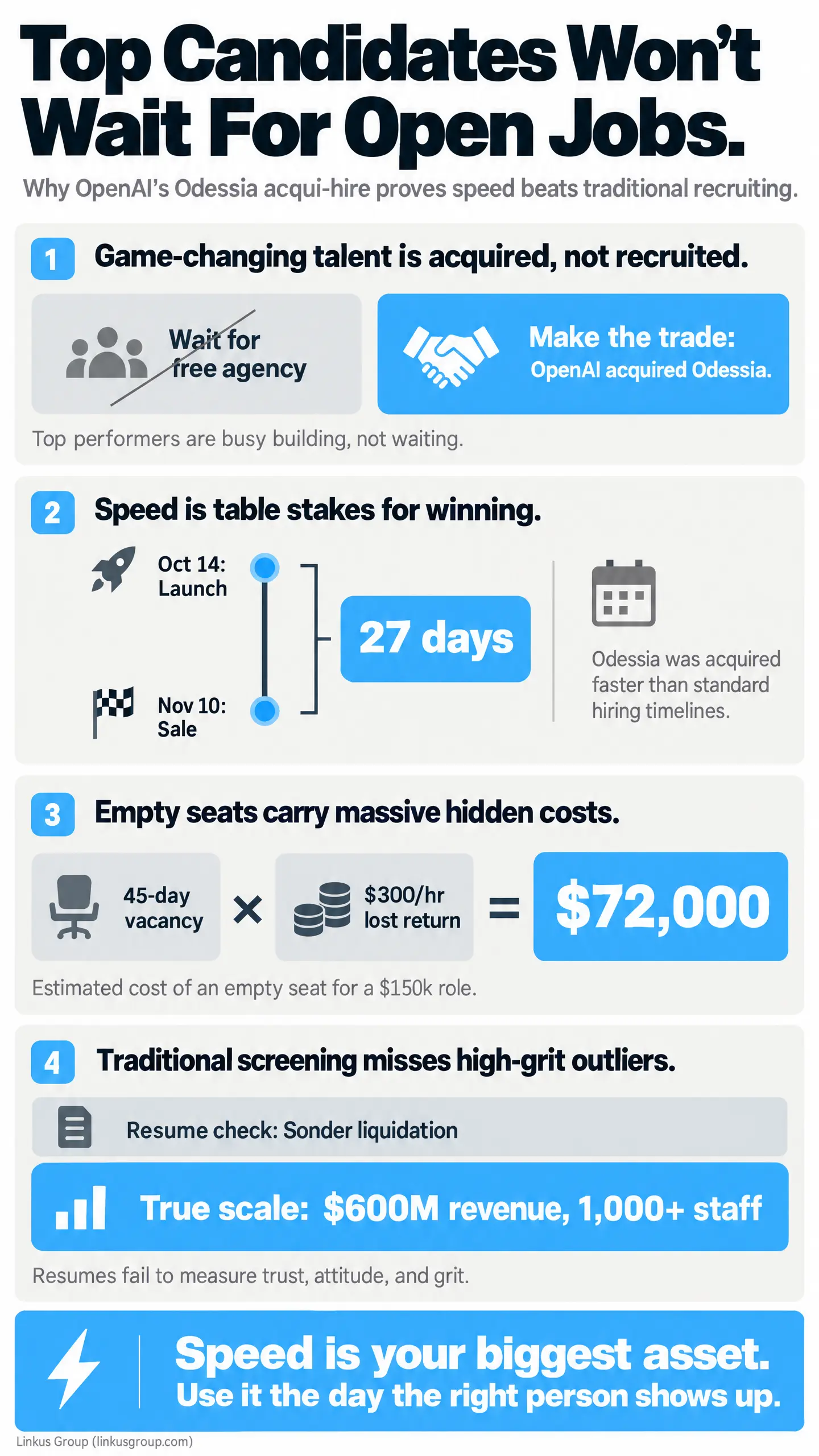
Talent is the biggest unlock a business has. The right person can generate millions, even tens or hundreds of millions, get you to your goals faster and cut your risk of losing. Everyone wants people like that, and so they're really hard to recruit. Someone like Davidson isn't waiting around for your job to open, because he's busy running a company of his own, right? To recruit really smart people, you've got to go the acquire route. In hockey, when you want another team's captain, you can wait years for free agency or you can make the trade.
OpenAI made the trade, and the travel fit is obvious. Its spokesperson told TechCrunch that people often ask ChatGPT about travel, and I'd say travel and shopping are two things most LLM users will do no matter what. ChatGPT's agent could already plan and book travel itineraries when OpenAI introduced it on July 17, 2025, and Odessia's product shut down with the sale. So what OpenAI got under its belt, in my view, is a founder who knows travel and moves fast, and probably a team of great people around him.
You don't need OpenAI's balance sheet to land another company's best people. I advised a 30-person, founder-led legal tech firm to hire single high-performing salespeople and product managers instead of tripling headcount. That let it move methodically, stay highly profitable and absorb top talent from bankrupt competitors.
Why Did Odessia Prioritize Execution Speed Prior to the 2026 OpenAI Acquisition?
Davidson said he prioritized speed to keep pace with advances in AI, according to PhocusWire, and that was smart, because speed has always been table stakes for winning. By his count, tens of thousands of early adopters planned more than $60 million a year of travel through Odessia over the summer of 2026, which is planned travel rather than revenue. His public launch post, "Introducing Odessia," went up on October 14, 2026, 27 days before he announced the sale.
Francis Davidson's path from Sonder's peak to OpenAI's acquisition of Odessia shows how fast it moved: one year from Sonder's wind-down to the sale, and 27 days from public launch.
|
Date |
Milestone |
Key figures |
|---|---|---|
|
2019 to 2023 |
Sonder, the short-term rental company co-founded by Davidson, grows revenue |
$143M revenue and 1,000+ employees by 2019 (per Davidson), $602.1M revenue in fiscal 2023 |
|
Nov 10, 2025 |
Sonder announces immediate wind-down and expects Chapter 7 liquidation |
Properties in 37 cities across nine countries and three continents |
|
Summer 2026 |
Early adopters plan trips on Odessia, Davidson's AI travel-planning startup |
Tens of thousands of early adopters, more than $60M a year of planned travel (not revenue), per Davidson |
|
Oct 14, 2026 |
Davidson publishes Odessia's public launch post, "Introducing Odessia" |
27 days before the OpenAI sale was announced |
|
Nov 10, 2026 |
Davidson announces OpenAI acquired Odessia and he joins OpenAI to work on travel |
Deal terms not disclosed, Odessia service discontinued, no OpenAI travel product announced |
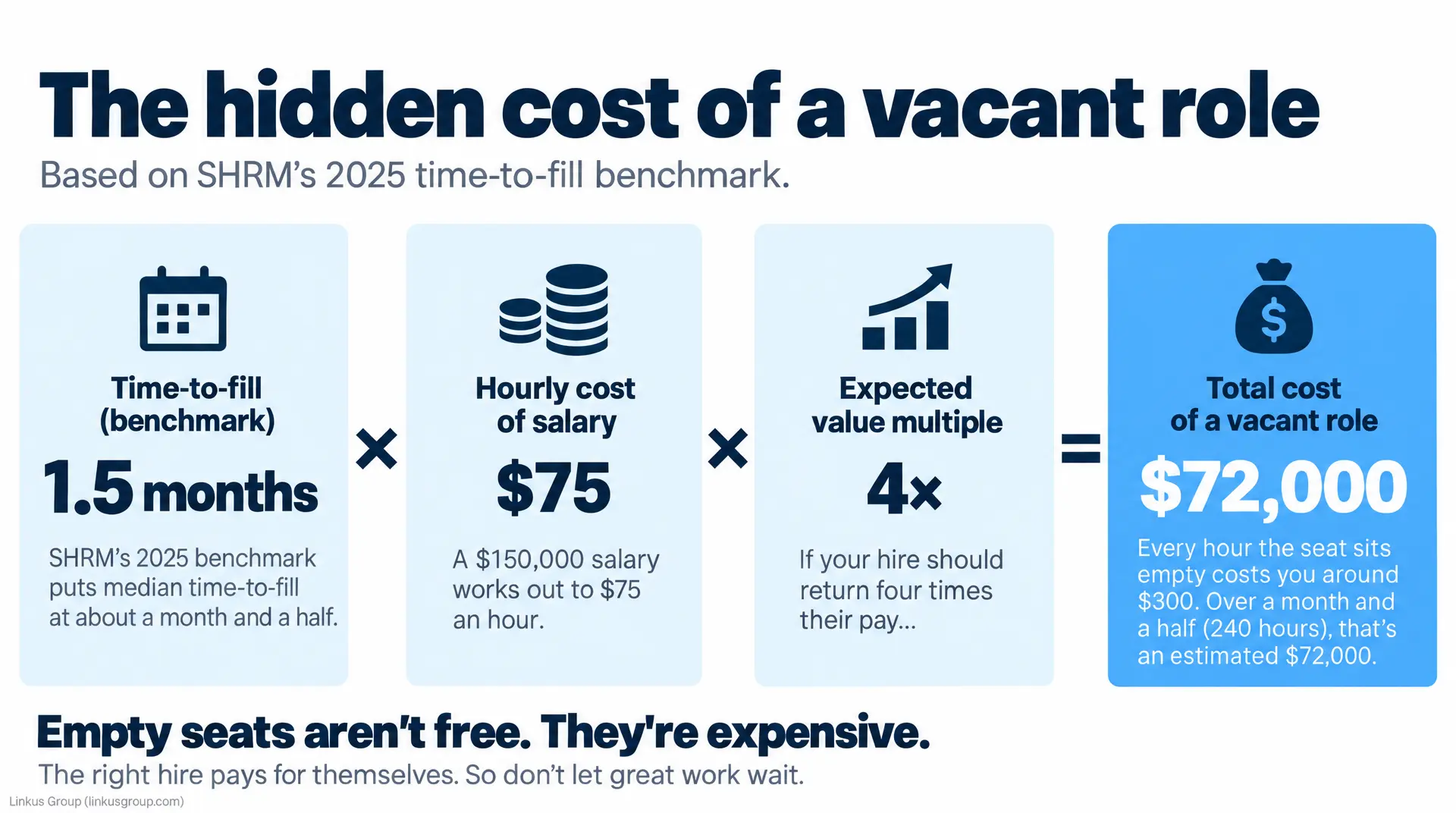
SHRM's 2025 benchmark puts median time-to-fill at about a month and a half, so Odessia went from launch post to sale faster than the typical company fills one seat. A $150,000 salary over a 2,000-hour year works out to $75 an hour. If your hire should return four times their pay, every hour the seat sits empty costs you around $300. Over a month and a half, about 30 working days or 240 hours, that's an estimated $72,000, before you count the burnout on the people covering for it.
What separates a failed company from a successful one is whether it moves fast enough and puts enough emphasis on hiring the right talent. One company won a major bank contract and then lost the project to a competitor. Its interview process wasn't aligned with the project's timeline, and it couldn't hire the three people it needed fast enough.
Why Does Francis Davidson's Sonder Liquidation Highlight the Limitations of Traditional Resume Screening?
A résumé screen would trip over Sonder, the short-term rental company Davidson co-founded. It announced on November 10, 2025, that it was winding down operations immediately and expected to pursue Chapter 7 liquidation, and a checklist stops reading there. It misses that, by Davidson's own account, Sonder reached $143 million in annual revenue by 2019, employed more than 1,000 people and later passed $600 million a year. It also misses what happened a year to the day after Sonder said it was winding down: Davidson announced that OpenAI had bought Odessia, a company he'd founded inside that year.
When I evaluate a candidate, it comes down to trust, attitude and grit. I want someone who understands nuance, knows how to show up, is dedicated and has integrity. All of that is beyond a résumé, and Davidson has shown it in what he's built.
I once pushed a client to hire a CTO who lacked industry experience and didn't have an obvious résumé match. That CTO helped the company raise its Series A and Series B before co-founding new businesses with the client.
The person who moves your company forward probably won't look perfect on paper either, and they won't wait while you make up your mind. What problem does your most important open seat solve, how long has it sat empty, and who actually gets to say yes? At under 250 people, speed is the biggest asset you have, and those answers decide whether you can use it the day the right person shows up.