

German-headquartered SPARETECH, which makes enterprise software for industrial spare-parts management, announced a $20 million Series B on November 10, 2026. Blume Equity and Insight Partners co-led the SPARETECH Series B round, and Headline also participated. The company says the money will go to AI for spare-parts availability, expansion into North America and other regions, and deeper work with existing customers. According to Blume Equity, its network already includes 15,000 manufacturer and supplier partners.
I think this raise is the first of many. Enterprise software companies are going to lean more on partners and raise money on that model. They'll run with less headcount and deliver to customers for less while the hardware side catches up to AI. SPARETECH hasn't announced any plan to cut headcount, so that part is my read of the industry.
That shift is going to carry down to small business, and that's good news. It means a lot more opportunity for the suppliers and operators who can get business with these companies.
How Do Enterprise Software Companies Use Expansion Capital to Build Leaner AI-Driven Teams?

Sales, customer acquisition and customer success all get done differently now that businesses are focused on profitability and using AI. Expanding into a new market makes sense when what you already do carries over. I think access to expansion capital is why SPARETECH raised, and with that capital around, more companies will make the same move.
Some local companies will compete head-on with the ones expanding in, and competition is good as long as it's fair. It's a big difference when a company coming in can undercut on certain things. We need the right laws and incentives to keep this kind of expansion exciting and accessible for North America.
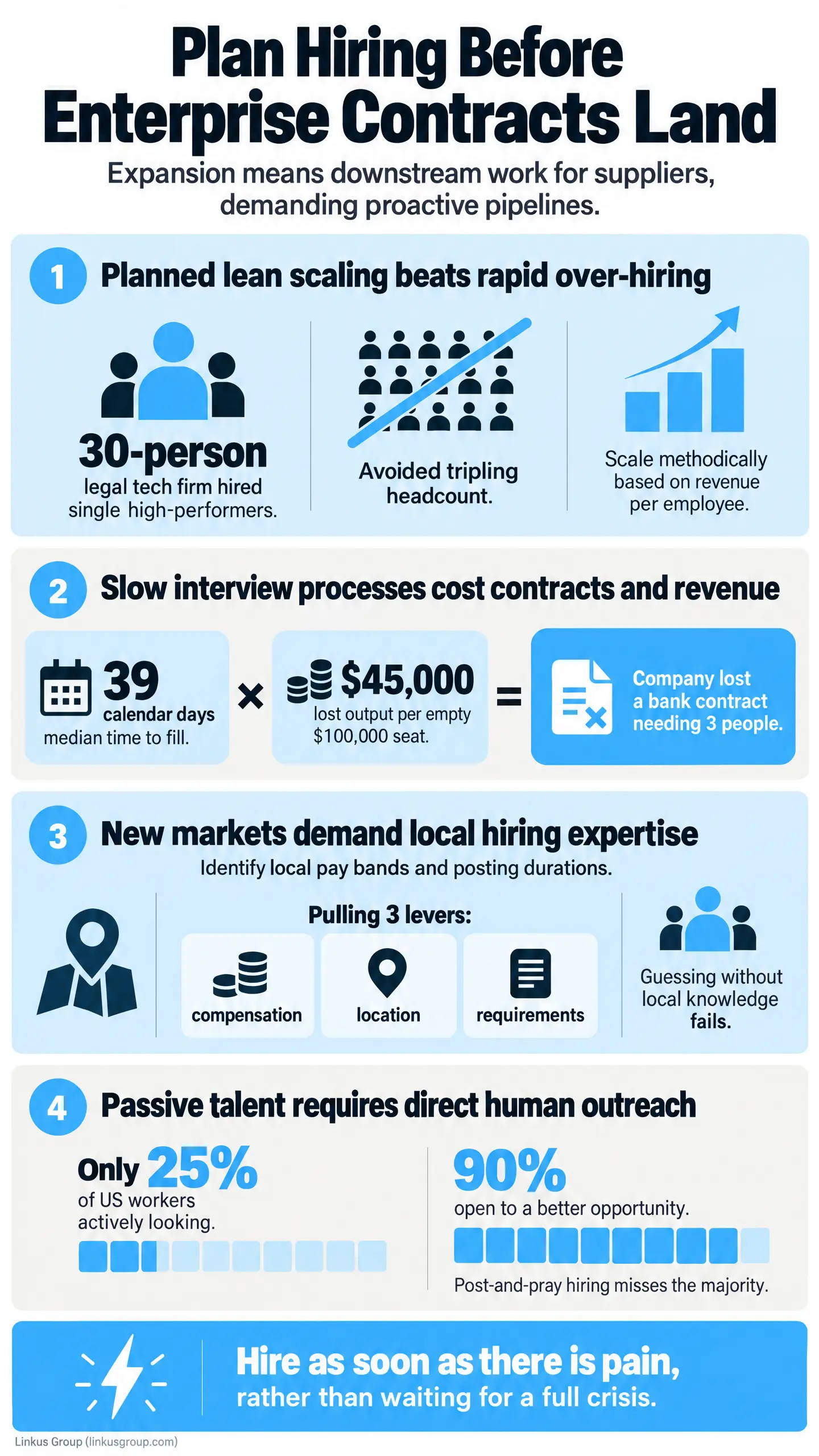
Running lean pays off at a much smaller size too. I advised a 30-person, founder-led legal tech firm to hire single high-performing salespeople and product managers instead of tripling headcount. They moved methodically, stayed highly profitable and were able to absorb top talent from competitors that went bankrupt. So when a founder tells me they need a certain number of people, I want to plan first, starting with revenue per employee. Maybe they need fewer, and maybe they're hiring too few.
How Does Time-to-Fill Impact Suppliers Executing Carry-Down Enterprise Software Contracts?
Suppliers and operators who land carry-down work will be staffing it on someone else's schedule. A company won a major bank contract and still lost the project to a competitor. Its interview process wasn't lined up with the project's timeline, and it couldn't hire the three people the work needed fast enough.
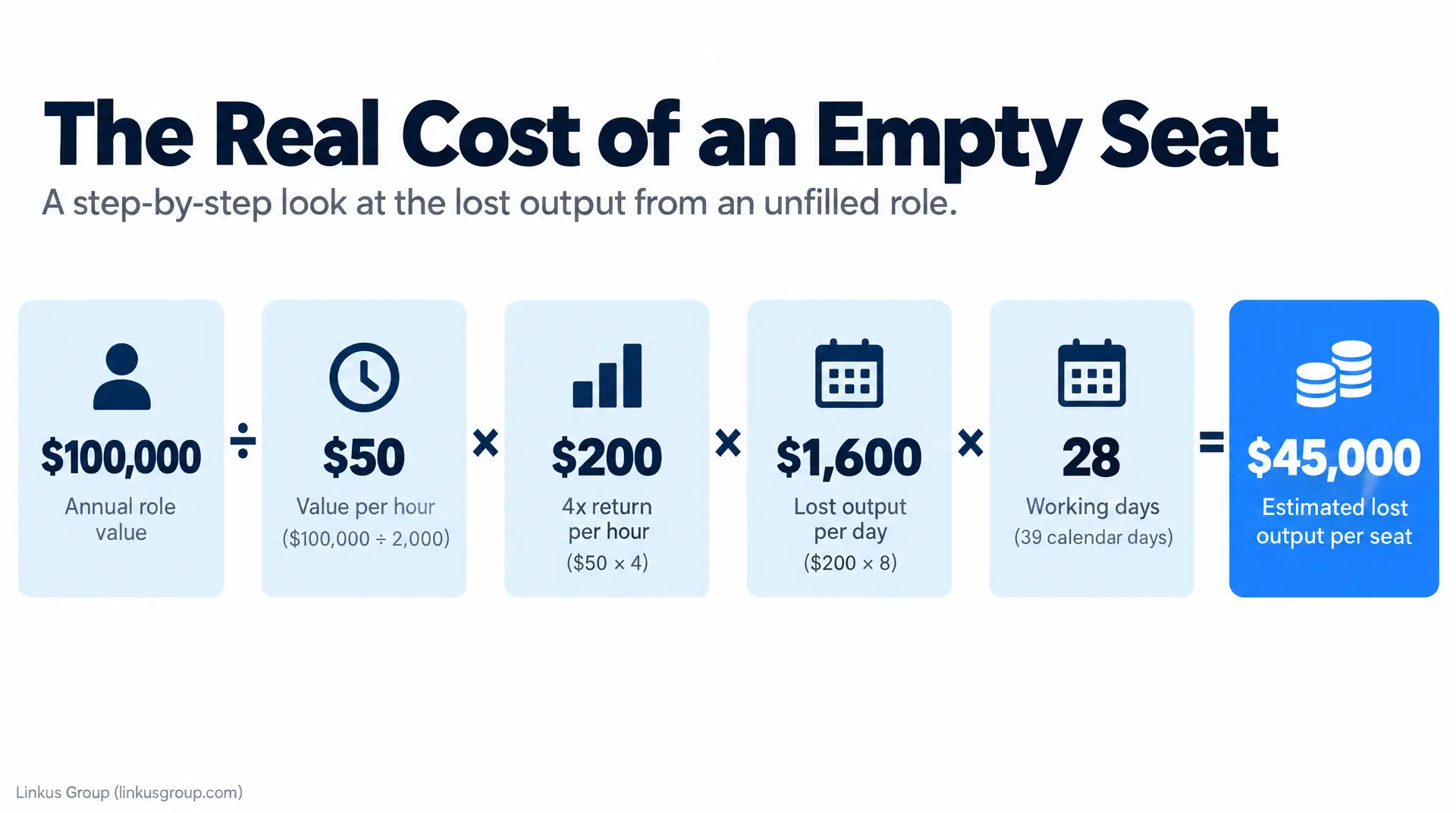
I price an empty seat by dividing the salary by 2,000 working hours. Then I multiply by what a good hire should return, which by my own rule of thumb is about four times salary. On a $100,000 role, that's $50 an hour, times four is $200 an hour, and $1,600 over an eight-hour day. SHRM's 2026 benchmarking puts the median time to fill a nonexecutive role at 39 calendar days. That's about 28 working days, so by my estimate each seat filled at that pace costs roughly $45,000 in lost output. And that bank contract needed three people, right?
At US median time to fill, a four-times-salary rule of thumb puts vacancy costs at roughly $27,000 for one $60,000 role and $134,000 for three $100,000 hires.
|
Open role and annual salary (US$) |
Median time to fill (US, SHRM 2026) |
Lost output per working day (US$, 4× salary rule of thumb) |
Estimated cost of the vacancy (US$) |
|---|---|---|---|
|
Nonexecutive role, $60,000 salary |
39 calendar days (~28 working days) |
$960 |
≈ $27,000 |
|
Nonexecutive role, $100,000 salary |
39 calendar days (~28 working days) |
$1,600 |
≈ $45,000 |
|
Nonexecutive role, $150,000 salary |
39 calendar days (~28 working days) |
$2,400 |
≈ $67,000 |
|
Executive role, $250,000 salary |
45 calendar days in 2025, unchanged in 2026 (~32 working days) |
$4,000 |
≈ $128,000 |
|
Three nonexecutive hires at $100,000 each |
39 calendar days (~28 working days) |
$4,800 |
≈ $134,000 |
So before work like that lands, I'd be asking a founder: Who signs off on each hire? How many interview rounds sit between a yes and a start date? What are you paying, and does the market agree?
Why Is Localized Recruitment Critical for Enterprise Software Companies Expanding Into North America?

SPARETECH's first hire for North America should be a recruiter who knows the market, and I'd say the same to a Toronto founder opening in the US. I know that's a recruiter's answer, and I'd give it anyway, because guessing isn't going to work somewhere new. Hiring on assumptions in a market you don't know is like a team joining a new league and drafting off stat sheets without a scout who's watched anyone play.
A local recruiter knows the pay bands and how long a posting should stay up. They also know which of the three levers you can actually pull there: compensation, location or requirements.
Blume says SPARETECH's AI is meant to make a needed part available even when another company is holding it. The people you'll want in a new market are at other companies too. Only 25% of US workers told Pew Research Center in October 2024 they were likely to look for a new job in the next six months. So post-and-pray hiring mostly reaches that quarter. I'd still put it at 90% of people being open to a better opportunity presented the right way at the right time. That takes a human conversation about where their career goes next, with someone who knows the market.
Most hiring is reactive, and 99% of the time the story is that someone needed to be hired as of yesterday. Raises like this one will put more companies in that spot, from suppliers and operators winning enterprise work to founders hiring in markets they don't know yet. I'd rather you hire as soon as there's pain and you can afford it than wait for the full crisis.